This month, we chatted to Sheffield artist RUOK about his graffiti roots, Californian beginnings and finding a through street art
What first drew you to illustration and street art, and how did you start creating the work you’re showing on your site?
I was drawn to graffiti first. I grew up on a tiny island called Tortola, where there was absolutely no graffiti – except for one older kid who used to draw it. I remember watching him sketch his name, Jack, in the shape of a shark. From that moment, I knew that was what I wanted to do.
I made a lot of teachers mad by doodling on absolutely everything, but drawing actually helped me focus – when I was drawing, I listened more intently in class.

I was properly exposed to street art and graffiti when I moved to Berkeley, California, as a young teenager, and from then on it was just what I did. I wasn’t great at school and I loved drawing more than sports because it was my own world. Me and my friends would skate, rap and do graffiti – I realised pretty quickly I wasn’t great at rapping or skating, so I stuck with the art.
I moved to Sheffield 11 years ago and went from doodling in notebooks to painting walls. Some of my friends stopped over time, but I kept going. Once I realised people could actually make a living from this, I went on to study illustration at UWE in Bristol.
Is there a story behind your artist name “RUOK” and what it means to you?
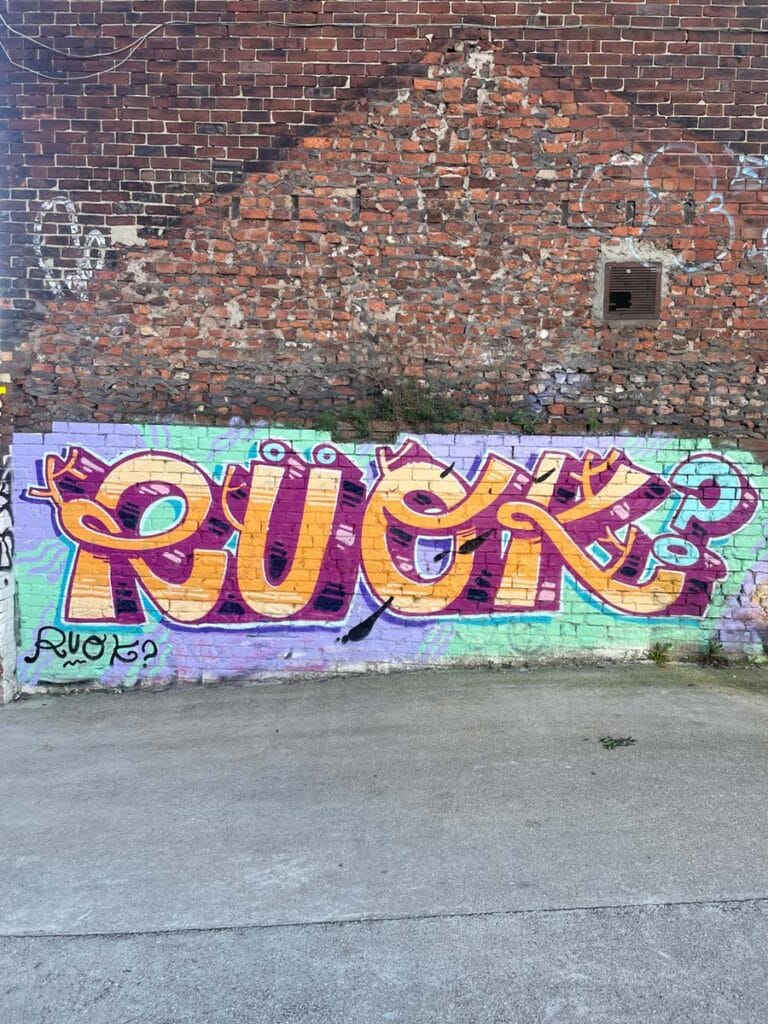
It’s simply the question: “Are you okay?” I love typography and the letters just sort of fell out of my brain.
I started RUOK during a time when I was really struggling with my mental health and battling addiction. I knew I could paint and draw, but I felt like I was missing my voice – what I actually wanted to say as an artist. I thought if I could just ask that question, maybe one person would pause for a split second and check in with themselves.
It’s my attempt to shine a small light in the dark. Now that I’m sober and healthy, I hope the story of RUOK? keeps evolving.
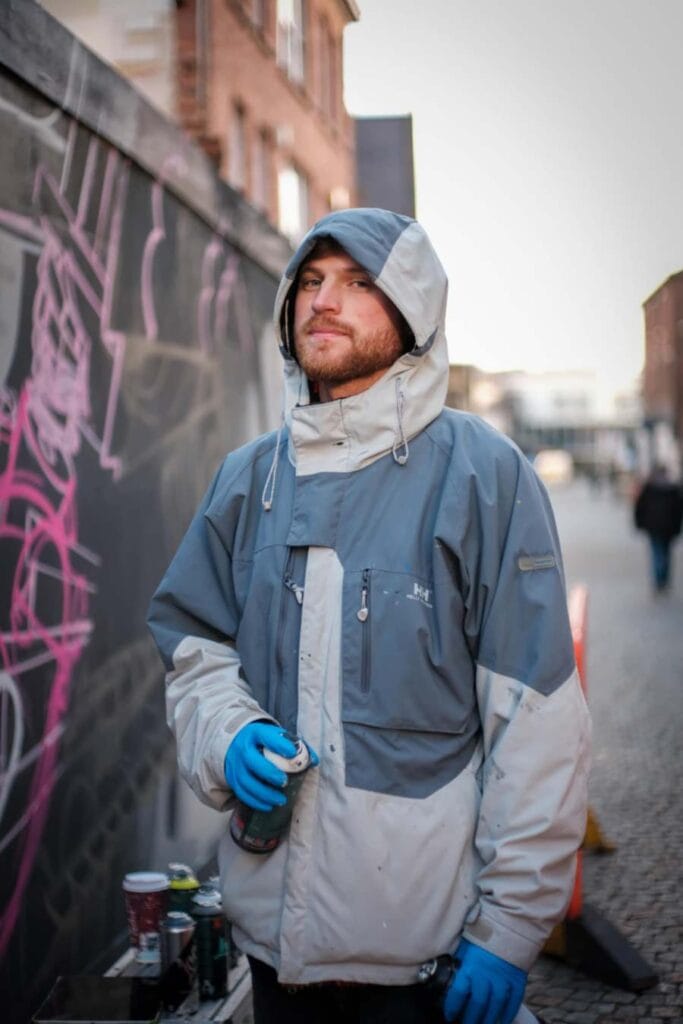
Who were your earliest artistic influences and how have they shaped your current style?
Going way back, books like Calvin and Hobbes, Tintin and Dr Seuss had a big impact on me. Growing up glued to Cartoon Network definitely infiltrated my style too
As a teenager I was heavily influenced by hip-hop – Odd Future, Pro Era, MF DOOM – mixed with skate graphics, comics, graffiti and a deep sense of rebellion. Those are my roots
My earliest street art influences came from the Bay Area. Riding the metro and seeing work by artists like GATS, Twist, Broke, Pemex and Optimist was huge. When I moved to Sheffield, I gravitated towards artists like Phlegm, Kid Acne, BOK Crew, Eugene Booms and Rocket01. What inspired me most was that they were pushing work they wanted to see – and as a teenager, that was the permission I needed to do the same.
Has your practice changed over time? If so, how?
Absolutely – and I hope it always keeps changing. I used to think I needed structure and predictability, but now I lean into intuition. If I force a piece or over-control a commission, it becomes stagnant. I’ve learned to leave room for play, because that’s where the magic happens.
I used to believe every line had to be perfect and every proportion correct. Now I’ve realised I can create far more emotional depth through loose, carefree mark-making. Not overthinking gives me more satisfying – and usually more interesting – work.
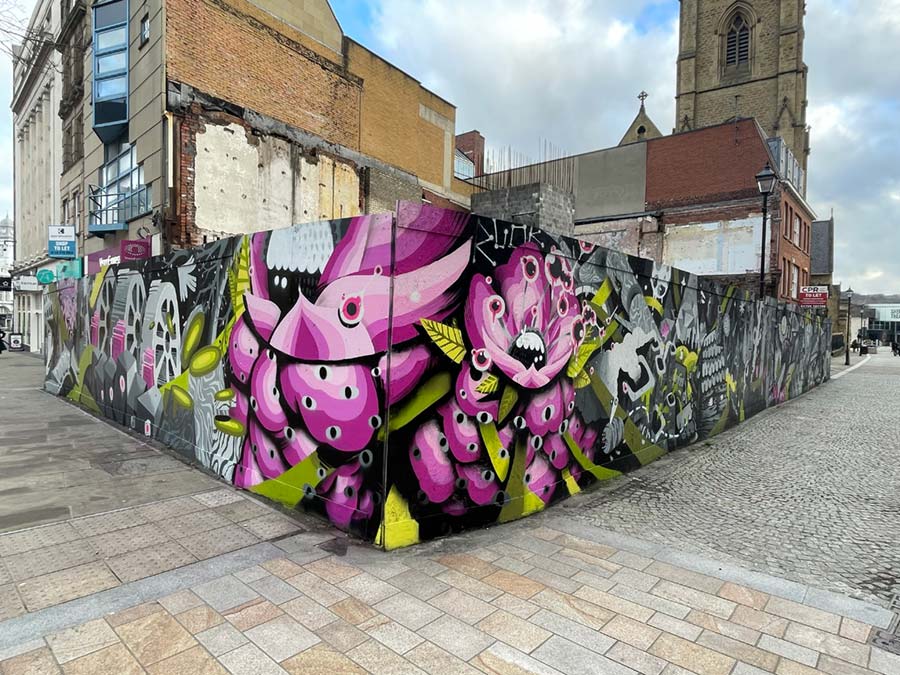
Do you have a favourite medium or surface to work on?
I love the intimacy of drawing in sketchbooks, but it will always be walls. I’m drawn to texture, decay and imperfections – the grimier the wall, the better. Street art belongs in the noise of the city.
Murals connect me to my body, the weather, pigeons, passers-by and the place I’m painting in. That interaction is a huge part of the work.
How do you choose the subjects or themes that you illustrate?
They come naturally. I rarely plan a drawing – it usually starts with abstract marks and I let my imagination take over. The characters, letters and recurring motifs are responses to my emotions, dreams and everyday experiences.
Certain things appear again and again, and I’m constantly finding new meanings in them. I like leaving space for other people to bring their own interpretations too.
How do you balance the spontaneous energy of street art with the control of fine illustration?
It really depends on the environment and how I’m feeling. I have conversations with the wall or the drawing – it tells me what it needs. Sometimes it wants to be quiet, sometimes it needs to shout. I’m still figuring out that balance every time I make something.
How does your mural work inform the smaller illustration pieces, and vice versa?
I think of murals like an album, or a full song. Smaller illustrations are more like experimental sounds, riffs or loose lines. Over time I build up a catalogue of ideas, and when it’s time to paint a wall, I can pull from that archive.
Sometimes a silly doodle I made years ago suddenly becomes the solution to a problem I’m having on a mural.
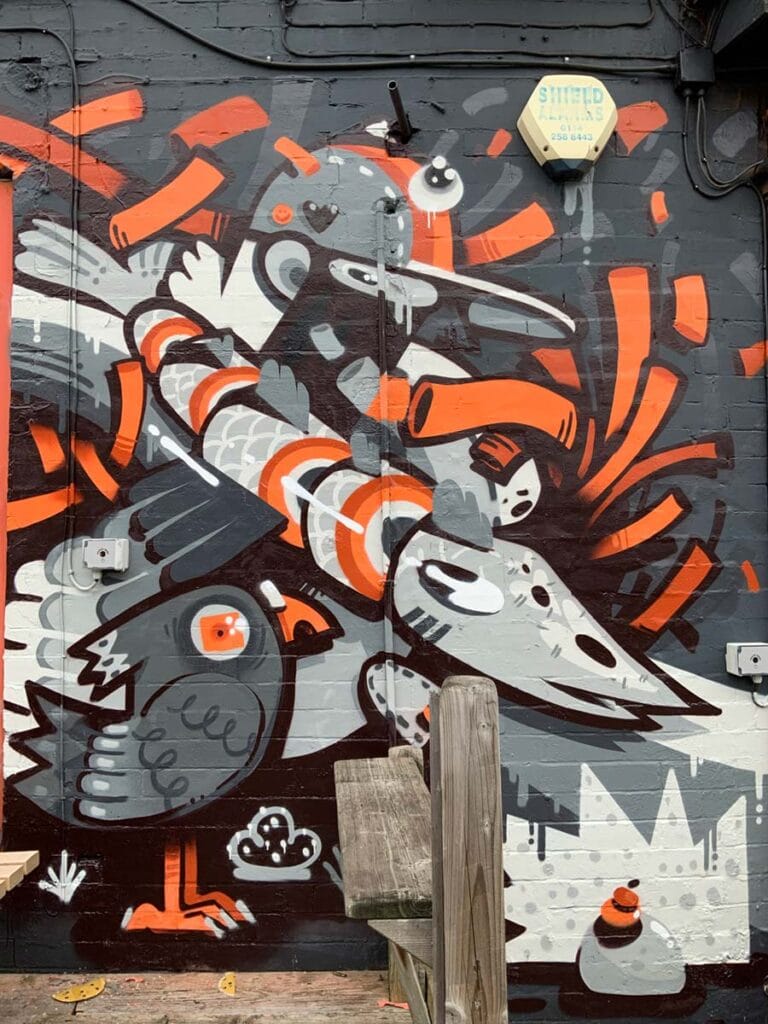
Do you have any dream spaces or cities where you’d love to create a large-scale mural?
Sheffield first. I feel like I’m only just getting started here and the city means a lot to me.
I recently travelled to Iceland and got the chance to paint there, which made me want to see more of the world. I’ve always said that if I ever get to paint a mural in Japan, it’ll feel like my art has taken me to the other side of the world – which would be pretty special.
What’s next for your work in 2026?
I’ve got a couple of big projects happening behind the scenes, and I’d love to paint more large-scale murals around Sheffield. I’m excited to find new ways to express narratives through animation, sculptural work and whatever else my ADHD brain can think of! I also recently moved to a new studio, which will give me space to make more focused paintings and illustration work alongside the street art.