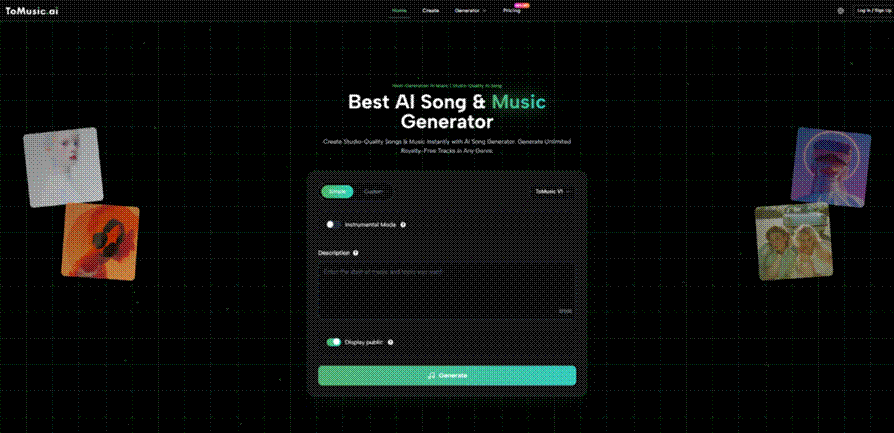
For a long time, music creation has been tied to tools that require precision—DAWs, MIDI grids, waveform editors. But that assumption is starting to feel outdated. With systems like AI Music Generator, the entry point is no longer technical execution. It is language. And that shift quietly changes who can participate and how ideas take shape.
There is, however, a subtle friction. While the interface is simpler, the responsibility shifts to the user: describing intent clearly enough for the system to interpret. In that sense, the difficulty hasn’t disappeared—it has moved.
What It Means To Turn Language Into Sound Structures
At its core, the system is not composing in a traditional sense. It is translating.
When using Text to Music, users provide:
- emotional tone
- stylistic direction
- contextual purpose
And the system maps those into:
- harmonic frameworks
- rhythmic pacing
- instrumentation layers
How Interpretation Happens Under The Surface
Emotion As Harmonic Instruction
Words such as “nostalgic” or “tense” influence:
- key selection
- chord movement
- melodic contour
Style As A Constraint System
Genres define:
- instrument palettes
- arrangement expectations
- production textures
Context As Structural Logic
Descriptions like “for a vlog” or “background study music” guide:
- loop stability
- intensity variation
- length consistency
In my testing, the outputs feel less like random generation and more like probabilistic interpretation.
Why Text To Music Changes Creative Entry Points
With Text to Music, the first step in creation is no longer “building”—it is “describing.”
A Different Kind Of Starting Point
Instead of:
- selecting instruments
- programming beats
users:
- define a feeling
- describe a scenario
Speed Versus Precision
This leads to:
- faster initial results
- but less granular control
Exploration Over Construction
It encourages:
- trying multiple prompts
- discovering variations
rather than refining a single track in detail.
How Lyrics Introduce Structural Discipline
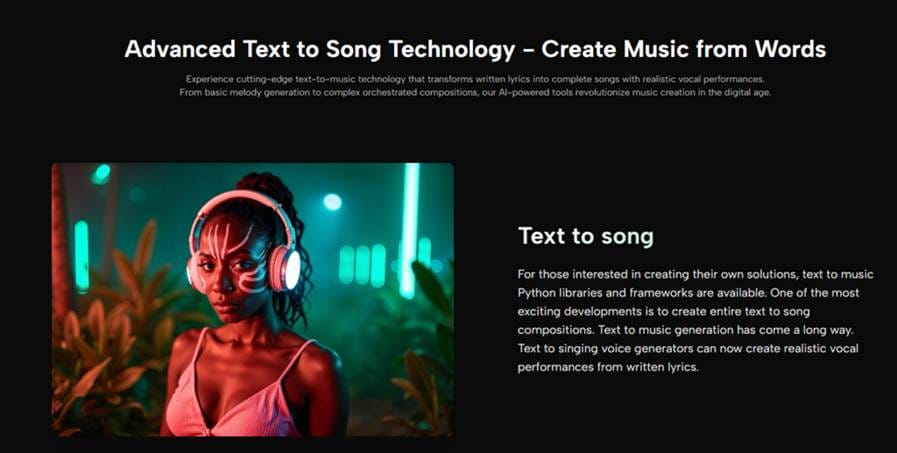
When switching to Lyrics to Music AI, the system operates differently.
Lyrics act as constraints, forcing alignment between:
- words
- rhythm
- melody
Why Constraints Improve Coherence
Timing Anchored By Syllables
Each word influences:
- note duration
- rhythmic placement
Narrative Shapes Arrangement
Story progression affects:
- build-ups
- transitions
Repetition Defines Structure
Repeated phrases naturally form:
- choruses
- hooks
In practice, lyric-driven outputs tend to feel more “complete” compared to prompt-only generation.
The Actual Workflow Users Follow
Despite its complexity, the system follows a relatively simple process.
Step 1: Provide Text Or Lyrics Input
Users begin by:
- writing a descriptive prompt
- or entering full lyrics
Clarity here strongly impacts output quality.
Step 2: Select Core Parameters
Options include:
- genre
- mood
- tempo
- vocal type
These act as boundaries for generation.
Step 3: Generate And Iterate Variations
The system produces full tracks in one pass.
Users typically:
- generate multiple versions
- compare outputs
- refine prompts
Iteration is not optional—it is central to the process.
Comparing This System To Traditional Music Production
| Aspect | Traditional Production | Prompt-Based Creation |
| Entry Skill | High | Low |
| Speed | Slow | Fast |
| Control | Detailed | Moderate |
| Starting Point | Tools | Language |
| Iteration | Editing | Regeneration |
The tradeoff is clear:
control decreases, but accessibility increases significantly
Where This Approach Feels Most Practical
Content Creation Workflows
Useful for:
- video background music
- short-form content
- marketing audio
Rapid Idea Exploration
Allows creators to:
- test multiple moods quickly
- experiment with styles
Non-Musicians Entering Audio Creation
People without formal training can:
- create usable tracks
- participate in music creation
Limitations That Appear In Real Use
Prompt Sensitivity
Small wording changes can lead to:
- very different results
- inconsistent outputs
Limited Fine Control
Users cannot:
- isolate instruments
- adjust mixing levels
Need For Iteration
High-quality results often require:
- multiple attempts
- gradual refinement
These limitations suggest that the system is best viewed as a creative exploration tool rather than a precision instrument.
Why This Shift Matters Beyond Convenience
The deeper change is not about speed—it is about perspective.
From Execution To Expression
Users focus less on:
- how to build
and more on:
- what to express
From Tools To Interfaces
The interface becomes:
- language
instead of:
- software controls
From Skill To Clarity
Success depends on:
- how clearly ideas are described
- how effectively results are evaluated
A Quiet Redefinition Of Music Creation
What emerges is not a replacement for traditional workflows, but a parallel path.
Music creation becomes:
- less about mastering tools
- more about guiding outcomes
And in that process, the role of the creator shifts—from technician to director.
That may be the most significant change of all.