Disclaimer: This article is not intended to be a recommendation. The author is not responsible for any resulting actions of the company during your trading experience. The information provided in this article may not be accurate or up-to-date. Any trading or financial decision you make is your sole responsibility, and you must not rely on any information provided here. We do not provide any warranties regarding the information on this website and are not responsible for any losses or damages incurred as a result of trading or investing.
Developing a commercial magnesium glycinate electrolyte formula requires R&D and co-manufacturing teams to account for total solids from the magnesium source and companion salts, confirm target elemental mineral loads, and test full-system physical and sensory compatibility. A magnesium glycinate ingredient that performs well in plain water will not automatically remain compatible once combined with sodium salts, potassium salts, food acids, sweeteners, and flavor systems. Formulators should therefore run isolated single-component controls alongside multi-component blends before adjusting the formula or approving scale-up.

Define the formulation constraints, not a universal electrolyte ratio
Commercial electrolyte development is formulation engineering, not a search for a universal mineral ratio. When technical teams scope a new beverage or powder project, the objective is a stable, manufacturable matrix that meets the brand brief. This guide does not recommend any magnesium-to-sodium-to-potassium ratio, and it does not propose consumer serving sizes.
The brand’s regulatory and quality teams must first lock intended market positioning, target serving parameters, and compliant label claims for the jurisdiction of sale. Food scientists and contract manufacturers then translate those elemental targets into an operational bill of materials. At the bench stage, the main constraint is how much total salt and carrier load the delivery format can tolerate before dispersion limits, appearance shifts, or flavor interference appear during mixing and storage.
Build an ingredient-to-element mass balance
Before weighing bench samples, formulators need a transparent ingredient-to-element mass balance that separates raw-material gross weight from elemental mineral contribution. A common early-prototype error is confusing the elemental target for sodium, potassium, or magnesium with the total mass of the corresponding salt or chelate added to the batch.
Every electrolyte source contributes a specific elemental percentage based on its molecular structure or commercial specification, plus non-mineral counterions, ligands, or carrier solids. The formulation sheet should record four distinct data points for each active component:
Ingredient identity and specification basis: Document the exact salt or chelate form and whether its elemental assay is reported on an anhydrous or as-is basis on the Certificate of Analysis.
Elemental conversion factor: Log the nominal elemental percentage so theoretical calculations match analytical verification targets.
Gross ingredient input per batch unit: Calculate the total weight of raw material required to deliver the target elemental mass.
Cumulative solids contribution: Sum the gross weights of the magnesium source, companion sodium and potassium salts, acidulants, sweeteners, and flavor carriers to estimate total solids (and dissolved solids where relevant) in the liquid phase or dry blend.
Tracking gross input alongside elemental mass shows why a magnesium glycinate electrolyte formula often carries a substantially higher total solids load than its elemental label declarations suggest. In dry mixes, a high load of hygroscopic solutes may raise equilibrium water activity and caking risk, and total solids (dissolved where relevant) may influence dissolution rate and solution density in reconstituted or ready-to-drink formats; the magnitude should be confirmed in the project’s own matrix rather than assumed from another brand’s formula.
Test the combination rather than the magnesium ingredient alone
Passing a simple water-solubility check on a standalone magnesium raw material does not validate how that ingredient will behave inside a complete electrolyte system. When sodium sources such as citrates or chlorides, potassium salts, organic acids, and flavor compounds are combined in one aqueous system, ionic strength and pH may shift together; whether precipitation or instability results depends on the specific salts, concentrations, and pH, and should be confirmed by testing.
To isolate where a compatibility issue originates, R&D teams should run a structured diagnostic matrix under fixed water quality, mixing temperature, and hold conditions. Rather than testing only the finished prototype, four conceptual trial arms help the bench team determine whether an observed change comes from the base system, the magnesium source, the companion electrolytes, or the interaction among all components.
Base control
| Components included | Water, acidulant, sweetener, flavor system |
|---|---|
| Comparison isolated | Baseline vehicle behavior without mineral load |
| Measurements/observations | Initial pH, clarity, color, baseline flavor profile |
| Next decision | Confirm base-system stability before adding minerals |
Magnesium-only control
| Components included | Base control plus magnesium glycinate ingredient |
|---|---|
| Comparison isolated | Standalone behavior of the magnesium source in the flavored acid base |
| Measurements/observations | Dispersion speed, pH shift, visual clarity, any mineral off-notes |
| Next decision | Check whether the chosen magnesium grade suits the base pH and flavor |
Electrolyte-base without magnesium
| Components included | Base control plus sodium and potassium salts |
|---|---|
| Comparison isolated | Impact of companion electrolytes without magnesium present |
| Measurements/observations | Salinity perception, solution density, clarity, acid-salt buffering |
| Next decision | Adjust acidulant or sweetener if companion salts distort baseline taste |
Complete blend
| Components included | Base control, magnesium glycinate, sodium and potassium salts |
|---|---|
| Comparison isolated | Multi-salt interaction and cumulative solids effect |
| Measurements/observations | Immediate and short-hold visual stability, final pH, sediment check, composite taste |
| Next decision | Proceed to process hold tests or reformulate salt and acid pairings |
Treat this matrix as a conceptual diagnostic framework, not a finished commercial formula. If turbidity or flavor drift appears in the complete blend but not in the magnesium-only control, investigate multi-salt ionic interactions or buffering capacity before disqualifying the magnesium raw material alone.
Separate sensory, physical and process decisions
When reviewing the diagnostic matrix, technical teams get cleaner data by separating sensory observations, physical appearance metrics, and post-processing shifts into independent decision tracks. Bundling taste, clarity, and thermal stability into one pass/fail score hides which variable needs adjustment.
On the physical track, record initial wetting time, dispersion completeness, and visual appearance (clarity, haze, or bottom sediment) both immediately after mixing and after a defined ambient or refrigerated hold. On the chemical track, measure pH after each sequential ingredient addition to see how strongly the magnesium glycinate and companion citrate or chloride salts buffer the selected food acid. In some magnesium–citrate or chloride and organic-acid systems, buffering may alter acid dissociation, which could affect perceived sourness and solution equilibria such as solubility; this depends on the specific magnesium salt, acid, and pH, and must be verified sensorially and analytically.
On the sensory track, evaluate salinity, sourness balance, metallic or alkaline notes, and mouthfeel separately. Product names in the raw-material market may include terms such as “Taste Free,” but sensory neutrality in a complex matrix remains a variable to verify, not a finished-goods guarantee. If the product will undergo thermal pasteurization, tunnel heating, or high-shear homogenization, subject the complete blend to lab-scale process simulation. Heat and shear during pasteurization or homogenization may change interactions among mineral complexes, companion salts, and flavor emulsions that are not evident in cold bench mixing; process-simulation and storage trials are needed in the project’s own matrix, and no shelf-life conclusion should be drawn from bench tests alone.
Choose a magnesium grade for this matrix
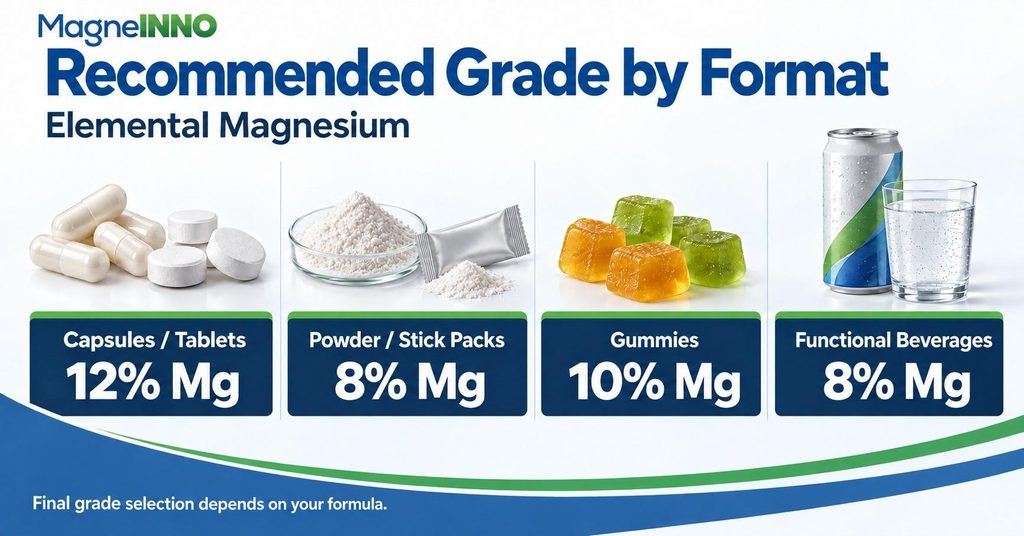
Selecting a practical starting grade simplifies how the diagnostic matrix performs. MagneINNO™ magnesium glycinate is supplied by NutraINNO USA Inc., the U.S. company behind the MagneINNO brand, and is developed using proprietary MagniLift™ technology to support predictable handling in commercial formulations.
When scoping an electrolyte beverage or stick-pack matrix where dispersion and flavor compatibility are primary engineering variables, R&D teams can evaluate a MagneINNO beverage-oriented magnesium glycinate grade such as Ultra Taste Free. This grade provides a nominal 8% elemental magnesium content and serves as a practical starting point for liquid and powder beverage applications without imposing rigid format restrictions. Because nominal elemental content dictates the gross input weight in the mass balance, formulators should calculate the addition rate for their specific project and verify compatibility alongside their chosen sodium and potassium salts inside the four-part trial matrix. Compatibility with any particular sodium or potassium salt pair is not assumed here and must be confirmed in the brand’s own system.
Make a cross-functional next-step decision
Once the bench matrix data is compiled, moving the project forward needs a coordinated review across R&D, quality, regulatory, and contract manufacturing. Treat the bench trials as inputs to the next operational stage, not as a final sign-off.
Formulation R&D reviews the comparison between isolated controls and the complete blend to adjust acidulant levels, modify buffering salts, or refine the order of ingredient addition if pH drift or haze occurred.
Quality and Regulatory audits the updated ingredient-to-element mass balance against the raw-material Certificates of Analysis, confirming that theoretical elemental inputs, overage allowances, and excipient levels align with regional labeling and specification boundaries.
Contract Manufacturing evaluates total solids (and dissolved solids where relevant), wetting behavior, and hold-time observations from the complete blend to design appropriate pilot-scale mixing, filtration, or thermal processing trials before committing to commercial production runs.
This framework does not claim that any specific blend has already passed validation. It only organizes the evidence each function needs before the next stage of work.
Frequently Asked Questions
Is magnesium ingredient weight the same as elemental magnesium?
No. Magnesium ingredient weight is the gross mass of the entire raw material added to the batch. Elemental magnesium is only the mass of the magnesium ion itself. For example, a commercial grade assayed at a nominal 8% elemental magnesium on the stated basis requires 12.5 grams of raw material to contribute 1.0 gram of elemental magnesium to the formula mass balance (1.0 ÷ 0.08). That figure is an R&D mass-balance example only, not a purity claim, recommended dosage, or consumer serving size.
Does passing a magnesium-only control validate the full electrolyte blend?
No. A magnesium-only control only shows how the magnesium raw material interacts with the base water, acid, sweetener, and flavor system. Adding sodium and potassium salts changes ionic strength, total solids (dissolved where relevant), and pH buffering, which can change both taste perception and physical stability in the complete blend.
Why track total solids in an electrolyte mass balance?
Because every magnesium source, companion salt, acidulant, sweetener, and flavor carrier adds gross solids beyond the elemental mineral declarations on a label draft. Logging total solids (and dissolved solids where relevant) helps the team see when dispersion limits, appearance shifts, or flavor interference may appear before scale-up. The magnitude still needs confirmation in the project’s own matrix.
Can sensory, clarity, and process results share one pass/fail score?
They should not. Bundling taste, visual clarity, and thermal or shear behavior into a single score hides which variable needs adjustment. Separate sensory notes, physical appearance metrics, and post-processing shifts so formulation, quality, and manufacturing can act on the right lever.
Does a beverage-oriented glycinate grade guarantee sodium or potassium salt compatibility?
No. A grade selected for liquid or stick-pack work is only a practical starting point for dispersion and flavor screening. Compatibility with any particular sodium or potassium salt pair must be confirmed inside the brand’s own four-part diagnostic matrix, not assumed from the grade name or from a magnesium-only water check.