Most materials have a history you can trace in decades, maybe centuries. Oak trees. Silver seams. Even diamonds, old as they are, formed inside the Earth, which puts them firmly in the terrestrial category.
Muonionalusta meteorite is different. It formed during the early solar system, roughly 4.5 billion years ago, before the Earth existed. It travelled through space, fell to northern Sweden approximately one million years ago, and has been sitting there ever since. The oldest human artefacts are around 3 million years old. This predates them by a factor of over a thousand.
That’s the thing about meteorite rings that takes a moment to fully land. You’re not wearing something old. You’re wearing something ancient in a way that has no real human frame of reference.
The pattern inside
Cut a piece of Muonionalusta and acid-etch the surface, and something remarkable appears. A geometric crystalline structure called the Widmanstätten pattern, interlocking bands of iron and nickel that formed as the metal cooled in space at a rate of approximately one degree per million years.
It cannot be replicated. No manufacturing process produces it. Every piece is unique because every piece cooled slightly differently, in a slightly different location, over billions of years. When you look at the surface of a Muonionalusta ring, you’re looking at a physical record of that cooling process, a texture that took longer to form than life has existed on Earth.
That’s what makes it genuinely rare rather than just marketed as rare. The supply is finite. There’s no meteorite farm.
The rise of the men’s engagement ring
The idea of men wearing engagement rings has shifted considerably in recent years. What once felt unconventional is increasingly common, driven partly by high-profile couples choosing to mark the commitment symmetrically, and partly by a broader cultural appetite for rewriting traditions that never had particularly good reasons behind them in the first place.
The practical question that follows is harder. Once a man is actually looking for an engagement ring, the traditional route, a jeweller, a cabinet of solitaires, the familiar vocabulary of carats and cuts, doesn’t always feel like the right answer. The design language was built around a different kind of buyer with different priorities. Some men find exactly what they want there. Others don’t.
That gap is where unusual materials come in. Meteorite appeals to a specific kind of buyer, someone who wants the ring to carry genuine meaning rather than conventional symbolism. Not a stand-in for something else. Not a format borrowed from a tradition built for someone else. A material with its own story, worn because the story matters.
It also helps that meteorite reads differently on the hand. The Widmanstätten surface has a quiet authority to it, complex without being decorative, interesting without trying to be noticed. For a piece of jewellery that will be worn every day for decades, that’s not a small thing.
The Astraeus: where the material takes centre stage
Most meteorite rings use crushed or fragmented meteorite as an inlay element, genuine and extraordinary, but sharing the band with other design details. The Astraeus takes a different approach. A wide band of solid Muonionalusta meteorite runs the full width of the ring in polished titanium, leaving nothing to compete with the material itself.
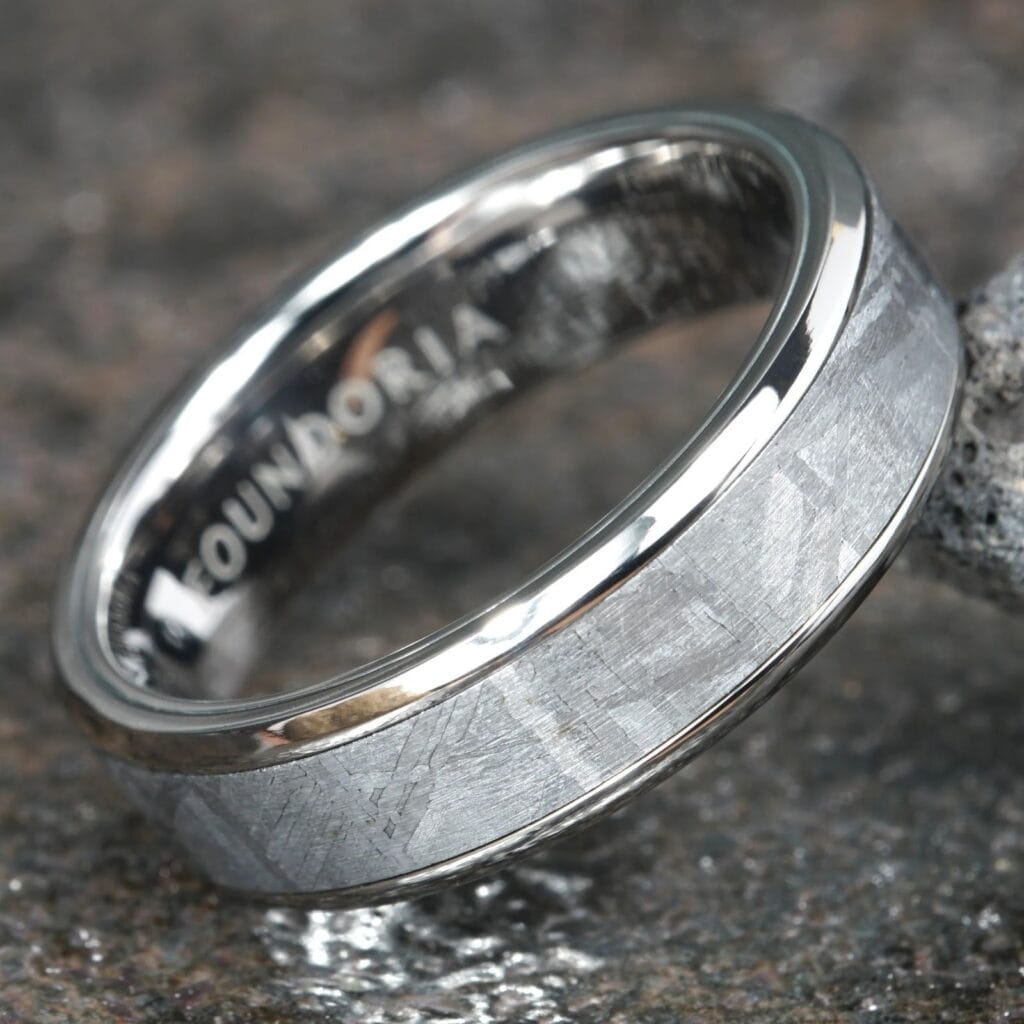
The result is a ring where the crystalline surface pattern is the entire exterior. That blue-silver texture sits uninterrupted around the full circumference, catching light differently from every angle because no two pieces of Muonionalusta are identical. You could own the same ring as someone else in name only.
It takes commitment, as a piece of jewellery. But then, so does the material.
Why it works as a wedding or engagement ring
There’s something fitting about meteorite for a ring specifically. The etched surface develops a blue-silver sheen, cool and subtle, not shouting for attention. It sits well against skin. And each piece being unique means the ring you wear exists, in a practical sense, once.
In terms of durability, meteorite inlays are typically set within titanium or tungsten for everyday wearability. Titanium sits light on the hand, most people forget they’re wearing it. Tungsten has more weight and more presence. Both handle daily life far better than gold, platinum, or silver. For those drawn to tungsten across a broader range of natural material inlays, including meteorite, Scottish deer antler, and reclaimed whisky barrel oak, tungsten wedding rings cover a wide range of options across different material combinations.
A few practical points worth knowing: meteorite rings can’t be resized, so getting properly measured before ordering matters. Quality rings carry an electrophoresis coating that prevents any patina developing in normal wear. On authenticity, look for brands that name the specific meteorite. Muonionalusta and Gibeon, a different iron meteorite from Namibia used in many tungsten inlay designs, have documented geological records. Vague references to “space rock” are worth questioning.
Where to find genuine ones in the UK
UK brand Foundoria specialises in meteorite rings alongside other natural material inlays. Their CELESTIUM collection runs from designs featuring genuine crushed meteorite fragments through to the Astraeus, the wide-inlay Muonionalusta band in polished titanium described above.
It’s worth taking seriously as a choice. The material has been around longer than the planet you’re standing on, and there’s only so much of it.