Disclaimer: This article is not intended to be a recommendation. The author is not responsible for any resulting actions of the company during your trading experience. The information provided in this article may not be accurate or up-to-date. Any trading or financial decision you make is your sole responsibility, and you must not rely on any information provided here. We do not provide any warranties regarding the information on this website and are not responsible for any losses or damages incurred as a result of trading or investing.
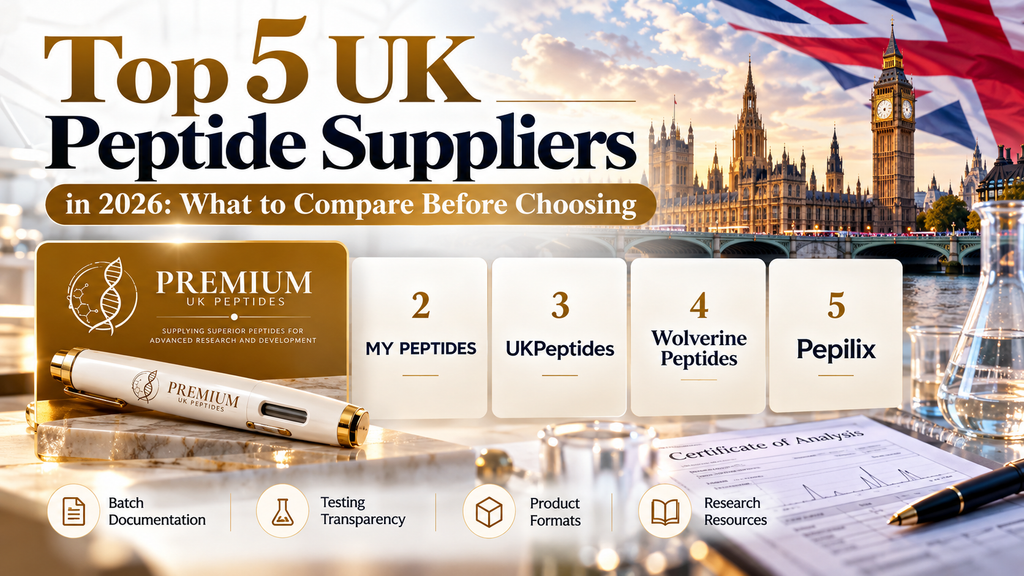
Top 5 UK Peptide Suppliers: What to Compare Before Choosing
Finding information about UK peptide suppliers can take time. Websites provide different product formats, testing details, certificates of analysis, and delivery options. When looking for suppliers for real laboratory work, it’s better to know what to compare. Don’t trust a catchy slogan or a lengthy product list.
This guide reviews five UK suppliers of research peptides:
● Premium UK Peptides
● MY PEPTIDES
● UKPeptides
● Wolverine Peptides
● Pepilix
The comparison looks at publicly available information. This includes documentation, product formats, and access to research resources. It is not a laboratory assessment or a guarantee of product quality.
Important: This is a brand-led comparison published by Premium UK Peptides. The first listing is the publisher’s own website. Supplier claims should be checked against current, product-specific documentation before drawing conclusions.
How We Compared UK Peptide Suppliers
A useful supplier comparison should look beyond product names and headline purity figures. The following points can help readers assess the information available on a supplier’s website.
● Certificate of Analysis (CoA): Is the relevant batch documentation available? Does it identify the tested material?
● Testing transparency: Does the supplier clarify the methods they use and identify the lab in charge? ● Product information: Are compound names, quantities, formats, and other specifications clearly presented?
● Research resources: Does the website explain analytical documentation, storage considerations, and research terminology?
● Supplier information: Are policies, contact information, and delivery terms easy to find
These criteria help readers ask better questions. However, a website’s statements alone can’t determine the quality, identity, or suitability of a specific batch.
1. Premium UK Peptides
Premium UK Peptides is a UK-based supplier of research peptides. They offer an online catalogue and helpful educational resources. The website says it supplies products for lab research. You can find batch documentation in the certificates of analysis section.
A useful feature of the website is how it combines product information with educational content. Readers can check the catalogue for resources on reading a Certificate of Analysis. They can also learn about laboratory storage considerations.
What stands out
● A dedicated online research peptide catalogue.
● A central Certificate of Analysis library.
● An educational guide on how to read a peptide CoA
● A published resource covering laboratory peptide storage considerations
● Product and category information is available through the main website
What readers should verify
Check each product’s batch documentation, test date, and analytical method. Also, ensure the certificate matches the described material. A general statement about testing is not a substitute for reviewing the actual report.
Best for readers who: want to check out a research peptide catalogue with clear docs and helpful educational resources.
Explore Premium UK Peptides
2. MY PEPTIDES
MY PEPTIDES offers a range of research compounds and blends. It provides product details and focuses on pre-mixed vial formats. The website states batches are HPLC-verified and come with certificates of analysis.
The site also provides information about its stated testing and dispatch processes. Readers can compare suppliers using these pages. They show what documentation the company claims to provide. Then, they can check the reports for specific materials of interest.
What stands out
● A catalogue covering individual compounds and blends
● Public-facing information about HPLC testing
● A stated CoA provision process
● Information about product formats and UK dispatch
What readers should verify
Check whether the certificate is specific to the relevant batch and what it actually measures. HPLC purity results and identity testing provide different insights. It’s key to grasp the report’s scope instead of just focusing on the headline percentage.
Best for readers who want to compare a catalogue that highlights pre-mixed vial formats and available testing details.
Visit MY PEPTIDES.
3. UKPeptides
UKPeptides provides a catalog of research peptides. Their materials are meant for in-vitro laboratory research. Its website features HPLC testing, mass spectrometry, and certificates of analysis. It also provides details about lyophilised product formats.
For detailed information, check the supplier’s descriptions. They’re a good way to learn about their quality-control process. The actual batch report is the main source for checking a specific analytical result.
What stands out
● A catalogue presenting laboratory research materials
● Public information about HPLC and mass spectrometry
● Descriptions of lyophilised product formats
● Online research notes and educational materials
What readers should verify
Review the batch number, test date, methods, and reported results in the relevant certificate. Also, check that the product description and the document refer to the same material and specification.
Best for readers who: wish to compare a supplier focused on lyophilised materials and analytical testing data. Visit UKPeptides
4. Wolverine Peptides
Wolverine Peptides offers various research peptide products. They also have a page about their Janoshik testing and any third-party verification reports. The website also directs readers to additional certificates and product-level documentation.
This structure lets readers check published results instead of just trusting testing claims. The supplier says that not all products have finished Janoshik analysis. So, check the evidence availability for each product.
What stands out
● A dedicated page for third-party testing information.
● Published reports for selected products and batches.
● Additional documentation referenced on product pages.
● A catalogue covering multiple research compounds.
What readers should verify
Confirm whether a report exists for the specific product and batch being reviewed. Check its date, analytical method, and result rather than assuming that a report for one product applies to the entire catalogue.
Best suited to readers who want to examine a supplier’s published third-party testing information.
5. Pepilix
Pepilix offers a catalogue of research compounds. Their products are HPLC-tested and come with Certificates of Analysis. The website includes product descriptions, research-use notices, and information about delivery.
The best next step is to check the documentation for the specific product you’re considering. A general quality statement shows how a supplier works, but the analytical report gives more detailed insights.
What stands out
● An online catalogue of research compounds.
● Published statements about HPLC testing.
● CoA information presented as part of its quality messaging.
● Product-level descriptions and research-use notices.
What readers should verify
Verify if the certificate matches the relevant batch. Also, check if the methods and results back up the claims about the material. Confirm any product specification directly from its current listing and documentation.
Best for readers who want to compare a catalogue with testing documents and product details.
What Makes a Certificate of Analysis Worth Reviewing?
A Certificate of Analysis, or CoA, shows the analytical details of a specific sample or batch. Its value depends on what was tested, which methods were used, and whether the report can be linked to the material being assessed.
When reviewing a certificate, consider these points:
● Compound identification: Does the report clearly identify the material tested?
● Batch reference: Is there a batch or lot number that can be matched to the relevant product?
● Analytical method: Does the report explain the method used, such as HPLC or mass spectrometry?
● Reported result: Is the result clearly stated, with units or relevant context where applicable?
● Laboratory details: Can you identify the testing organisation? Is it possible to independently verify the report?
● Date and traceability: Is the report dated, and is it clear which material it relates to?
HPLC is often used to check chromatographic purity. Mass spectrometry gives details about molecular identity. Neither method ensures complete quality, composition, sterility, or fitness for a specific purpose.
For a more detailed explanation, read this guide: How to Read a Peptide Certificate of Analysis.
Vials, Pens, and Other Product Formats
Product format is another detail worth checking when comparing supplier websites. Listings may describe lyophilised material, liquid formats, pens, or combinations of compounds. These formats shouldn’t be seen as the same just because they have a similar compound name.
Read the exact product description and accompanying documentation. Check what the supplier says about the material’s form, composition, storage needs, and intended research context. Do not assume that handling instructions for one format apply to another.
Frequently Asked Questions
What should you look for when comparing UK peptide suppliers?
Look for clear product specifications, relevant batch documentation, transparent analytical methods, identifiable laboratory information, and accessible supplier policies. Review the evidence available for the specific product rather than relying only on general marketing claims.
What is a Certificate of Analysis (CoA)?
A Certificate of Analysis is a document that reports analytical findings for a particular sample or batch. Its usefulness depends on the tests performed, the methods used, and whether the report can be linked to the material being assessed. Read more: how to read a peptide Certificate of Analysis
Does an HPLC purity result confirm product identity?
Not by itself. HPLC can provide information about chromatographic purity, while methods such as mass spectrometry can provide information relevant to molecular identity. The meaning of a result depends on the method and the report’s scope.
Where can readers find Premium UK Peptides’ CoA resources?
Premium UK Peptides provides a dedicated Certificate of Analysis library. Readers should check the relevant documentation and confirm that the report matches the product and batch being reviewed. Read more: Certificate of Analysis library
What should you check when comparing peptide product formats?
Check the exact product description and supporting documentation for the material’s form, composition, and stated storage requirements. Do not assume that information for one format applies to another. Read more: laboratory peptide storage guide.