Tokyo makes a very good first impression. It can give you a tiny whisky bar under the tracks, a basement jazz club, ramen at midnight and a train home that arrives when the display says it will. But if you are thinking about staying for months rather than days, the real test arrives the next morning.
Where do you buy milk? How long is the commute when everyone else is commuting too? Can you dry clothes when it rains for three days? Is there enough kitchen counter to chop an onion? Does the “ten-minute walk” to the station feel like ten minutes when it is 34°C and humid?
For British creatives, remote workers, students, and professionals considering a longer spell in Japan, this is the useful version of Tokyo: not less exciting, just more complete. The city’s residential life is a patchwork of fiercely local neighbourhoods, each with its own rhythm. Choosing where to live means deciding what kind of Tokyo you want on a completely unremarkable Tuesday.
Forget the idea that central always means convenient
London has trained plenty of people to understand that mileage is not the same as journey time. Tokyo takes that lesson and adds several dozen railway companies, subway lines, and station exits.
A flat that looks close to your office on a map can be annoying if the route involves two crowded changes. A place much farther away can be easier if one train takes you almost door to door. The line matters; the station matters; even the exit matters.
Start with the journeys you will repeat. If you work near Shibuya, map direct connections rather than simply searching Shibuya Ward. If you need regular access to Haneda Airport, look at the railway lines that make that painless. Or, if you work from home most days, decide how much commute you would exchange for a separate room or enough floor area for a desk.
This is how Tokyo opens up. Places you barely noticed as a visitor—Koenji, Asagaya, Kameido, Oimachi, Nerima, Nishi-Ogikubo—can become very attractive once you understand what they connect to.
Your local station is basically your high street
In much of Tokyo, the station does far more than move people. It is the supermarket, bakery, pharmacy, takeaway strip, meeting point and weather shelter. Bigger stations swallow whole shopping centres; smaller ones gather useful businesses into a tight ring of streets.
That means apartment hunting should include loitering. Arrive after work. Walk the route you would take home. See which supermarket is still open. Check whether there is somewhere to eat after 10 p.m. Find the nearest pharmacy. Notice whether the final five minutes are down a calm residential lane or beside a six-lane road.
A neighbourhood can change character in the distance between two convenience stores. Famous district names are only rough clues.
Japanese floor plans have their own shorthand
The first time you see “1K” or “1LDK” in a listing, it looks like someone has accidentally pasted in a product code. It is actually useful once decoded.
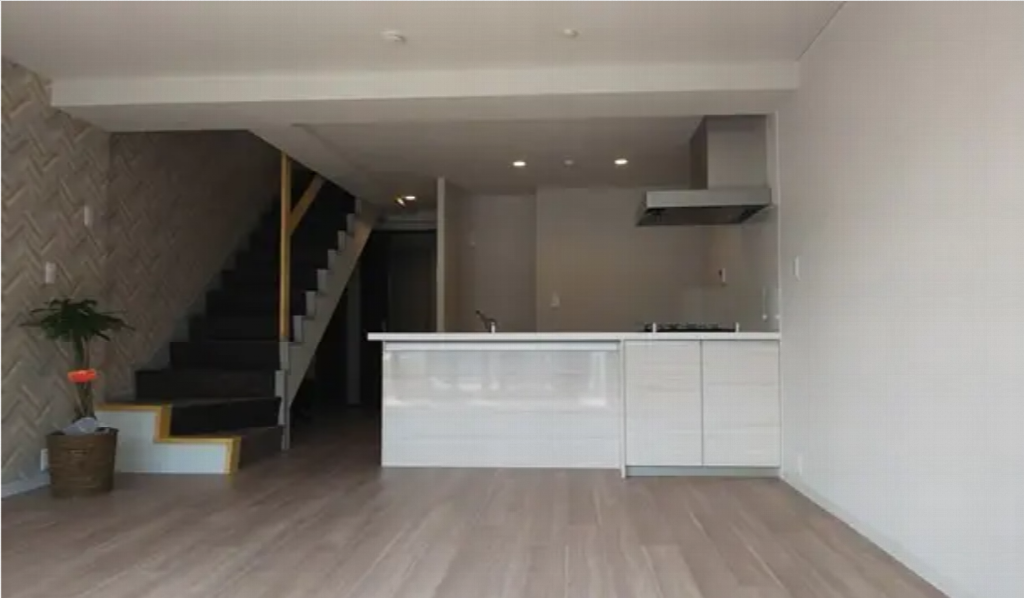
1R is normally a one-room studio with a kitchenette in the main space. 1K has one main room with a separate kitchen. A 1DK adds a dining-kitchen area. A 1LDK gives you a combined living-dining-kitchen space plus one separate room. The number increases with the number of separate rooms.
The catch is that the label does not tell you how generous the space will feel. Check the square metres and the shape. A clever 25-square-metre flat can work better than a 30-square-metre one with an awkward corridor. Storage is also crucial. Japanese flats often expect you to own fewer bulky things than a British terrace or suburban semi quietly accumulates over the years.
If you are bringing a desktop setup, music gear, or more than one suitcase of clothes, measure your ambitions against the plan.
The bathroom may be the smartest room in the flat
Japan’s residential bathrooms can make British rental bathrooms look slightly underdeveloped. Many modern flats have a separate wet room for bathing, with a deep tub, a washing area and controls that can fill or reheat the bath automatically. Ceiling units can ventilate the room and dry laundry.
The last function is not a gimmick. Tokyo’s rainy season and humid summers make indoor drying a fact of life. A bathroom dryer can turn a small flat into a surprisingly workable laundry system.
In cheaper or older studios, you may instead find a compact unit bath with toilet, basin, and tub together. Listings that boast of a “separate bath and toilet” are therefore describing a feature many renters genuinely care about.
Moving in can cost much more than one month’s rent
Here is the part worth knowing before you become emotionally attached to a sunlit balcony. Japanese rental contracts can involve a collection of initial charges that do not have neat British equivalents.
Depending on the property, you may see a deposit, key money, an agency fee, renter’s insurance, a guarantor-company charge, cleaning costs, and a fee to change the lock. The building may also charge a monthly management fee in addition to the rent. Some leases charge a renewal fee later.
Not every flat has every charge. Plenty of listings now promote zero key money, zero deposit, or other reduced initial costs. But the only sensible comparison is the total amount needed to get the keys.
When looking for Tokyo apartments for rent with room to settle in, ask for the move-in estimate early. It stops a £-to-yen budget based on headline rent from collapsing at the contract stage.
Key money is as odd as it sounds
“Key money,” or reikin, is a non-refundable payment to the landlord. It is a long-standing rental custom rather than a deposit held against damage. For newcomers, it can feel like paying money simply because someone agreed to rent you the flat—which, broadly speaking, is why it gets so much attention.
The good news is that it is not universal. Market competition has produced many no-key-money properties. Treat it as one line in the overall cost structure, not a mysterious tax that every renter must pay.
You may need a guarantor company

Another difference is the widespread use of rent guarantor companies. Instead of relying only on references or a personal guarantor, many landlords require a commercial company that screens the tenant and guarantees certain obligations. The tenant pays for the services.
Foreign applicants may be asked for employment details, proof of income, visa or residence information, and an emergency contact. Some landlords are more accustomed to international tenants than others. The practical move is to make your situation clear before viewing: job, visa, intended lease term, number of occupants, and any pets.
If you are moving for work, ask the employer whether the company will sign the lease, provide relocation support, or reimburse fees. Corporate arrangements can change which properties are realistic.
Unfurnished can mean properly unfurnished
Britain’s “unfurnished” rentals usually leave you with certain assumptions. Japan can remove a few more of them.
A standard long-term flat may not include a fridge, washing machine, curtains, microwave or even every light fitting. There will usually be air conditioning in at least the main room, but appliances should be checked rather than assumed.
The washing machine often has a designated waterproof tray with fixed dimensions. The fridge may have a specific recess. Curtains can require unusual lengths. Measure before buying anything large. Tokyo apartments have a way of punishing optimism by 12 millimetres.
For a stay of only a few months, furnished or serviced accommodation can be worth the premium. For a year or more, buying your own basics often gives you more choice and a more personal home.
The seasons matter inside as much as outside
British people tend to imagine a mild Tokyo winter and think, “That will be easy.” Outdoors, perhaps. Indoors, the calculation can be stranger.
Many flats heat individual rooms with wall-mounted air-conditioning units rather than central heating. Older buildings with less efficient windows can feel chilly. In summer, west-facing upper-floor flats may become heat traps. The rainy season adds a humidity problem that has no exact Sheffield equivalent, however committed South Yorkshire may be to damp weather.
Check the orientation, building age, and number of air-conditioning units. Ask how the bathroom ventilates. Think about where you will actually spend evenings in January and August.
Noise is hyperlocal
Tokyo has a reputation for being astonishingly quiet for a megacity, and much of it is. Then you find the flat beside an elevated railway, a school playground, a fire station, or the back door of a bar that empties bottles at 1 a.m.
Do not judge the noise with the windows shut for a 10-minute viewing. Look for construction notices nearby and check whether the bedroom faces the road or the back of the building.
The same applies to sunlight. North-facing flats can be cheaper but darker. South-facing units are prized for light. A balcony facing another building two metres away may technically be “outdoor space” without delivering much sky.
The building has a personality too
A beautifully renovated room can exist inside a poorly managed block. Look at the rubbish area, bicycle parking, post boxes, corridors and entrance. Are parcel lockers available? Is there an auto-lock door? Is the lift large enough for your move? Do residents appear to follow the rubbish rules?
These are unglamorous clues to how the building functions. In a small flat, shared infrastructure carries more weight. A parcel locker can save repeated missed deliveries; a tidy rubbish area can save a lot of domestic irritation.
Rubbish day will become part of your calendar
Japan’s waste sorting varies by municipality, but it is often more structured than newcomers expect. Different days can be assigned to burnable rubbish, bottles, cans, plastics, paper, and other categories. Oversized items require a separate process and cannot be abandoned beside normal bins.
This sounds bureaucratic until you realise how little spare storage a small flat has. Miss a collection, and suddenly packaging becomes furniture.
Most ward offices and building managers provide guidance, often in multiple languages. Learn it early. There are more interesting ways to spend your first month in Tokyo than arguing with a bag of PET bottles.
Do not overlook the ordinary neighbourhoods
Visitors naturally know Shinjuku, Shibuya, Harajuku, Asakusa, and Roppongi. Residents build attachments to smaller places: a particular shotengai shopping street, a tiny park, the bakery under the tracks, the sento two blocks away, the cheap lunch counter that knows your order.
Living one or two stops outside a famous area can change the economics significantly while keeping the fun within easy reach. It can also give you a better distinction between going out and coming home.
For creative workers, that distinction can be valuable. Tokyo offers endless stimulation, but having a quieter base makes it easier to choose when to engage with it. Japan-Property’s guide to Tokyo’s 23 wards is a useful starting point for seeing how those smaller areas differ.
If you make music, ask before you make music
Musicians should be careful. Many standard rental contracts restrict musical instruments, loud audio, and other noise-producing activities. A flat with thick concrete walls is not automatic permission to rehearse.
Dedicated soundproof apartments and practice studios exist, and Tokyo has an excellent ecosystem of rentable rehearsal rooms. If music is central to your work, solve that requirement explicitly rather than hoping a normal lease will tolerate it.
The same goes for pets, shared occupancy, and home-business use. Ask first. Japanese contracts can be detailed, and “probably fine” is not a useful category.
Give the flat the morning test
The easiest way to choose is to stop imagining your life as a montage. Picture a normal morning in February. You wake up. The room is cold or warm. Coffee is brewing. You need clean clothes. You have a call at nine; it’s raining, and you leave for the station with a laptop and an umbrella.
Does the home still work?
Now picture August. You return late. The supermarket is open. Your walk from the station is manageable. The air conditioner cools the room. There is somewhere to dry a shirt for tomorrow. You can make food without moving the laptop off the table.
That is the useful Tokyo fantasy: not that every day will be cinematic, but that the ordinary days will be easy enough to leave energy for the extraordinary ones.
Tokyo will still give you basement gigs, tiny bars, all-night noodles, strange museums, and accidental nights out. Choosing the right home simply means you have somewhere that feels good to return to when the city finally lets you go to bed.