For decades, the four-carat diamond was a creature of the red carpet. It flashed from the hands of pop stars and film actresses, it made headlines when a footballer proposed, and it lived comfortably in the realm of things ordinary people admired but never expected to own. That distance has closed. The statement ring has come down from the celebrity pedestal, and lab-grown diamonds are the reason.
Walk through any city centre today and you will spot them: large, brilliant, unmissable diamonds on the hands of women who are not millionaires. The four-carat look, once shorthand for extraordinary wealth, has become a genuine option for couples with sensible budgets. This is the story of how that happened, and how to wear the look if you want it.
Why Was the 4-Carat Diamond Always a Celebrity Symbol?
Size has always signalled status in fine jewellery, and four carats sat near the top of that ladder. A natural four-carat diamond of good quality is genuinely rare, and rarity commands a price that historically ran into six figures for the stone alone. That price tag made the four-carat ring an unambiguous marker of serious money, which is exactly why the press loved photographing them.
When a celebrity appeared with a four-carat rock, the coverage wrote itself. The ring became a talking point, a symbol of a relationship’s seriousness, and a small piece of theatre. For everyone watching at home, it reinforced the idea that a diamond of that scale belonged to a different world entirely.
What Actually Changed to Make Big Diamonds Attainable?
Lab-grown diamonds rewrote the maths. A lab-grown diamond is a real diamond, chemically and physically identical to a mined one, grown in a matter of weeks rather than found after a billion years underground. As the technology matured and production scaled, the price of large lab-grown stones fell dramatically, and kept falling.
The result is stark. A four-carat lab-grown diamond in a lovely near-colourless, eye-clean grade now costs a small fraction of its mined equivalent. The celebrity look no longer requires a celebrity bank balance, and that single shift has changed what couples feel able to ask for when they walk into a jeweller.
Is a lab-grown diamond a real diamond?
Yes, entirely. Lab-grown diamonds are not imitations like cubic zirconia or moissanite. They share the identical crystal structure, hardness, sparkle and fire as mined diamonds, and even a trained gemmologist needs specialist equipment to tell them apart. On the hand, under any light, there is simply no visible difference to see.
How Big Does a 4-Carat Diamond Look in Real Life?
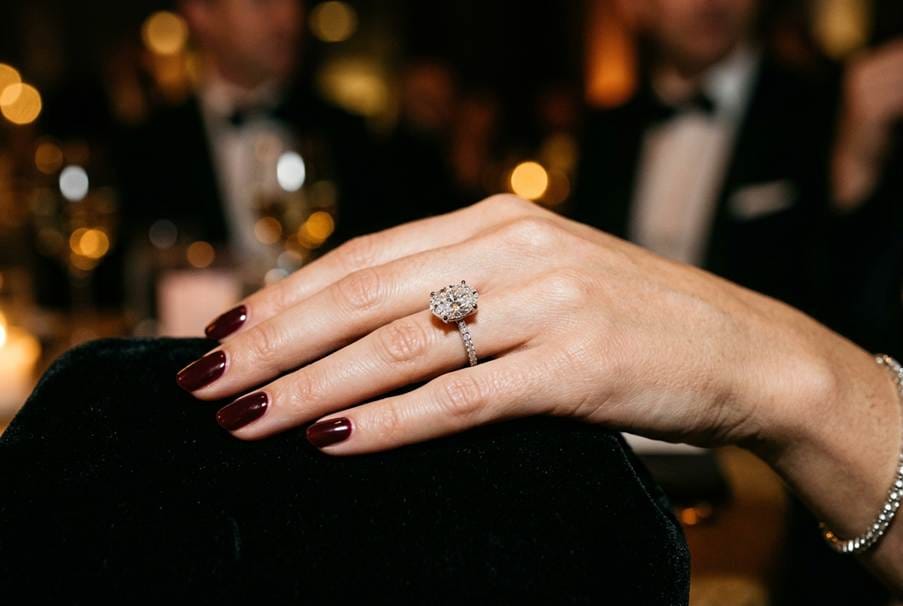
Substantial is the honest answer. A four-carat round brilliant measures roughly 10.2 millimetres across, covering a commanding portion of the finger and catching light from across a room. This is a diamond people notice, comment on, and remember. It is, by any measure, a statement.
Elongated shapes appear even larger. A four-carat oval can stretch to nearly 14 millimetres in length, and a pear or marquise longer still, running dramatically down the finger. The shape you choose changes not just the character of the ring but how much presence it projects, and at this size the differences are impossible to miss.
| Shape | Approx. Face-Up Size at 4ct | The Vibe | Celebrity-Inspired Appeal |
| Round Brilliant | ~10.2mm diameter | Timeless, maximum sparkle | The classic Hollywood solitaire |
| Oval | ~13–14mm x 9–10mm | Elegant, elongating, modern | The most-copied A-list shape |
| Emerald | ~10–11mm x 8–9mm | Sleek, architectural, cool | The understated old-money look |
| Cushion | ~9.5–10.5mm | Romantic, soft, glamorous | The vintage-glamour choice |
| Pear | ~14–16mm x 8–9mm | Bold, directional, fashion-forward | The trendsetter’s statement |
| Radiant | ~9.5–10.5mm | Vibrant, high-energy sparkle | The show-stopping party ring |
Which Celebrity Ring Styles Can You Now Recreate?
The elongated oval
The oval has dominated celebrity engagements for years, prized for the way it flatters the finger and looks even larger than its carat weight suggests. At four carats, an oval solitaire on a slim band delivers that instantly recognisable modern-glamour look, the one that fills bridal magazines and social feeds alike.
The emerald-cut statement
Long, clean and coolly sophisticated, the emerald cut has become the choice for women who want scale without fuss. Its open, hall-of-mirrors facets read as quietly expensive and effortlessly chic. A four-carat emerald cut channels a refined, old-money glamour that never shouts but always registers.
The classic round solitaire
Some looks never age, and the round brilliant solitaire is chief among them. At four carats it becomes the ultimate version of a timeless idea: one extraordinary stone, a simple setting, nothing to distract from the sparkle. It is the ring that will look as right in thirty years as it does today.
How Do You Style a Ring This Size?
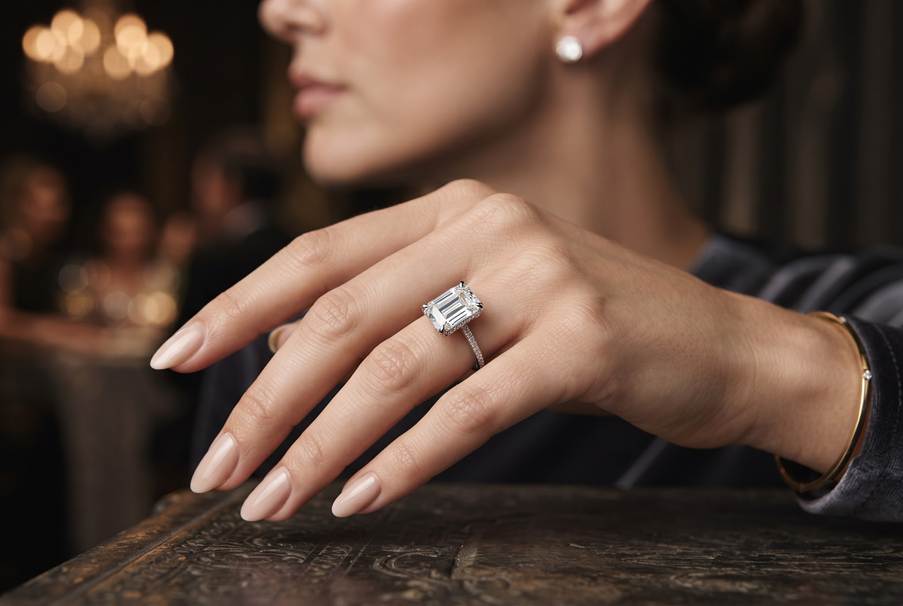
A four-carat diamond is the main event, so the golden rule is to let it lead. Keep the rest of your jewellery deliberately restrained and the ring does all the talking. A pair of simple studs, a fine bracelet, and you have an evening look that feels considered rather than crowded.
Pairing with a wedding band
A large centre stone pairs best with a slim, understated band. A delicate pave band adds a subtle shimmer without competing, while a plain metal band keeps the attention entirely on the diamond. Because the setting for a four-carat stone often sits a little wider, a gently contoured band nests neatly against it for a seamless, custom finish.
Choosing your metal
White metals such as platinum and white gold keep the look crisp and icy, letting a near-colourless stone appear as bright as possible. Yellow gold, riding its current fashion revival, lends warmth and a richer, more vintage feel. Two-tone settings offer the best of both and read as thoroughly modern on a large stone.
Do You Need Higher Quality at 4 Carats?
To a degree, yes. A larger diamond has more surface area, so anything less than ideal becomes easier to spot. At four carats it is worth prioritising a clarity grade that is eye-clean and a colour grade that stays bright in your chosen setting, rather than chasing the absolute maximum on paper.
The good news is that lab-grown pricing gives you room to be choosy. Because the stone itself costs so much less than a mined equivalent, you can comfortably select a higher clarity and colour than you might have been able to afford in a natural diamond of the same size. Quality and scale stop being a trade-off. For couples who want to explore the look, curated collections of 4-carat lab-grown diamond engagement rings show how shape, colour and setting come together in finished pieces with transparent, stone-level detail.
What Sort of Budget Does a 4-Carat Lab-Grown Ring Need?
Exact pricing depends on shape, quality and setting, but the headline is transformative. A mined four-carat diamond of good quality can command a figure well into six figures for the stone alone, which is precisely why it was always a celebrity purchase. A lab-grown equivalent brings that same visual drama down to a figure that ordinary couples can realistically plan for.
The freedom this creates is the real point. The money saved on the stone can be redirected towards a more beautiful setting, a matching band, or simply kept in the bank while still securing the size you genuinely want. For many buyers, the appeal is not spending less for its own sake but getting far more ring for a sensible outlay.
Is There an Ethical Case for Choosing Lab-Grown?
For many buyers, the appeal goes beyond price. Lab-grown diamonds require no mining, which removes concerns about environmental disruption and sourcing that some people feel strongly about. Choosing a large lab-grown stone means you can have the dramatic look you want while sidestepping those worries entirely.
At four carats in particular, where a mined stone would represent a very significant extraction, the contrast is meaningful. A lab-grown diamond offers the same beauty and the same permanence with a clear conscience attached, and for a growing number of couples that peace of mind is part of the ring’s appeal rather than an afterthought.
What Should You Ask Before Buying?
At this size, a little due diligence protects your investment. Confirm the diamond is certified by a respected laboratory such as IGI or GIA, and check the report number on the certifier’s own website. Ask to see a video of the actual stone under natural and indoor light, and confirm the return policy, the setting metal, and whether an insurance appraisal is provided.
A reputable seller will offer all of this without being pushed. If any of it proves difficult to obtain, treat that as useful information about the retailer. Buying a four-carat ring should feel exciting and transparent, never uncertain, and the right jeweller will make sure it does.
How Do You Care for a Statement Diamond?
A ring you wear often will need occasional attention to stay dazzling. A weekly clean with warm water, a little mild washing-up liquid, and a soft brush removes the oils and lotion that dull a diamond’s sparkle. An annual check of the setting keeps the prongs secure and the stone safe.
Remove the ring before the gym, gardening, or anything involving harsh chemicals and heavy impact. Diamonds are remarkably hard, but settings can still bend or loosen with rough handling. Treat a four-carat ring with the same easy care you give your finest pieces and it will hold its brilliance for a lifetime.
How Does 4 Carats Compare to Smaller Statement Sizes?
Two and three carats are impressive in their own right, but four carats crosses a visual threshold. It is the point where a ring stops reading as simply lovely and starts reading as a genuine showpiece. The jump from three to four carats adds noticeably more spread on the finger, and the difference is obvious even to people who know nothing about diamonds.
What lab-grown has done is make that jump affordable rather than reckless. In the mined market, moving from three to four carats could mean tens of thousands of pounds of difference. In lab-grown, the step up is modest by comparison, which is why so many couples who might once have settled for less are choosing to go bigger without stretching their budgets.
Does bigger always mean better?
Not necessarily, and this is worth saying plainly. Four carats is a bold, high-impact choice that suits women who genuinely love a large, eye-catching ring. For someone whose style is delicate and understated, a smaller stone may simply feel more like them. The right size is the one that matches the wearer, not the one that impresses a stranger.
Which Shapes Photograph Best on the Hand?
In an age when engagement rings are shared online almost instantly, how a stone photographs matters. Elongated shapes such as oval, pear and marquise tend to be the most flattering in pictures, stretching the finger and catching light along their length. Their generous spread means they look every bit as large on camera as they do in person.
Round brilliants and radiants win on sheer sparkle, throwing bright flashes of fire that read beautifully in natural light. Emerald cuts offer something different again, a calm, mirror-like elegance that photographs as sophisticated rather than showy. Whichever you choose, good daylight and a relaxed hand will always capture a four-carat stone at its most spectacular.
The Bottom Line: The Statement Ring Belongs to Everyone Now
The four-carat diamond has completed a remarkable journey, from the exclusive preserve of the famous to a realistic choice for couples who simply love the look. Lab-grown diamonds did not just make big stones cheaper; they democratised an entire aesthetic that was previously locked behind extraordinary wealth.
If you have always admired the celebrity statement ring and quietly assumed it was not for you, the maths has changed. A real, brilliant, ethically grown four-carat diamond is now something you can genuinely consider. The only decision left is which shape gets to make the statement, because the size is finally yours to claim.