You have found the right flat, the offer is agreed, and now everything seems to pause while someone runs their checks. That waiting period is tenant referencing, and it is the last gate between you and your new front door. Most checks in the UK wrap up within two to five working days, yet the exact timing rests on how fast a few other people reply. Knowing what sits behind the process helps you prepare the right paperwork, sidestep the common hold ups, and move in sooner. Here is a clear walk through of what referencing involves, how long each stage tends to take, and the simple steps that keep yours moving.
Key Takeaways
- Most UK applications are approved within several working days once every document is supplied.
- Straightforward cases can clear in 48 hours, sometimes within hours when referees reply fast.
- The report covers identity, right to rent, credit history, affordability, employment and previous tenancies.
- Slow employer or landlord replies cause the biggest delays, so line up your contacts early.
- A guarantor on roughly 36 times the rent can rescue a borderline affordability result.
How Long Does Tenant Referencing Normally Take?
In most cases, referencing is completed between two and five working days once you have handed over every required document. Simple cases finish faster, sometimes inside 48 hours, and occasionally within a few hours when each referee answers straight away.
If you are at the offer stage and quietly counting the days, it helps to understand how long does tenant referencing take before you settle on a moving date. The clock really starts the moment you submit your details, not when your offer is accepted.
Speed depends on the people answering questions about you. Credit results from agencies usually return within minutes, but a work reference or a note from a former landlord can take a day or two to arrive. The more responsive everyone is, the quicker your report gets signed off. Agents who chase referees daily tend to close cases at the shorter end of the range.
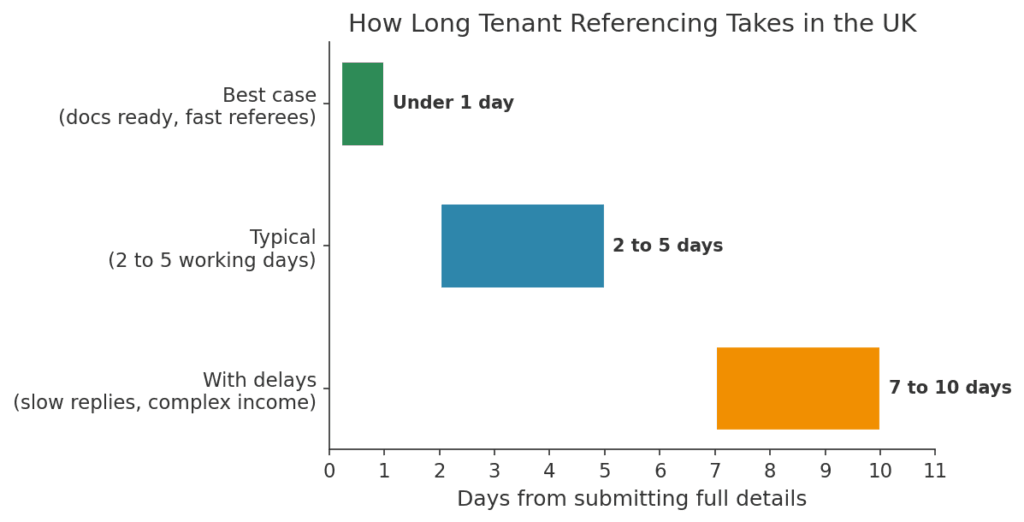
Typical tenant referencing timelines once full details are submitted.
| Key Stat: An application with credit results back in minutes can be cleared in 48 hours, though one missing document may add a week. |
What Tenant Referencing Actually Checks
Tenant referencing is a background check that letting agents and landlords run to confirm you can afford the rent and will look after the property. It pulls several separate searches into one report, and each part examines a different slice of your history. None of the individual checks take long on their own; the wait comes from stitching them together.
Identity and Right to Rent Checks
Right to Rent is the only element of referencing that the law actually demands. Landlords in England must confirm that every adult moving in has the legal right to rent in the UK, a duty set by the Immigration Act 2014. You will show a passport, a driving licence, or a share code, and the agent keeps a record before anything is signed. The government Right to Rent guidance explains which documents count for British, Irish and overseas applicants, and getting yours ready early removes one common bottleneck.
Credit History and Affordability
Your credit file shows whether you have kept up with payments and flags anything like a County Court Judgment or bankruptcy. Agents draw this from credit reference agencies such as Experian, Equifax and TransUnion, and the figure often appears instantly. Affordability is the part most applicants worry about. The usual benchmark asks for a gross annual income of at least 30 times the monthly rent. On a property at £1,200 a month, that works out at roughly £36,000 a year. Fall short and a guarantor can step in, normally someone who earns about 36 times that monthly amount, close to £43,200 on the same home. The NRLA guidance on guarantors sets out who qualifies and exactly what they are agreeing to.
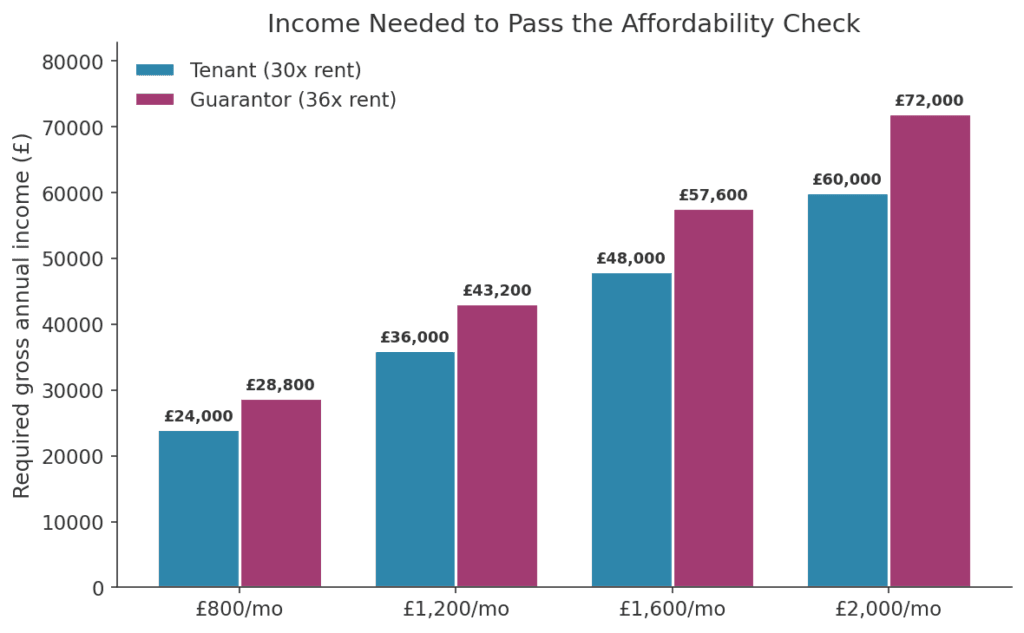
Gross annual income needed to pass the affordability check at common rent levels.
Employment and Previous Landlord References
An employer reference confirms your job, salary and how secure your position is, while a previous landlord reference reveals whether you paid on time and respected the property. These two stages tend to be the slowest, because they depend on busy people getting back to the agent. A current landlord who is glad to see you go usually replies within hours; one you are in dispute with may drag their feet.
| Check | What it confirms | Typical turnaround |
|---|---|---|
| Right to Rent | Permission to rent in England | Same day |
| Credit check | CCJs, bankruptcy and payment history | Minutes |
| Affordability | Income against the rent threshold | Same day |
| Employer reference | Job, salary and security | 1 to 3 days |
| Previous landlord | Rent history and property care | 1 to 5 days |
Landlords carry out all of this for sound reasons, as Exposed Magazine’s look at the realities of having tenants in a UK city makes plain.
What Slows Tenant Referencing Down
Delays rarely come from the credit search itself. They almost always trace back to a person who has not replied yet, or a piece of paperwork that is missing. The usual culprits are:
- An employer who is slow to confirm your salary or start date
- A former landlord who ignores the reference request
- Out of date proof of income, address or identity
- Self employed earnings that need extra evidence such as tax returns
- Overseas applicants whose status takes longer to verify
- Adverse credit that prompts a closer look
Any one of these can stretch a two day job into a fortnight.
| ⚠ Warning: Do not arrange removals or hand in notice on your current place until every check is signed off. Until then, the tenancy is not secure. |
This is where a proactive agent earns their fee. A tenant who rented through Portland Estate Agents in North West London shared on Google that the team, and Mohan in particular, kept things moving and stayed in touch the whole way, turning what can feel like a nervous wait into a smooth handover. Patient chasing of referees is often the difference between two days and two weeks.
How to Speed Up the Referencing Process
You cannot control how fast a referee responds, but you can clear almost every other obstacle before it appears:
- Gather your documents up front, including photo identification, recent payslips or bank statements, and proof of where you currently live.
- Warn your employer and current landlord that a request is on its way, and hand the agent a direct contact for each.
- Reply to forms and emails the same day wherever possible.
- If your income sits near the threshold, sort out a guarantor early so there is no last minute scramble.
Small habits like these routinely shave days off the wait.
| 💡 Pro Tip: Send the agent a single PDF with your ID, last three payslips and proof of address attached. One tidy bundle can knock a day or more off the back and forth. |
[Video: “Tenant Referencing Explained: Essential Checks Every Landlord Must Do” — https://www.youtube.com/watch?v=2woK_bj2wyU]
This short guide walks through the checks a landlord runs and why each one matters.
Speed counts for most in competitive markets. In cities with heavy demand, like the rental scene described in Exposed Magazine’s piece on Sheffield’s student driven housing market, a fast and tidy application can be the thing that wins the property ahead of other renters.
What Happens Once Referencing Is Complete
Pass the checks and the agent draws up your tenancy agreement. You will pay a deposit, capped at five weeks’ rent for most homes under the Tenant Fees Act 2019, before you collect the keys. A holding deposit, if one was taken to reserve the property, is normally put towards that first payment. One reassuring point for renters in England: you cannot be charged a fee for the referencing itself. That same Act stopped agents and landlords from passing those costs on to you.
A clean, well prepared application can clear referencing in under 48 hours, while one slow referee can stretch the same case out to a fortnight.
Once you are settled, it is worth tracking where the wider market is heading, including the shift Exposed Magazine charts in the rise of sustainable housing across the UK.
Frequently Asked Questions
Can tenant referencing be completed in 24 hours?
Yes, in straightforward cases. When you supply every document up front and your referees reply quickly, a clean application with no credit issues can be approved inside a day, though the longer window of several working days is more usual.
What happens if you fail tenant referencing?
A failed check does not always end your application. You might be asked for a guarantor, a larger deposit within the legal cap, or some rent paid in advance. The landlord can also decline and pick another applicant instead.
Can you move in before referencing is finished?
No. Reputable agents will not release keys until referencing and the right to rent check are finished and the tenancy is signed. Moving in early risks the whole agreement collapsing if something is flagged later on.
Do you always need a guarantor?
Only if you cannot meet the affordability rule on your own. Renters whose income clears 30 times the rent each month, with clean credit and solid references, usually pass without one. Students and people starting their first job often need that extra backing.
How much does tenant referencing cost the tenant?
Nothing, if you are renting in England. Since 2019, the law has banned landlords and agents from charging tenants for referencing or credit checks. The cost falls to the landlord, whether they vet applicants in house or pay a provider.
Conclusion
Tenant referencing feels like a hurdle, but for most renters it is a short one. Have your paperwork ready, give your referees a heads up, and answer quickly, and there is a strong chance you will be holding keys within the week. The checks exist to protect both sides of the deal, giving the landlord confidence and giving you a tenancy that begins on solid ground. A little preparation turns the wait from an anxious unknown into a predictable final step.
References
GOV.UK, Renting and tenant Right to Rent checks, 2026 — https://www.gov.uk/check-tenant-right-to-rent-documents
National Residential Landlords Association, A Guide to Guarantors for Residential Tenancies, 2023 — https://www.nrla.org.uk/news/a-guide-to-guarantors-for-residential-tenancies
GOV.UK, Tenant Fees Act 2019: guidance, 2019 — https://www.gov.uk/government/publications/tenant-fees-act-2019-guidance
HomeLet, How Long Does Tenant Referencing Take, 2026 — https://homelet.co.uk/tenants/tips-for-tenants/how-long-does-tenant-referencing-take
Portland Estate & Letting Agents, How Long Does It Take for Tenant Referencing in North London, 2025 — https://portlandestateagents.co.uk/letting/how-long-does-tenant-referencing-take/
Fact Check: All statistics and data points in this article were verified against original sources as of 15 June 2026. Sources are listed in the References section.