A recent graduate in a Sheffield flat looking at a laptop job application, with a framed photo of themselves in a graduation gown on the shelf behind
Every autumn, a few thousand people in Sheffield do the same thing at roughly the same time. The summer after finishing at the University of Sheffield or Sheffield Hallam has run out, the part-time bar shifts are no longer quite enough, and it is time to apply for proper jobs. They polish a CV, set up or dust off a LinkedIn profile, register with a couple of recruitment sites and then reach the small grey circle asking for a profile photo.
What goes into that circle is usually whatever is closest to hand. For a lot of recent graduates, that means the graduation photo: mortarboard slightly askew, gown over a smart shirt, a proud parent cropped out of one side. For others it is a picture from a night out on Division Street, trimmed down until only one face remains. Neither is a terrible choice, but both quietly work against the person using them.
What a recruiter actually sees
Recruiters and hiring managers look at profiles quickly. Someone filling a graduate scheme or an entry-level role in a Sheffield firm might skim dozens of profiles in an hour, and the photo is often the first thing they register before reading a name or a degree title.
In those few seconds, they are not judging whether you are attractive. They are picking up small signals about how recently the profile was updated and whether the person behind it is ready for a working environment. A clear, recent face in decent light sends those signals without effort. A picture in academic dress sends a different message: that this person’s most recent milestone is finishing university, which is exactly what everyone else on the shortlist has also done.
Why the gown photo has a short shelf life
There is nothing wrong with being proud of a degree, and a graduation picture can look perfectly respectable. The trouble is timing. In the few months after the ceremony, a gown photo reads as fresh. By the following spring, it starts to suggest that the profile has not been touched since, and by the time someone has been working for a year it looks faintly out of place.
Ceremony-day pictures are usually shot in awkward conditions, too. Ceremonies run to tight schedules, lighting in a busy hall or outdoors on a cloudy Yorkshire afternoon is unpredictable, and the pose is usually dictated by whoever is holding the camera. The result is often a squint, a slightly startled smile or a hat casting a shadow across the forehead. Fine for the family album, less helpful when the aim is to look calm and capable.
The cropped night-out photo has a different weakness. Even when it is well cropped, people can usually tell. Light from a bar gives skin a warm orange cast, the background is dark and busy, and there is often a hint of someone else’s shoulder at the edge of the frame. It says sociable, which is not a bad thing, but it rarely says professional.
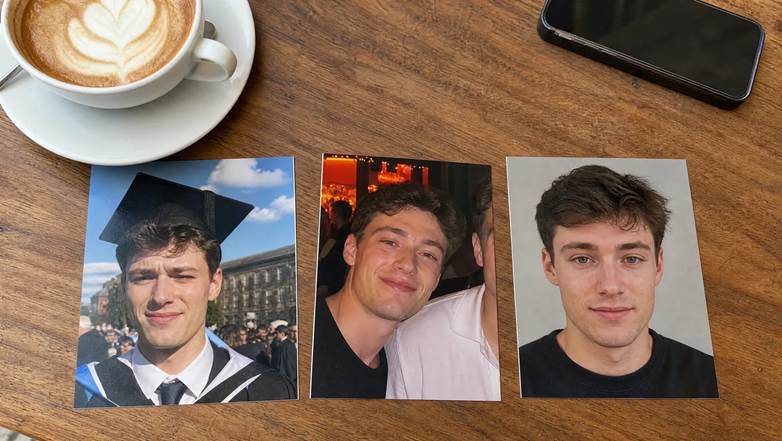
Three printed photos on a café table in Sheffield: a graduation gown shot, a cropped night-out selfie and a clean daylight portrait of the same young man
Three ways to get a better photo
The first option is a local photographer. There are plenty of portrait studios and freelance photographers around Kelham Island, the city centre and beyond, and a lot of them run quick half-hour portrait slots. The advantage is expert direction: someone will tell you to drop your chin, relax your shoulders and stop gripping your hands. The downside is cost, which can feel steep when you are still waiting for a first salary.
The second option is free and surprisingly effective if done properly. Ask a friend with a recent phone to meet you on an overcast day, which Sheffield provides generously, and stand facing an open, bright space such as a wide pavement or a park. Soft cloud cover gives even, flattering light. Keep the background simple, wear what you would wear to an interview, and take thirty or forty frames rather than five. Most people relax after the first few minutes, and the best shot is usually one of the later ones.
The third option is an AI headshot service. You upload a set of ordinary photos and the service generates studio-style portraits with different backgrounds and outfits. ProfessionalHeadshot.io is one example of an ai professional headshot tool that returns a batch of options in about half an hour, which is useful if you need something before a deadline or cannot afford a studio yet. It is worth being honest about the limits. You will still need to choose carefully, check that details such as your hairline, glasses and skin tone look like you, and discard any image that looks overly polished. The goal is a photo that someone could match to your face when you walk into an interview.
Small choices that make a difference
Whichever route you choose, a few details matter. Frame the photo from roughly mid-chest upwards so your face fills most of the circle. Look directly at the lens with a natural, slight smile. Avoid sunglasses, hats and heavy filters. Wear something plain in a colour that suits you rather than a busy pattern.
Once you have a good picture, use it everywhere you are looking for work: LinkedIn, recruitment platforms, freelance marketplaces and even the email account you use for applications. When an employer searches your name after an interview, it helps if the same face turns up each time.
A fresh start deserves a fresh photo
Leaving university is a big change, and most graduates put real effort into their CV and cover letters. The photo is a much smaller task, but it is the first thing on every profile, and it is often the first impression a Sheffield employer gets. Keep the graduation picture for the mantelpiece. For the job hunt, use something that shows the person who is ready for what comes next.