Disclaimer: This article is not intended to be a recommendation. The author is not responsible for any resulting actions of the company during your trading experience. The information provided in this article may not be accurate or up-to-date. Any trading or financial decision you make is your sole responsibility, and you must not rely on any information provided here. We do not provide any warranties regarding the information on this website and are not responsible for any losses or damages incurred as a result of trading or investing.
Opening your post and finding a letter that proposes a higher monthly figure is a stomach-dropping moment for any tenant. You are not imagining the squeeze, either. Average private rents across the UK reached £1,381 a month in the year to April 2026, a rise of 3.5% according to the Office for National Statistics.
The encouraging news is that the rules shifted firmly towards renters on 1 May 2026. Your landlord can no longer lift the figure whenever they fancy, and you hold a real right to push back. Here is a plain guide to what they can do, what they cannot, and the steps that protect your budget.
Key Takeaways
- Average UK rent reached £1,381 a month in April 2026, up 3.5% across the year.
- Since 1 May 2026, a landlord can raise rent no more than once a year.
- Any rise needs a Section 13 notice on Form 4A, served two months ahead.
- You can dispute an unfair figure at the First-tier Tribunal for a £47 fee.
- The tribunal can never set your rent above the landlord’s own proposed figure.
How a Rent Increase Actually Works in 2026
A rent increase is the formal process a landlord uses to lift the rent on an existing tenancy, and there is now only one lawful route to apply it. For a private periodic tenancy in England, your landlord must serve a statutory Section 13 notice, give you no less than two months of notice, and allow a full year to pass between rises.
The detailed rules behind a rent increase sit within the Housing Act 1988, recently reshaped by the Renters’ Rights Act 2025. Three principles shape every lawful rise:
- Frequency: rent can move upward only once in any twelve-month window.
- Notice: a written warning must reach you no fewer than two months before the new figure starts.
- Fairness: the proposed amount must reflect the open market for comparable nearby homes.
Since 1 May 2026, a landlord in England can lift your rent only once a year, and only with two months of written notice.
What the Renters’ Rights Act Changed on 1 May 2026
The Renters’ Rights Act 2025 received Royal Assent on 27 October 2025 and switched on its main provisions on 1 May 2026. The law applies in England and rewrote how rises happen for roughly 11 million private renters. Informal letters, fixed yearly hikes and contract formulas have gone, replaced by a single statutory path.
| Before 1 May 2026 | From 1 May 2026 |
|---|---|
| Rent review clauses with CPI or RPI formulas allowed | All such clauses are null and void |
| One month of notice on a Section 13 rise | Two months of written notice required |
| Fixed-term tenancies common | Tenancies roll onto a periodic footing |
| Tribunal could backdate an increase | No backdating before the hearing date |
Table 1: How the rules on raising rent changed in England.
Section 13 Notices and Form 4A
A Section 13 notice is the official document a landlord serves to propose a higher rent during a tenancy. It must now use the prescribed Form 4A, and it stands as the single valid route for raising rent on a rolling agreement. The paperwork has to set out the new figure, when it takes effect, and how you may respond.
The End of Rent Review Clauses and Fixed Terms
Contractual review clauses, including any pegged to inflation indices, lost their force on the commencement date. Wording in an older agreement that set automatic yearly hikes carries no weight now. Fixed terms also ended, so almost every existing assured tenancy rolled onto a rolling arrangement with no set end date for a landlord to rely upon.
| Good to know: A landlord can request no more than one month of rent in advance, and a deposit stays capped at five weeks of rent where the yearly rent is below £50,000, or six weeks above that level. |
How Much Can Your Rent Realistically Rise?
Rent levels climbed steadily through 2025 and into 2026, though the pace has cooled noticeably. The typical UK home now lets for £1,381 a month, and the yearly growth rate of 3.5% counts among the gentlest readings since early 2022. Where you live makes a striking difference to the figure on your tenancy.
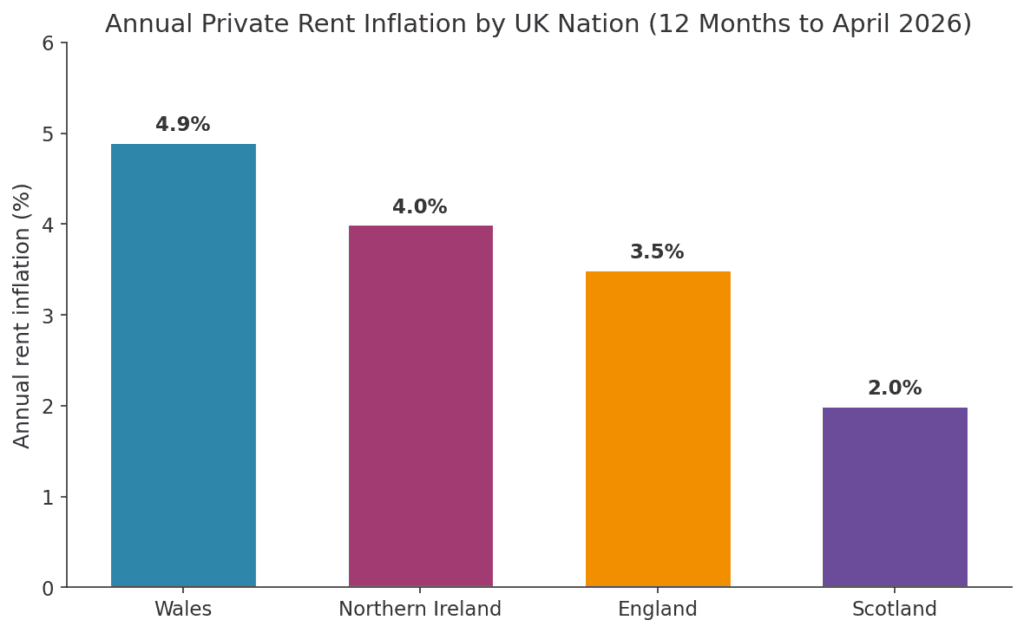
Source: ONS Price Index of Private Rents, 12 months to April 2026.
England remains the priciest nation at £1,438 a month, while Wales sits lowest at £834. You can sense-check the picture for your own area against the latest official ONS data, which breaks figures down to local level.
| Nation | Average rent | Annual change |
|---|---|---|
| England | £1,438 | 3.5% |
| Scotland | £1,019 | 2.0% |
| Northern Ireland | £877 | 4.0% |
| Wales | £834 | 4.9% |
Table 2: Average private rents and yearly change to April 2026.
Source: ONS Price Index of Private Rents, 12 months to April 2026.
Within England the gap widens further. The North East recorded the fastest annual jump at 6.5%, while London posted the slowest at 2.0%. If you are weighing up a move, our guide to what you need to know when moving to Sheffield gives a feel for how northern rents compare with the capital.
No legal ceiling exists as a percentage. The benchmark is open market rent, meaning the amount a comparable nearby property would command if advertised fresh today. A proposed figure that sails past that level is exactly what the tribunal exists to correct.
How to Challenge a Rent Increase You Think Is Unfair
You challenge a proposed rise by applying to the First-tier Tribunal, and you must act before the start date printed on the notice, usually within one month of receiving it. The panel weighs local market evidence and decides a fair figure. It cannot set your rent higher than the sum your landlord asked for, so disputing one carries very little downside.
- Read the notice closely and diarise the deadline the moment it lands.
- Gather evidence: adverts for similar nearby homes, photos of any disrepair, and your rent history.
- Apply to the First-tier Tribunal on the official form before the new rent is due to begin.
- Wait for the ruling; your revised rent starts no sooner than the date of that decision.
| Pro tip: Save screenshots of comparable local listings before you apply. Solid evidence of what similar homes actually let for is the single strongest argument that a proposed figure overshoots the market. |
The tribunal fee sits at just £47, and lodging a case delays the new rent until after the panel rules. For a calm, plain-English overview of your options, the free and impartial guidance from MoneyHelper is a reliable starting point.
Clear communication smooths the whole process. In a recent Google review, a long-standing tenant known as M.S. praised their managing agent for resolving every query “in a clear, honest manner” across three years of renting. That kind of open dialogue often means a proposed rise can be discussed sensibly before any notice is ever served.
[VIDEO: Embed a current explainer on the Renters’ Rights Act rent rules. Suggested search on YouTube: “Renters Rights Act 2025 rent increases Section 13 explained”. Place it here, after the steps, so readers can watch the process in action.]
Smart Ways to Prepare for a Possible Rise
A little homework on the local market, your budget and your tenancy type puts you on the front foot well before any notice arrives.
- Track local listings so you know the genuine going rate for your street, not a guess.
- Set aside a small buffer to cover the two-month window between notice and new rent.
- Speak to your landlord early; a figure you both agree to can beat a formal notice. If a move starts to look likely, the arrival of a TV property search show in the city is a reminder that fresh options appear all the time.
- Confirm your tenancy type, since lodgers, company lets and very high-rent homes sit outside these rules.
Supply matters too. A wave of new city-centre developments can ease pressure on local rents, while relocating cities entirely, as one Sheffield newcomer described, can reset your housing costs altogether.
| Worth remembering: You only have a short window, usually about one month, to challenge a Section 13 notice. Diarise the date the day it arrives so the deadline never slips past you. |
Frequently Asked Questions
How much can a landlord legally increase rent in the UK?
No fixed percentage cap applies. A landlord can propose any figure, yet it must match the open market rent for comparable homes in your area. If you disagree, the First-tier Tribunal can lower an excessive amount to a fair level.
How often can my rent go up?
Just once a year on a rolling tenancy in England. A landlord must leave a full year between one rise and the next, serving a fresh Section 13 notice each time after giving two clear months of notice.
How much notice must a landlord give before raising rent?
At least two months in writing, using Form 4A. That doubled the old one-month rule when the new system took effect on 1 May 2026. The notice states the new rent and the date it begins.
Can I refuse a rent increase?
You cannot simply ignore a valid notice, but you can dispute it at the tribunal before its start date. The panel sets a fair market figure and can never order a rent above the figure the landlord first put forward.
Do these rent rules apply across the whole UK?
These reforms cover England only. Scotland, Wales and Northern Ireland run separate systems, though several already restrict how and when landlords lift rents. Always check the specific rules that apply where you live.
Final Thoughts
Rent rises are now a slower, more predictable affair than they were a year ago. A landlord still has every right to keep pace with the market, yet the timing, the paperwork and the cap on frequency all tilt towards fairness for tenants. Knowing your tenancy type, watching local listings and acting quickly on any notice puts real control back in your hands. Treat the next letter through your door not as a shock, but as a process you already understand.
References
Office for National Statistics, Private rent and house prices, UK: May 2026 — https://www.ons.gov.uk/economy/inflationandpriceindices/bulletins/privaterentandhousepricesuk/may2026
GOV.UK, Guide to the Renters’ Rights Bill, 2026 — https://www.gov.uk/government/publications/guide-to-the-renters-rights-bill/guide-to-the-renters-rights-bill
MoneyHelper, What the new 2025 Renters’ Rights Act means for you, 2026 — https://www.moneyhelper.org.uk/en/blog/buy-or-rent-a-home/what-the-2025-renters-rights-act-means
Legislation.gov.uk, Housing Act 1988, Section 13 — https://www.legislation.gov.uk/ukpga/1988/50/section/13
GOV.UK, Private renting: rent increases — https://www.gov.uk/private-renting/rent-increases
Fact Check: All statistics and legal points in this article were verified against original sources (ONS, GOV.UK, legislation.gov.uk) as of 11 June 2026. Sources are listed in the References section.