Cillian Murphy has worn three different Shelby wardrobes by now — the 1919 street tailoring of series one, the boardroom pinstripes of the later seasons, and the wartime overcoats of The Immortal Man. That last one landed on Netflix in March 2026. The peaky blinders outfit men keep copying is still the first one. Baker boy cap, collarless shirt, three-piece tweed with the trousers cut short, heavy boots, a watch chain across the waistcoat — and not much else.
Thirteen years after the show first aired, that combination has outlived the series, survived a film, and turned into a menswear reference in its own right. The look breaks down into six pieces — and the history behind them is stranger than the fiction.
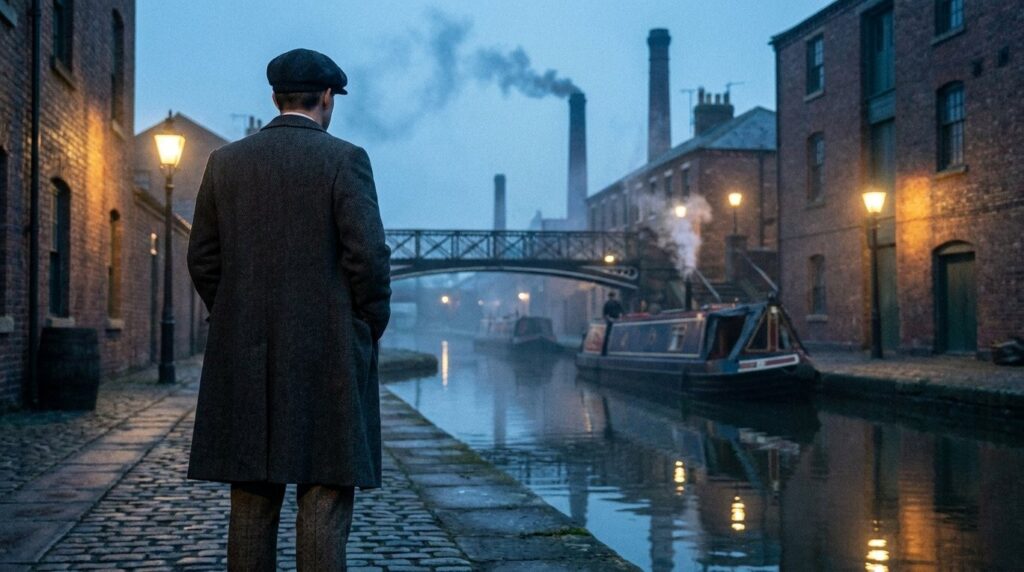
Illustration: the series-one silhouette — baker boy cap, layered tweed and a long overcoat — that still defines the look.
The Real Peaky Blinders Didn’t Dress Like Cillian Murphy
The gang was real. The wardrobe, mostly, wasn’t.
Historian Carl Chinn, who wrote The Real Peaky Blinders, points out that the actual gang ran Birmingham’s back streets around the turn of the 20th century. That puts them in the 1890s and 1900s — a full generation before the 1920s world of the show. They weren’t criminal masterminds either. Police records list offences like shop-breaking, bike theft and “false pretences”, and the mugshots of real members like Harry Fowler and Stephen McHickie show young men, some barely out of their teens, dressed with obvious care.
One eyewitness, a Birmingham manufacturer named Arthur Matthison, described the archetypal Peaky Blinder as a man who “took pride in his personal appearance and dressed the part with skill.” His uniform: bell-bottomed trousers, hobnail boots, a colourful scarf knotted at the neck, and a peaked cap with a long elongated brim. Hair cropped close, except for a quiff plastered down over the forehead.
And the razor blades? Almost certainly a myth. Safety razors were a luxury item at the time — an expensive thing to sew into a soft cap — and Chinn traces the story to a later novel, John Douglas’s A Walk Down Summer Lane, not to any court record.
The name is more mundane: “peaky” for the peaked caps, “blinder” being Birmingham slang for someone strikingly turned out. They were named for how they dressed. Which, for a style guide, feels about right.
| Element | The Shelbys (screen) | The real gang (street) |
|---|---|---|
| Era | 1919 to 1940 | 1890s to 1900s |
| Cap | Baker boy, razor sewn in (fiction) | Long-brimmed peaked cap, no razors |
| Trousers | Narrow, cropped above the boot | Bell-bottomed |
| At the neck | Collarless shirt, bar pin | Colourful knotted scarf |
| Boots | Polished leather lace-ups | Hobnail work boots |
The Six Pieces That Make a Peaky Blinders Outfit
The screen version was built by costume designer Stephanie Collie, who dressed the first series and set the template everything since has followed. Her rules were specific: a three-piece suit with “the trousers narrowed and shortened,” long heavy overcoats for what she called a “High Noon” effect. Boots were non-negotiable: “a good pair of lace-up boots that go above your ankle.”
Her reasoning was simpler still — “At heart, I think every Englishman wants to wear a suit.” Collie died in 2024, but the silhouette she drew is still the one men bring to their barbers and tailors.
The Cap Everyone Gets Wrong
Start at the top, because most people buy the wrong hat. The Shelbys don’t wear flat caps — they wear baker boy caps (also sold as newsboy caps), a rounder, fuller eight-panel cut with a button on the crown. A true flat cap sits lower and slimmer. The two get confused constantly, and the fuller shape is the one that reads “Birmingham, 1919” on sight.
The cap’s working-class charge is older than the gang. A 1571 Act of Parliament ordered every English male over six — nobility excepted — to wear a wool cap on Sundays and holidays, at a fine of three farthings a day. The point was propping up the wool trade.
The law was repealed in 1597, but the association stuck for four centuries: wool cap, working man. That’s the frequency the whole outfit broadcasts on.
Below it, the shirt does quiet work. Band-collar — often called collarless or grandad collar — usually in white or soft stripes, worn buttoned to the throat with no tie. Then the suit itself: three-piece, in tweed or herringbone with real surface texture, the waistcoat worn closed and the trousers ending high enough to show boot.
The Chain That Held the Whole Look Together
Look at any waistcoat in the show and there’s a line of silver across it. That’s an albert chain — named after Prince Albert, Queen Victoria’s consort, who popularised the style. A T-bar anchors through a waistcoat buttonhole; the watch rides in the pocket on a swivel clip.
A double albert runs chains to both pockets, leaving room for a fob or medallion in the middle. It was standard male equipment from the mid-1800s until wristwatches made pocket watches obsolete.
The format never really died, though — it moved from the waistcoat button to the belt loop. The clip-and-anchor logic of the albert survives most visibly in heavy silver wallet chains, which secure a wallet the way an albert once secured a watch. Same job, same hardware grammar, a century apart. If the full waistcoat rig feels like too much, this is the piece of the era a man can still carry daily without explanation.
A .925 sterling curb-link wallet chain on herringbone tweed — the same hardware grammar the albert ran on.
The other metal the period allowed was a ring — usually one, usually a signet, worn without ceremony by men who owned little else worth engraving. It’s the same instinct that keeps signet rings selling in 2026, a straight line from wax-seal tool to modern staple. One cap, one chain, one ring. The era kept a man’s metal count low, and that restraint is half of why the look photographs so well.
Finish with the boots — dark leather lace-ups above the ankle, built like they expect weather — and the overcoat, long and heavy enough to move like a curtain when you walk. That’s the six: cap, shirt, suit, chain, ring or pin, boots. The coat is the seventh piece for cold months, and the one Collie leaned on for drama.
What Changed in The Immortal Man?
The film jumped the wardrobe forward two decades. Peaky Blinders: The Immortal Man — directed by Tom Harper, written by series creator Steven Knight — is set in Birmingham in November 1940, during the Blitz. It premiered at Birmingham’s Symphony Hall on 2 March 2026, took a short cinema run, then hit Netflix worldwide on 20 March. Tommy Shelby returns as the former leader of the gang, and the clothes read 1940 to match: darker wools, trench-and-overcoat weight, wartime restraint in place of 1919 swagger.
The film didn’t replace the peaky blinders outfit people actually search for — it re-armed it. Keyword tools put worldwide searches for the outfit in the tens of thousands every month in 2026, and the searches climb every October as the costume crowd arrives.
The look that survives is still series-one Shelby: cap, collarless shirt, cropped tweed. Peaky blinders fashion belongs to the 1919 wardrobe, not the 1940 one. First impressions, it turns out, wear best.
Wear It in 2026 Without Looking Like You’re in Costume
The whole rig at once — cap, waistcoat, chain, collarless shirt, boots — is a Halloween costume now, and every October proves it. The way to wear peaky blinders style seriously is to break it up. One or two pieces, surrounded by clothes from this decade.
Illustration: one piece at a time — the cap and a silver chain worn against plain modern knitwear.
The cap works over a plain knit and a wool overcoat. The collarless shirt works under a modern unstructured blazer, or on its own with dark denim. The waistcoat is the riskiest piece solo — keep it for occasions that already ask for tailoring. And the metal travels best of all: a silver chain at the belt or across a waistcoat, a single signet, both era-correct and both invisible as “costume” because they never left men’s wardrobes in the first place.
Texture is the last rule. The look dies in shiny polyester and lives in wool, tweed, moleskin and worn leather. If a thomas shelby outfit is the goal for a themed night, buy cheap and commit fully. If the goal is getting dressed, buy one good piece and let it disappear into your rotation.
Peaky Blinders Outfit Questions, Answered
What did the real Peaky Blinders actually wear?
Bell-bottomed trousers, hobnail boots, a colourful knotted scarf and a peaked cap with a long brim — per Arthur Matthison, a Birmingham eyewitness. Hair was cropped short with a quiff at the front. The real gang dressed sharply for the 1890s street, but nothing like the show’s tailored 1920s look.
Is the Peaky Blinders cap a flat cap?
No — the show’s caps are baker boy (newsboy) caps: rounder, fuller, eight panels and a crown button. A flat cap is slimmer and sits lower. The two are confused constantly, so check the panel construction before you buy the hat.
Can you wear a peaky blinders outfit casually in 2026?
Yes — but only in parts. Wear one or two pieces with modern clothes: the cap over a plain knit, the collarless shirt with dark denim, a silver chain or signet ring with anything. The full six-piece rig reads as fancy dress anywhere outside a wedding or a themed event.
What jewellery goes with the look?
Keep it to silver and keep it sparse, the way the era did. A watch chain or wallet chain worn visibly, and a single signet ring. Yellow gold and stacked pieces fight the period’s restraint. One chain, one ring — that ratio is what makes the metal read 1919 rather than 2019.
The wardrobe has now done thirteen years of work across six series and a film, and it shows no sign of retiring. You don’t need all of it. Buy the cap or the chain — whichever you’ll actually use — and let the rest of the era stay on screen, where the tailoring budget is bigger than yours.
Tepparit Kacha has spent more than a decade working with sterling silver and exotic leather, and curates handcrafted men’s rings, chains and wallets at Bikerringshop.