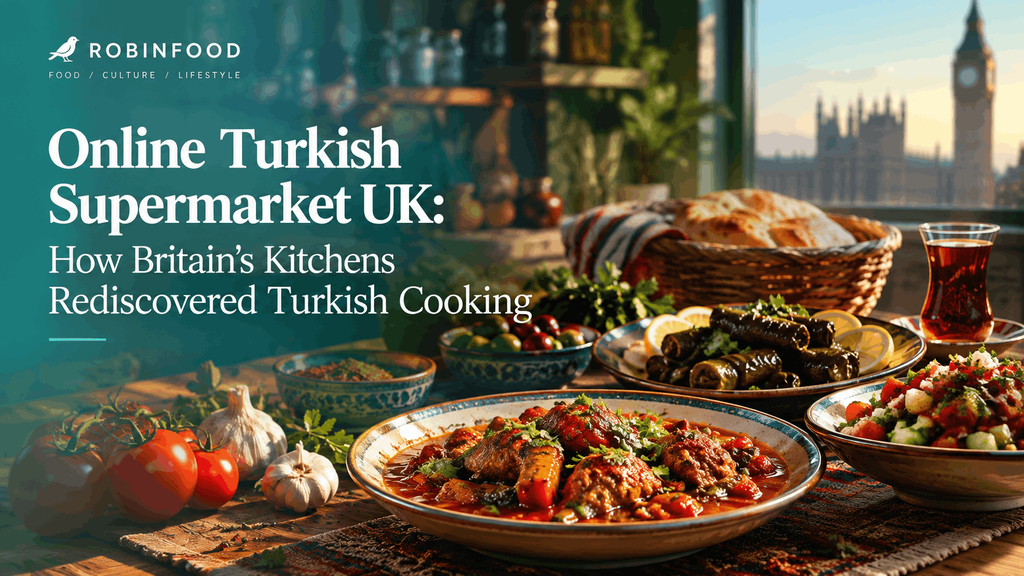
Finding an online Turkish supermarket UK shoppers can genuinely rely on has become one of the more practical questions in British food retail, and the answer says a lot about how the country eats now. Something quiet has been happening in British home cooking over the past three years. The jar of pul biber on the spice rack, the slab of white cheese in the fridge, the ring of cured sausage waiting for Sunday breakfast, these are no longer the preserve of North London’s Turkish neighbourhoods.
Why Turkish Food Stopped Being a Speciality
Turkish cuisine occupies an unusual position in Britain. It is familiar enough that almost everyone has eaten it, yet unfamiliar enough that most people have never cooked it at home. The high street kebab shop taught the country to recognise the flavours; it did not teach anyone how to build a mezze table or fry sucuk properly.
That gap is closing for two reasons. The first is demographic. The UK is home to a large and well established Turkish, Kurdish and Turkish Cypriot population, concentrated in London but spread across Manchester, Birmingham, Leeds and Glasgow. These households have always cooked this way. What changed is that they stopped having to drive to a specific street to do it.
The second reason is curiosity. British home cooks who discovered Turkish breakfast on holiday, or through social media, now want the actual ingredients rather than approximations. Supermarket feta is not beyaz peynir. Chorizo is not sucuk. The distinction matters once you have tasted the difference, and the internet made the real thing findable.
What Is an Online Turkish Supermarket UK Shoppers Can Trust?
The term covers more ground than it first appears. At the simplest end, it means a website that ships a handful of Turkish products. At the useful end, it means a full grocery operation, chilled dairy, fresh produce, a butcher counter, bakery, store cupboard staples and prepared food, delivered to the door in a condition worth eating.
A genuine online Turkish supermarket UK households order from weekly will carry the brands people actually recognise: Pınar, Sütaş, Duru, Koska, Mehmet Efendi, Ülker. Brand recognition is not snobbery in this category. It is how a shopper who grew up with these products knows the tarhana will taste right.
Three things separate a serious operation from a hobby shop. Cold chain handling, because cheese, yoghurt and cured meat all travel badly without it. Catalogue depth, because Turkish cooking assumes a pantry rather than a shopping list. And delivery speed, because nobody plans a Tuesday dinner four days in advance.
The London Advantage, and the National Problem
Anyone searching for a turkish supermarket london has options. The capital’s Turkish food scene is dense, competitive and well supplied. The harder question has always been what happens outside the M25.
This is where the online Turkish supermarket UK market has matured fastest. Operators built for national shipping now serve customers in cities with no Turkish grocer at all, and the economics finally work: consolidated cold packaging, two to three day national delivery, and free shipping thresholds that make a proper weekly shop worthwhile rather than a novelty order.
In London itself, the standard has moved further. Same day turkish grocery london delivery, order in the morning, cook that evening, has shifted these retailers from planned purchases to everyday ones. That single change is what turns an occasional shopper into a weekly one.
Halal Sourcing Is Not a Feature. It Is the Baseline.
For a large share of customers, the question of whether meat is halal is not a preference to be accommodated but a precondition for shopping at all. A credible halal butcher online uk offering means certified sourcing, transparent supply, and chilled packaging that arrives cold.
This matters commercially as well as ethically. Sucuk, pastırma and kavurma are among the highest value items in a Turkish basket, and they are precisely the products shoppers will not buy from a retailer they do not trust. Anyone selling turkish sucuk uk customers will reorder has to earn that trust first, and certification is the cheapest possible way to do it.
The same logic extends to snacks and confectionery, where halal certified sweets and biscuits have become a steady category in their own right.
The Dairy Question
If Turkish cooking has a foundation, it is dairy. Beyaz peynir, tulum, kaşar, ezine, kaymak, ayran, strained yoghurt, this is where Turkish breakfast lives and where the quality gap with mainstream retail is widest.
Shoppers looking for turkish cheese uk delivery are usually looking for something specific: a particular region, a particular salt level, a particular texture. Ezine is not interchangeable with generic white cheese, and anyone who has eaten both knows it immediately. A retailer that stocks the range rather than a single compromise product is doing the one thing a supermarket aisle cannot.
Ready Meals, Street Food and the Weeknight Problem
The newest category is also the most revealing. Turkish ready meals uk searches have climbed steadily, and the reason is straightforward: people want the food without the three hour preparation.
Lahmacun, mantı, prepared mezze, börek and traditional soups now arrive ready to heat. This is not a compromise on authenticity, most of these dishes are bought ready made in Turkey too, from bakeries and specialist shops rather than home kitchens. Bringing that habit to Britain simply closes the loop.
Street food follows the same pattern. The appeal of Turkish cooking has always been partly informal, and an online Turkish supermarket UK wide shipping network is now the most practical way to eat it on a weeknight.
How Do You Choose an Online Turkish Supermarket UK Delivery Service?
Work through five questions before placing a first order.
• Does the catalogue go deep or wide? A few hundred token products is a gift shop. A thousand or more, across dairy, butchery, bakery, produce and store cupboard, is a supermarket.
• How is chilled stock packaged? Ask, or check the delivery page. Insulated, chilled packing is the difference between cheese that arrives and cheese that arrives ruined.
• What is the realistic delivery window? London same day and two to three days nationally is the current benchmark. Anything slower narrows what you can reasonably buy.
• Is halal status stated explicitly? Vague language is a warning sign. Certification should be easy to find.
• What does delivery actually cost? Free shipping thresholds around £60 suit this category well, because Turkish shopping is a basket habit rather than a single item purchase, the average order runs to a dozen items or more.
One of the operators applying this model across both London and the wider country is Robin Food, which combines same day London delivery with a halal butcher counter, a ready to eat range and national two to three day shipping. It is a useful reference point for what the category now looks like when it is done properly.
Where This Goes Next
Two developments are worth watching. The first is apps: repeat grocery shopping is a habit, and habits live on phones rather than browsers. The second is regional expansion, the turkish grocery online uk market has been London weighted for obvious reasons, but the demand curve outside the capital is steeper than most retailers assumed.
For anyone who has been waiting for a reliable route to proper Turkish ingredients, the waiting is largely over. Reliable turkish food delivery london and nationwide is now ordinary infrastructure rather than a lucky find, which is, in the end, exactly what a supermarket is supposed to be.