A gearbox failure is one of the most dreaded repair conversations a driver can have with their mechanic. The diagnosis alone tends to cause a sharp intake of breath, and for good reason: a new gearbox fitted by a specialist is one of the most expensive individual repairs on any passenger car. The cost of replacing an automatic gearbox can range from £1,800 to £3,000 for mainstream models, with DSG and dual-clutch transmissions running from £2,000 to £3,500. Add six to ten hours of labour at rates between £50 and £120 per hour, and the total bill easily reaches a figure that prompts the age-old question: is the car worth repairing at all?
The answer to that question, for a very large number of drivers, is yes – but only if the gearbox itself can be sourced at a price that makes the arithmetic work. That is precisely where a quality used gearbox enters the picture. A second-hand unit from a low-mileage donor vehicle, properly tested and sourced from a verified seller, can cost 30 to 60% less than a new replacement, and in many cases delivers equivalent reliability over the remaining life of the vehicle. Understanding when that trade-off makes sense – and how to execute it safely – is what this guide covers.
The Cost Case: Where the Savings Come From
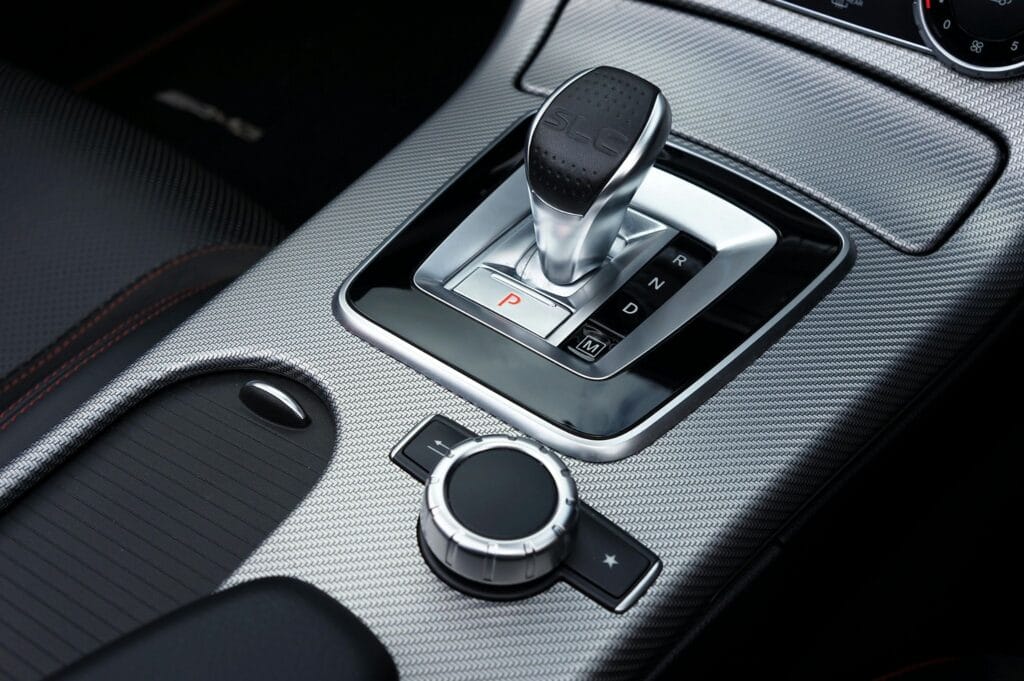
Source: https://www.pexels.com/photo/gear-lever-in-mercedes-benz-car-16188313/
The financial logic of a used gearbox is straightforward. A new or fully remanufactured automatic gearbox for a common family car typically costs between £1,200 and £2,500 for the unit alone, before labour. A quality used unit from a verified dismantler, sourced with documented mileage and test history from a compatible donor vehicle, commonly sells for £400 to £900 for the same application – savings of 40 to 60% on the part cost.
For manual gearboxes, the savings are similar in proportion though the absolute figures are somewhat lower, since new manual units tend to be cheaper than automatics. A used manual gearbox for a mainstream model in good condition typically costs £250 to £600, against £600 to £1,200 new. The savings become meaningful when combined with the labour cost, which is the same regardless of whether a new or used unit is being fitted – often £500 to £1,200 depending on the complexity of the installation and the labour rate of the workshop.
The implications compound quickly. For a car with a market value of £4,000 to £6,000, a new automatic gearbox at full dealer pricing can represent 40-60% of the vehicle’s worth – a repair that most financial advisors would suggest doesn’t pencil out. The same repair with a quality used gearbox might represent 15-25% of the vehicle’s value, which is a far more defensible calculation. This is why used gearboxes are not a niche product: they are often the economic mechanism that keeps older and mid-value vehicles on the road.
Manual, Automatic, and DSG: How the Risk Profile Differs
Not all gearboxes carry the same risk profile as used purchases, and understanding the differences between transmission types is essential before sourcing.
Manual gearboxes are the most straightforward used purchase of the three. They are mechanically simpler, contain fewer wear surfaces than automatics, and their condition is more readily evaluated. A manual gearbox from a documented low-mileage donor that shifts cleanly through all gears and shows no signs of contaminated or degraded oil is, in most cases, a reliable purchase. The main wear items – synchronisers, bearings, and selector forks – degrade gradually and relatively predictably with mileage. A unit under 80,000 miles from a well-maintained donor is generally a sound investment.
Conventional automatic gearboxes (torque converter automatics) are more complex and carry a higher risk premium as used purchases – but that risk is manageable with proper sourcing. The key variables are fluid condition (burnt, darkened, or contaminated ATF indicates internal wear or overheating damage), shift behaviour, and absence of fault codes. Automatic gearboxes from low-mileage donor vehicles that have been properly serviced – with regular fluid changes as recommended by the RAC and most manufacturer service schedules – can offer many further years of reliable service. The risk increases significantly with units over 100,000 miles or from unknown maintenance histories.
DSG, dual-clutch, and CVT transmissions are the most technically complex and command the most caution as used purchases. DSG and dual-clutch units contain mechatronic control units, clutch packs, and valve bodies that require specific servicing intervals and are sensitive to maintenance history. A DSG unit that has been properly serviced with original-grade oil at the recommended intervals is a very different proposition from one that has been neglected – and the external condition of the unit gives no indication of which scenario applies. For these transmissions, verified service records from the donor vehicle are not a luxury: they are a minimum requirement for a responsible purchase decision. CVT transmissions, with their belt or chain drive mechanisms, are similarly unforgiving of poor maintenance history and should be sourced with the same level of documented evidence.
What Good Sourcing Looks Like
The difference between a used gearbox that delivers reliable service and one that fails within months almost always comes down to the sourcing process. Specific variables determine outcome.
Donor vehicle mileage. Lower is better, with meaningful thresholds at around 60,000 miles for automatics and DSG units, and around 80,000 to 100,000 miles for manual gearboxes. These are guidelines rather than hard limits, but they reflect where wear accumulation begins to affect reliability. A well-documented 90,000-mile manual gearbox from a fleet-maintained vehicle is a more reliable purchase than an undocumented 60,000-mile unit with no service history.
Documented reason for removal. A gearbox removed from a vehicle written off due to bodywork damage in a rear-end collision is fundamentally different from one removed because it was faulty. Professional dismantlers document the reason for vehicle disposal; sellers who cannot explain why the donor vehicle was dismantled are providing no basis for confidence in the component’s condition.
Fluid condition. Before purchasing, ask the seller to confirm the condition of the transmission fluid. Clean, correctly coloured ATF (bright red in a healthy automatic, typically dark brown-gold in a healthy manual) indicates proper lubrication. Dark, burnt-smelling, or milky fluid indicates degradation, overheating, or water ingress respectively – any of which should be disqualifying. Metal shavings or particles in the fluid are a definitive red flag: they indicate active internal component breakdown.
Tested and verified. The strongest possible evidence of a used gearbox’s condition is documented testing. Professional dismantlers who remove gearboxes from running vehicles and test shift behaviour before sale are offering a meaningful quality indicator. A listing that states the gearbox was “removed from a running vehicle,” documents the mileage, and describes verified shift behaviour across all gears is a substantively different product from one that simply describes the unit as “used – good condition.”
Fault codes. For automatic, DSG, and modern electronic manual gearboxes, ask the seller whether the unit has been scanned for fault codes before removal or after bench testing. The absence of stored transmission fault codes is a meaningful positive indicator. Stored codes – particularly those related to solenoids, pressure sensors, or the mechatronic unit on DSG transmissions – indicate problems that may not be apparent from a basic shift test.
The Inspection Checklist
For buyers collecting a used gearbox in person, or for a mechanic inspecting one before installation, the following checks provide the most useful information about the unit’s condition.
External inspection. Check the casing for cracks, significant corrosion, or damage to mounting points. Minor surface rust is expected; cracks in the casing or damaged bell housing flanges are disqualifying. Check the output shafts and input shaft for straight rotation without resistance or rough bearing feel. Look for evidence of previous leaks – oil staining around seals or drain plugs can indicate seal wear.
Fluid check. Remove the drain plug or dipstick (where accessible) and evaluate the fluid. The condition criteria described above apply: colour, smell, and the presence or absence of metallic particles are the three most informative indicators of internal health.
Shift mechanism. For a manual gearbox, physically engage each gear through the shift mechanism and confirm clean engagement without roughness, jumping out, or resistance. Gear synchronisers that are worn produce a grinding resistance on engagement; selector forks that are bent or worn cause gears to disengage under load.
Input shaft rotation. Manually rotate the input shaft and listen and feel for smooth, consistent rotation. Any roughness, grinding, or irregular resistance indicates bearing wear or internal damage.
According to London Motorsports, a specialist gearbox centre, labour costs for gearbox replacement in the UK typically run between £300 and £1,200 depending on the vehicle and transmission type, with the job taking six to ten hours on most passenger cars. This means the total cost of a used gearbox installation – part plus labour plus new consumables – needs to be calculated in full before the sourcing decision, not just the unit price.
What to Fit Alongside a Used Gearbox
Source: https://www.pexels.com/photo/black-manual-gear-stick-91152/
A critical and frequently overlooked aspect of a used gearbox installation is the ancillary components that should always be replaced new, regardless of the apparent condition of the used unit.
For any gearbox replacement – new or used – the following should be treated as standard: fresh transmission fluid of the correct specification for the vehicle (not a generic grade, and particularly not the wrong type for a DSG or CVT, which can cause immediate damage); new input shaft seal and output shaft seals, which are inexpensive and prevent leaks that would otherwise require disassembly to rectify; a new sump gasket or transmission pan gasket; and, for automatics, a new transmission filter where applicable.
For a vehicle with a manual gearbox, the clutch assembly should be assessed at the same time. Since accessing the clutch requires the same disassembly as fitting the gearbox, replacing a clutch that has 60,000 or more miles on it at the time of gearbox installation is a sound preventive investment – one that avoids repeating the labour cost within a year if the clutch reaches the end of its life shortly after.
These ancillaries typically add £80 to £250 to the total cost of the job. Their omission is the single most common reason that otherwise good used gearbox installations develop problems in the first months of service.
When a Used Gearbox Is the Right Answer
The strongest case for a used gearbox is an older or mid-value vehicle facing a transmission failure whose repair cost with a new or remanufactured unit approaches or exceeds the vehicle’s market value. In this scenario, a quality used unit at 40-60% of the new price makes the repair viable and extends the vehicle’s service life – often by many years, since a gearbox that accounts for most of the vehicle’s mechanical complexity will, once replaced, typically run without further major transmission work for a substantial period.
Used gearboxes are also the practical solution for models whose gearboxes are no longer produced new, or where the manufacturer’s unit has been superseded and the original specification is unavailable except from donor vehicles. For older vehicles or limited-production models, the used market is often the only realistic route to a period-correct or specification-correct replacement.
Platforms like OVOKO aggregate tested used gearboxes from verified European dealers, with VIN-based compatibility filtering, documented donor mileage, and explicit warranty terms – providing the transparency and traceability that make this category of used part a reliable purchase when the right information is in place. For buyers who need to search beyond local availability, access to pan-European inventory substantially increases the chances of finding the right unit from the right donor vehicle at the right mileage.
When to Think Twice
A used gearbox is not always the right answer. For vehicles where the transmission failure is symptomatic of a broader mechanical deterioration, addressing the gearbox without assessing the overall mechanical condition of the car is an incomplete solution. A vehicle with a failed gearbox, failing engine mounts, a tired engine, and corroded ancillaries is not necessarily worth the combined repair investment even if the gearbox sourcing is cost-effective.
For very recent vehicles where the residual warranty – manufacturer’s or extended – covers transmission failures, a used replacement may void that coverage; new or remanufactured units from approved suppliers are the appropriate route in that scenario.
And for drivers who do not have access to a mechanic they trust to properly install and adapt the gearbox to the vehicle – particularly for DSG and modern automatic units that may require software adaptation after fitting – the used gearbox purchase should be part of a conversation with that mechanic before the order is placed, not a unilateral decision made in advance. The best unit in the world produces a poor outcome if the installation is done incorrectly or the adaptation step is skipped.
Done correctly, with the right information and from the right source, a used gearbox is one of the most cost-effective major repairs available to any vehicle owner.