Fashion tends to be discussed in terms of colour, cut, and silhouette. The pieces that sit on the body, the earrings, the bracelets, the pendants, are usually treated as finishing touches. Something added at the end, after the real decisions have already been made.
But jewellery has never been just decoration. For centuries, the symbols women choose to wear have carried meaning that runs far deeper than aesthetics. And those symbols, more than most people realise, have quietly influenced how women put themselves together.
When a Shape Carries More Weight Than a Style
A plain gold chain is a piece of jewellery. A pendant shaped like a cross, a clover, or an initial is something else. It is a statement about identity, belief, heritage, or intention, communicated without a single word.
This distinction has shaped jewellery choices across cultures for thousands of years. In Celtic traditions, the three-leaf clover was considered sacred, representing earth, sea, and sky. Victorian women wore four-leaf clover motifs in lockets and brooches as symbols of luck and love. In Japan, the clover carries associations with romantic fortune. Across all of these contexts, the appeal was never purely visual. It was personal.
That same impulse is visible today. Women are not simply choosing jewellery that looks good. They are choosing pieces that mean something to them, and building their outfits around those choices rather than the other way around.
The Clover as a Modern Symbol
Few motifs demonstrate this better than the four-leaf clover. Each leaf has been traditionally associated with faith, hope, love, and luck. Finding a real one is rare, roughly one in every five thousand clovers has four leaves, and that rarity has kept the symbol relevant across generations.
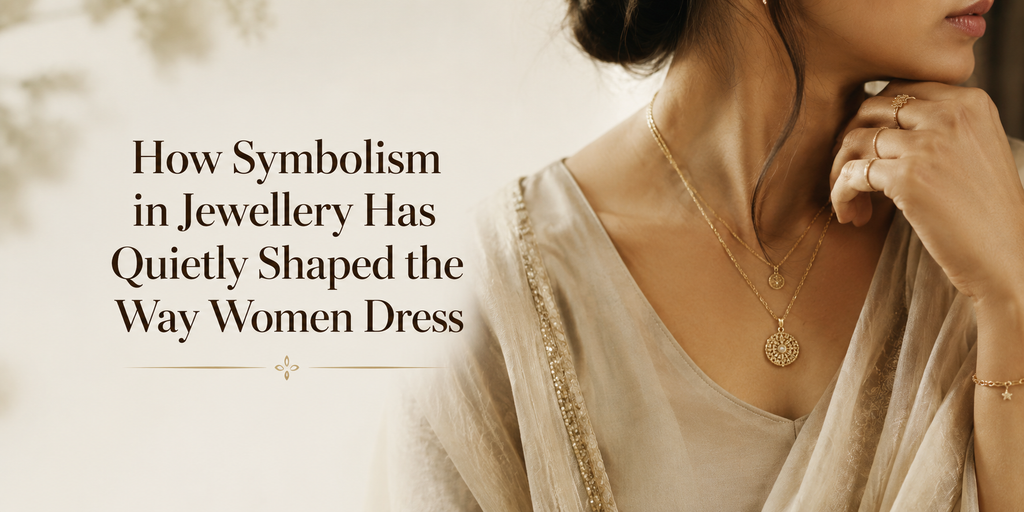
What has changed is how it is worn. A century ago, a clover might have appeared in a brooch pinned to a lapel. Today, the same symbol is more likely to sit against the collarbone as a pendant. A clover necklace worn daily becomes part of the wearer’s identity rather than a decorative accent. It is the piece she does not take off, the one she reaches for before deciding what to wear, and the outfit forms around it.
That reversal, jewellery first, clothing second, is a quiet but significant shift in how personal style is constructed.
Italian Charms and the Art of Wearable Storytelling
Not all symbolic jewellery relies on a single motif. Some pieces are designed to accumulate meaning over time.
The Italian charm bracelet, which originated in the late 1980s in Arezzo, introduced a completely different approach to personal jewellery. Instead of dangling charms on a chain, Italian designs used flat, interlocking modular links, each one replaceable, each one customisable. The bracelet became a kind of wearable narrative, built link by link as the wearer moved through life.
A link added after a trip abroad. Another for a milestone birthday. One with initials, another with a symbol that only the wearer fully understands. Over time, an Italian charm bracelet stops being a single purchase and starts functioning as a personal archive, a visual record of moments that mattered, carried on the wrist every day.
This concept resonated widely when it first appeared and has seen a strong resurgence recently. The appeal is not nostalgia. It is the idea that jewellery can grow with you, rather than remaining static.
Why Symbolic Pieces Change the Way an Outfit Feels
There is a practical styling effect to wearing something meaningful. A woman who puts on a necklace that represents something she values carries herself differently than one who grabbed the nearest chain from a jewellery box. The outfit might be identical, but the intention behind it is not.
Symbolic jewellery also tends to create consistency in personal style. When one piece stays constant, the same pendant, the same bracelet, it becomes an anchor. Everything else can change around it, and the look still feels cohesive because there is always a fixed point that ties it together.
This is why so many women describe their most meaningful piece of jewellery as something they “never take off.” It is not laziness. It is the opposite. That piece has become the foundation of their personal style, and removing it feels like removing part of the outfit’s identity.
The Cultural Thread That Connects All of It
Whether it is a Celtic clover, an Italian charm link, a religious pendant, or a family heirloom, the pattern is the same. Women are drawn to jewellery that tells a story. And the stories those pieces tell end up influencing everything around them, the neckline chosen to frame a pendant, the sleeve length that shows a bracelet, the earring that sits against a particular hairstyle.
Fashion commentary rarely credits jewellery with that kind of influence. But the women who wear these pieces know it instinctively. The symbol comes first. The outfit follows.