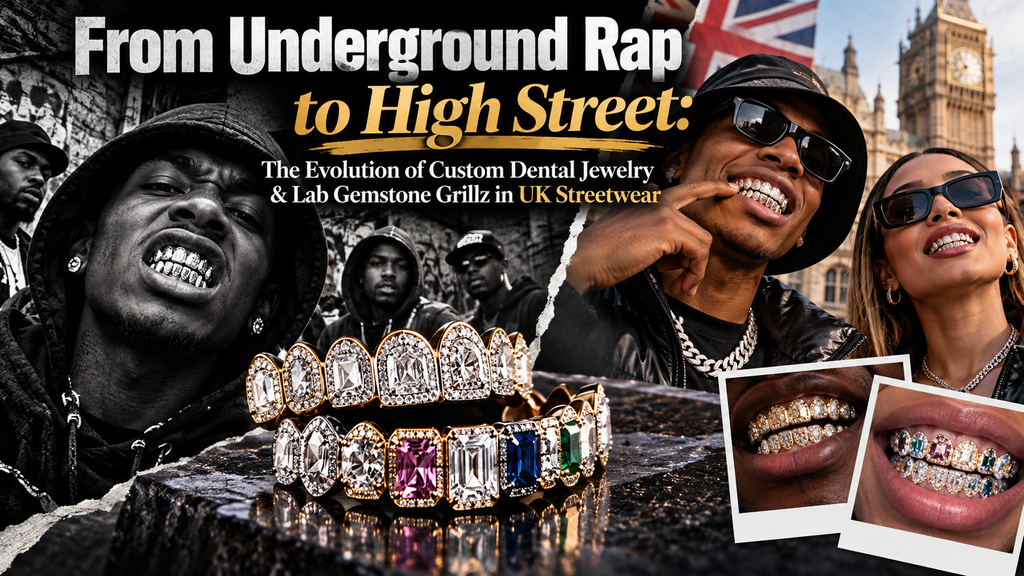
Dental jewelry once belonged almost exclusively to pirate radio studios, underground cyphers, and gritty warehouse raves across London, Birmingham, and Manchester. For decades, gold caps and diamond fronts served as an unapologetic badge of defiance, heavily influenced by Southern hip-hop pioneers in the US but recontextualized by the raw aesthetics of UK grime and drill.
Today, that narrative has shifted dramatically. Custom dental pieces have stepped out of subcultural niches and into luxury editorial spreads, London Fashion Week runways, and everyday high-street streetwear. What was once seen as counter-cultural rebellion is now recognized as one of the most technical, expressive art forms in modern fashion.
The Subcultural Roots: Grime, Drill, and the London Shift
During the early 2000s, grime artists wore solid yellow-gold pull-outs and single-tooth caps as localized status symbols. Unlike the iced-out, oversized fronts prevalent in American rap, the UK aesthetic favored a sharper, utilitarian edge—open-face canines, subtle silver trims, and minimalist silver-tooth caps that complemented tracksuits, windbreakers, and technical outerwear.
As UK drill and rap gained mainstream dominance through artists like Skepta, Central Cee, and slowthai, the culture surrounding teeth jewelry matured. The conversation expanded from simply flashing gold to curating individual identity. Grills became bespoke facial adornments, treated with the same design nuance as high-end eyewear or designer leather accessories.
The Lab Gem Revolution: Performance Meets Accessibility
The recent surge in grill popularity isn’t solely driven by music—it is propelled by a technological shift in modern metallurgy and lab-grown stones.
Mined diamonds, long the standard for setting pavé fronts, carry two major drawbacks: extreme price inflation and frequent ethical ambiguities surrounding sourcing. Streetwear enthusiasts and conscious collectors have increasingly turned toward lab-grown alternatives, particularly high-grade moissanite.
With a higher refractive index (2.65–2.69) and greater fire dispersion than diamond, moissanite offers intense visual brilliance under direct flash and streetlights. Moreover, testing at 9.25 on the Mohs hardness scale, it withstands daily wear without clouding or scratching, making it an ideal candidate for oral jewelry.
Precision Craftsmanship and Dental Safety
The modern shift toward lab gemstones has forced jewelers to abandon one-size-fits-all molds. Because teeth are dynamic and living structures, poorly fitted caps risk enamel wear, gum irritation, and bite misalignments. Contemporary dental jewelry demands a bridge between traditional bench jewelery and dental lab science.
When selecting oral jewelry, material safety and setting precision are critical. Ateliers like VVS Lab Jewelry have introduced medical-grade casting methods to ensure custom caps fit cleanly without affecting dental alignment. Utilizing food-safe dental alginate impression kits, 3D laser-scanning, and computerized CAD designs, artisans can map every micro-contour of an individual’s dentition before stone-setting begins.
Stones must be microscope-set in solid 925 sterling silver, 10k, 14k, or 18k solid gold. Prongs are rounded flat to eliminate rough edges that could snag lips or oral tissue, balancing visual fire with functional, wearable comfort.
Current Trends: From Single-Tooth Accents to Full Honeycomb Sets
Today’s streetwear styling treats grillz with versatile modularity. Rather than locking into a permanent look, collectors rotate pieces based on the fit and occasion:
· Open-Face Canines & Frames: Minimalist window cuts framing the natural tooth enamel in polished silver or rose gold.
· Bridge Bars & Gap Fillers: Sleek horizontal bars that bridge incisors or fill natural diastemas, creating sharp, graphic facial lines.
· Deep-Cut Honeycomb Sets: Maximum-coverage pieces where lab stones are pavé-set in tight hexagonal matrices, maximizing surface fire while keeping metal visibility minimal.
· Mixed-Metal Contrast: Pairing white-gold caps with yellow-gold canines to complement layered chain necklaces and mixed-metal watches.
From honeycomb pavé layouts to subtle single-tooth accents, exploring a dedicated bespoke moissanite teeth grillz collection highlights how contemporary creators are achieving high-refractive sparkle while retaining everyday comfort.
How to Maintain Custom Dental Jewelry
To preserve mirror finishes and prevent hygiene issues, follow proper daily care protocols:
1. Clean After Every Wear: Soak pieces in warm water with mild, antibacterial soap. Gently scrub setting crevices with a soft-bristled baby toothbrush to remove plaque and saliva residues.
2. Never Smoke or Eat While Wearing: Food particles lodge easily behind caps, causing rapid bacterial buildup against enamel. Smoke can tarnish silver-based alloys over time.
3. Store in a Ventilated Case: Once thoroughly dried with a microfibre cloth, place the set in a lined hard case to prevent surface scratching and moisture retention.
4. Avoid Harsh Chemical Cleaners: Do not clean gem-set dental jewelry with standard chemical metal cleaners or bleach, as these can strip plating and irritate mucosal tissue.
Custom dental jewelry has redefined personal ornamentation in contemporary UK fashion. By combining digital dental modeling, conscious gemstone selection, and bold street aesthetics, modern grillz are no longer just an underground statement—they are a permanent fixture of bespoke self-expression.