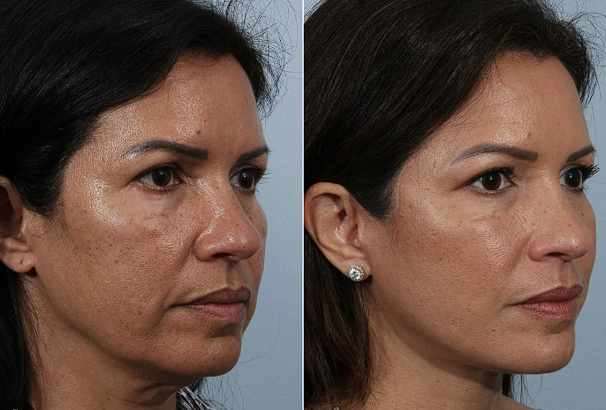
A particular kind of patient has become common in the last couple of years. They have lost a significant amount of weight, often with the help of medication, they feel better than they have in years, and they cannot work out why their face looks a decade older than it did when they were heavier. Friends tell them they look tired. Photographs they used to like now feel unrecognisable.
What they are describing is real, and it is worth understanding properly before anyone starts talking about surgery, because the face after weight loss has usually developed two separate problems and they do not have the same solution.
The first is volume. Fat in the face is not a single layer, it sits in distinct compartments around the cheekbone, the temple, the area under the eye and along the jaw. Those compartments give a younger face its fullness and its light. When you lose weight quickly, the face loses fat along with everywhere else, and it comes out of those compartments in a way that reads as hollow rather than slim. The temples sink slightly. The cheeks flatten. Shadows appear under the eyes that were never there before.
The second is laxity. The skin and the deeper soft tissue that were draped over the old volume are still there, and skin that has been stretched for years does not shrink back to fit. What was supported from underneath now has nothing holding it up, so it descends. That is where the jowling and the loss of the jawline come from.
Most people arriving in a consultation after major weight loss have some of both, and the proportion is different in every face. That proportion is what decides whether surgery helps them, and which surgery.
What a deep plane facelift actually does
A deep plane facelift in London or anywhere else is an operation that addresses the second problem rather than the first.
The technique works underneath the muscle layer of the face. The surgeon releases the retaining ligaments that tether the facial soft tissue to the bone beneath it, then lifts and repositions that tissue as one unit, with the skin travelling along with it rather than being pulled separately. Because the result is held by the deeper layer, the skin is laid back down without tension.
That distinction matters enormously for a post weight loss face. An operation that relies on pulling the skin tight has very little to work with when the skin has already lost its elasticity, and the result tends to relax quickly. Releasing and repositioning the deeper tissue gives a more durable change in a face where the support structure has genuinely descended.
What it does not do is put volume back. Repositioning hollow tissue gives you hollow tissue in a better position. If your main complaint is that your face looks drawn and tired rather than that it has dropped, a facelift on its own will not fix what is bothering you, and it may even emphasise it by tightening a face that is already short of fullness.
So what fixes the gaunt look
Volume is replaced rather than lifted, and the usual answer is fat transfer. Fat is harvested from somewhere on the body, processed, and placed into the facial compartments that have emptied. Where it takes, it stays, which is the main reason it is preferred to filler for this particular problem. Filler is a reasonable short term option for mild cases, but replacing substantial facial volume with repeated filler appointments is expensive, temporary, and tends to produce a heavy look over time rather than a natural one.
In practice the two procedures are frequently done together in a post weight loss face, because the two problems are present together. The lift restores the position, the grafting restores the fullness, and neither alone would have been enough.
Timing matters more than people expect
The single most common mistake is operating too early.
If your weight is still moving, your face is still changing, and a result that looks right today may look loose or overfilled in six months. Surgeons generally want to see weight stable for a period of months before planning facial surgery, and that is not caution for its own sake. Grafted fat survives in proportion to the environment it is placed into, and further weight loss afterwards will take some of it with it.
The same applies to anyone still actively on weight loss medication who has not reached their intended target. There is no benefit to rushing a decision that is going to last ten years to save three months of waiting.
Who it suits, and who it does not
A deep plane facelift tends to help most when the dominant complaint is descent rather than deflation. If the jawline has softened, the tissue below the cheek has dropped, and the neck has lost definition, there is something to reposition and the operation does what it is designed to do.
It helps least when the face is simply emptier than it was and the underlying structure is still roughly where it belongs. That face needs volume, not tension, and lifting it will not produce the change the person is hoping for.
Anyone still losing weight, anyone whose expectations run to looking like they did at thirty rather than looking rested at fifty five, and anyone unwilling to stop smoking for the required period before and after surgery is better served by waiting or by doing something else.
What to ask in a consultation
Ask the surgeon to tell you, looking at your face, how much of what bothers you is position and how much is volume. A good answer will be specific about your face rather than general about the procedure, and it will name both components honestly rather than steering everything toward the operation they prefer doing.
Ask what happens if you lose or regain weight afterwards. Ask what the plan is if the volume problem turns out to be the larger one. And ask to see results from patients who came to them in the same situation you are in, because a facelift performed on a face that has lost forty kilos is a different problem from one performed on a face that has simply aged.
The honest answer to the question in the title is that a deep plane facelift fixes the sagging and does very little about the gauntness. Knowing which of the two is actually troubling you is most of the decision.