Disclaimer: This article is not intended to be a recommendation. The author is not responsible for any resulting actions of the company during your trading experience. The information provided in this article may not be accurate or up-to-date. Any trading or financial decision you make is your sole responsibility, and you must not rely on any information provided here. We do not provide any warranties regarding the information on this website and are not responsible for any losses or damages incurred as a result of trading or investing.
When you should skip the food trial and see a vet
Most itchy dogs just feel miserable, but your dog needs a vet, not a new kibble, if any red-flag symptom shows up.
Call your clinic right away if you notice any of the following:
- Oozing, bleeding, or foul-smelling skin lesions: so-called “hot spots” can balloon from a coin-size patch to a palm-size wound within hours
- Ears that feel hot, hurt to touch, or leak discharge: untreated otitis may rupture blood vessels and leave you paying for aural-hematoma surgery
- Swelling of the face or muzzle, or sudden hives: airway swelling can block breathing and trigger life-threatening anaphylaxis
- Scratching so frantic your dog cries out or can’t rest
- Sudden vomiting, severe diarrhoea, collapse, or any obvious distress
These problems escalate fast. Waiting to “see whether the new food helps” can turn a treatable flare into an emergency bill. Once your vet rules out infection, parasites, or allergic shock, you can circle back to diet with a clearer and safer starting point.
Quick comparison: find your best starting point
Stop scrolling. This one matrix shows what each vet-only food does, what it costs today, and the trade-off you should weigh before you click “Checkout.”
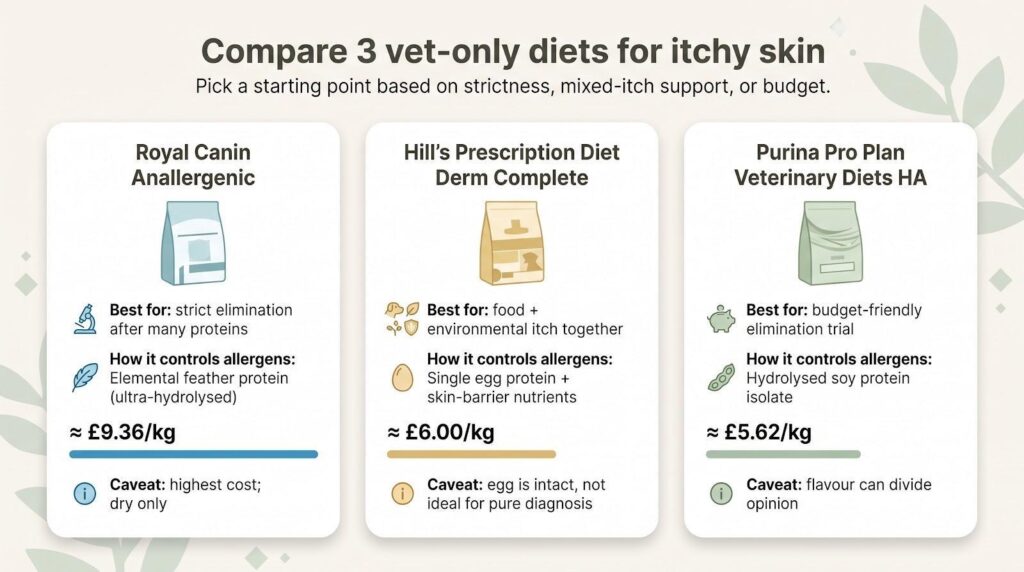
| Product | Best for | How it controls allergens | Live UK price* | Main caveat |
| Royal Canin Anallergenic | Formal elimination after many protein exposures | Ultra-hydrolysed feather amino-acid blend (elemental) | £74.89 for 8 kg ≈ £9.36/kg | Highest cost; dry only |
| Hill’s Prescription Diet Derm Complete | Dogs with food-plus-environment itch | Single intact egg protein plus skin-barrier nutrients | £81.89 for 12 kg ≈ £6.82/kg | Egg is intact, so not ideal for pure diagnosis |
| Purina Pro Plan Vet Diets HA | Budget-smart first elimination trial | Hydrolysed soy isolate kibble | £61.79 for 11 kg ≈ £5.62/kg | Flavour can divide opinion |
*Prices checked August 5, 2026 on Pets at Home online. Promo deals change quickly, so tap “Refresh” before you buy.
If you already suspect a food allergy, start with the first row. Need one diet that calms both pollen and food flare-ups? The middle option tackles skin and gut in the same bowl. Watching your budget but still want a controlled trial? The last choice keeps costs down without ditching veterinary safeguards.
Putting ‘hypoallergenic’ in context
Brands often plaster hypoallergenic on the bag, yet in the United Kingdom the term carries no legal definition; any maker can use it on single-protein, grain-free, or hydrolysed recipes, according to the UK ingredient glossary All About Dog Food. That is why the label alone rarely predicts success in an allergy trial.
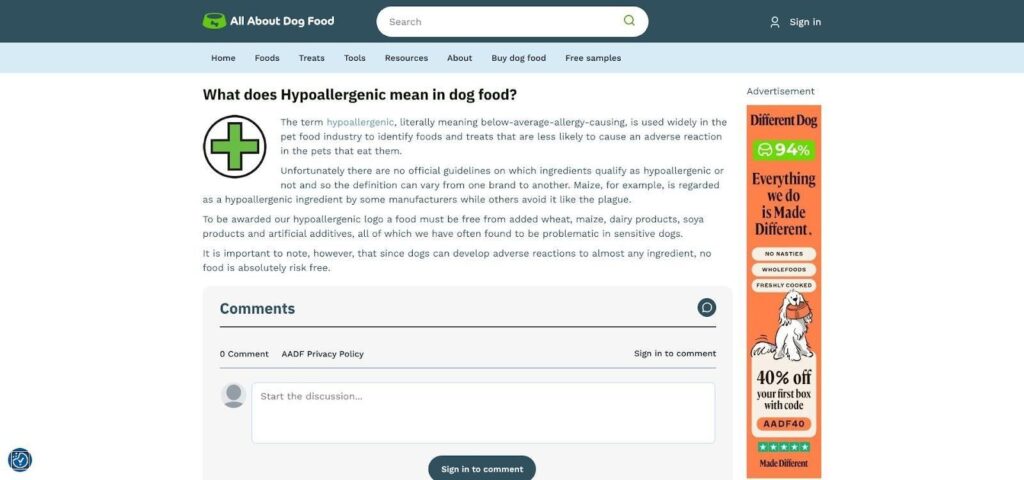
UK Hypoallergenic Dog Food Term Definition Screenshot
Prefer a plant-based approach? The Bramble guide on what to feed dogs with food allergies notes that many “hypoallergenic” vet diets are still ultra-processed and packed with animal by-products, a mix that can keep sensitive guts churning even after the main protein trigger is gone. By replacing every familiar animal protein with gently cooked plant ingredients, the menu can settle mild flare-ups without the usual fillers. Clinical studies, however, show that hydrolysed or elemental veterinary diets control hidden allergens more reliably. Both viewpoints matter, and your vet can help you match theory with evidence.
Bottom line: a salmon-and-sweet-potato kibble marked hypoallergenic is not the same tool as an ultra-hydrolysed prescription diet. Knowing that difference saves time, money, and, most important, your dog’s skin.
Which food should you choose first?
- Royal Canin Anallergenic is the strict reset. Its ultra-hydrolysed feather protein has proved reliable in blinded elimination trials. A 2016 crossover study found no pruritus flare in chicken-allergic dogs fed the feather formula, while 40 percent flared on a larger-peptide control diet.
- Hill’s Prescription Diet Derm Complete helps when food sensitivity and spring-time pollen team up. One egg protein plus omega-3s and skin-barrier nutrients tackle both triggers in the same bowl. Hill’s reports that 82 percent of owners saw less itching in dogs with environmental sensitivities.
- Purina Pro Plan Veterinary Diets HA is the cost-smart option. Hydrolysed soy keeps antigen size small, and the 11 kg bag (about £5.62/kg) makes it easier to fund a full six-week trial. In a study of soy- or corn-allergic dogs, nearly 80 percent had no adverse reaction after two weeks on a highly hydrolysed soy diet.
How we ranked the best dog food for itchy skin
First, we built a 100-point rubric around recognised veterinary standards, then weighed each factor by how much it matters in a real allergy work-up:
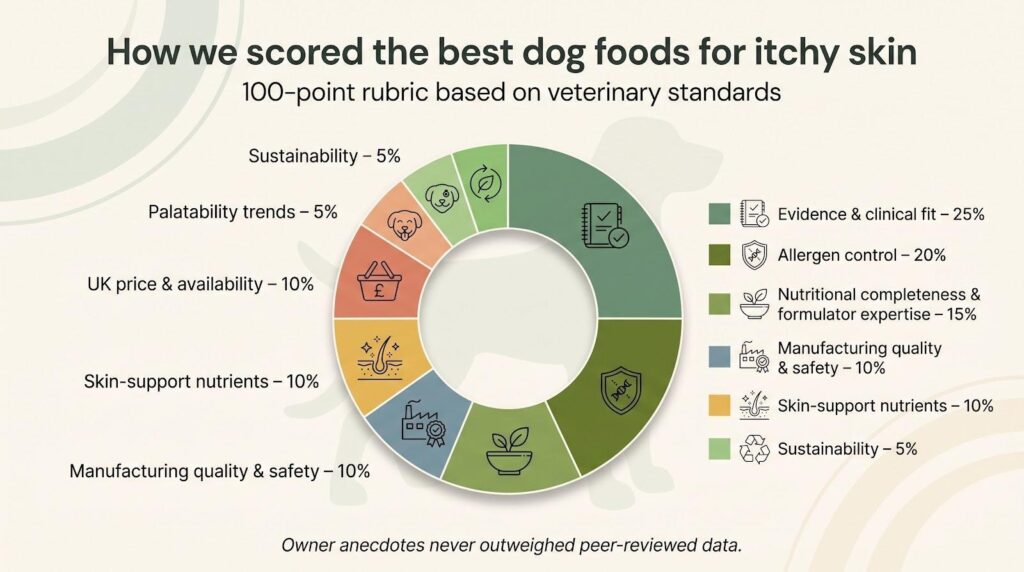
- Evidence and clinical fit – 25 percent
Peer-reviewed trials or long-standing veterinary use had to show that the food can diagnose or calm allergic skin. Pure marketing claims scored zero. - Allergen control – 20 percent
We checked protein source (ultra-hydrolysed, hydrolysed, intact), factory segregation, and recent batch-test data. Fewer intact proteins and dedicated lines meant higher scores. - Nutritional completeness and formulator expertise – 15 percent
Each recipe had to meet the 2025 FEDIAF adult-dog guidelines, and the manufacturer had to employ or consult a board-certified nutritionist, criteria adapted from the WSAVA food-selection checklist. - Manufacturing quality and safety – 10 percent
Public recall history, ISO or HACCP certification, and transparent quality-control reporting were rewarded. - Skin-support nutrients – 10 percent
Therapeutic levels of EPA/DHA, linoleic acid, zinc, and antioxidants earned extra points but never outweighed allergen control. - UK price and availability – 10 percent
We used August 5, 2026 retail prices to compare cost per kilogram and removed foods with chronic stock issues. - Palatability trends – 5 percent and sustainability – 5 percent
Owner-reported acceptance and verifiable sourcing or packaging initiatives rounded out the score.
Every score traces back to a published label, a peer-reviewed trial, or a live United Kingdom retail listing.
Important terms before the reviews
Allergy jargon can pile up, so here are four keywords you will see in this guide and why they matter.
Hydrolysed.
The protein (soy, poultry feather, and similar sources) is enzymatically cut into smaller peptides, often less than 10 kDa, so the immune system is less likely to recognise them as threats.
Elemental or amino-acid.
Ultra-hydrolysed diets go one step further, leaving mostly free amino acids. Royal Canin Anallergenic sits in this lane; think of it as powdered protein for dogs that have reacted to several meats.
Novel protein.
A protein is novel only if your dog has never eaten it and the recipe is free of extras such as chicken fat. Duck stops being novel the moment duck treats reach the bowl.
Sensitive-skin.
A marketing term, not a diagnostic standard. Because hypoallergenic has no legal definition in the United Kingdom, brands can apply it to anything from grain-free salmon to basic limited-ingredient kibble. Useful for mild itch, but too loose for a true elimination trial.
Keep these definitions handy; they will turn the upcoming product breakdowns from alphabet soup into a roadmap you can follow with confidence.
1. Royal Canin Anallergenic – best for a strict elimination diet
Quick verdict (about 30 words).
Need a clean slate? Anallergenic’s ultra-hydrolysed feather protein, with peptides under 10 kDa, showed high diagnostic reliability in blinded trials and retails at £74.89 for 8 kg, or £9.36 per kg.
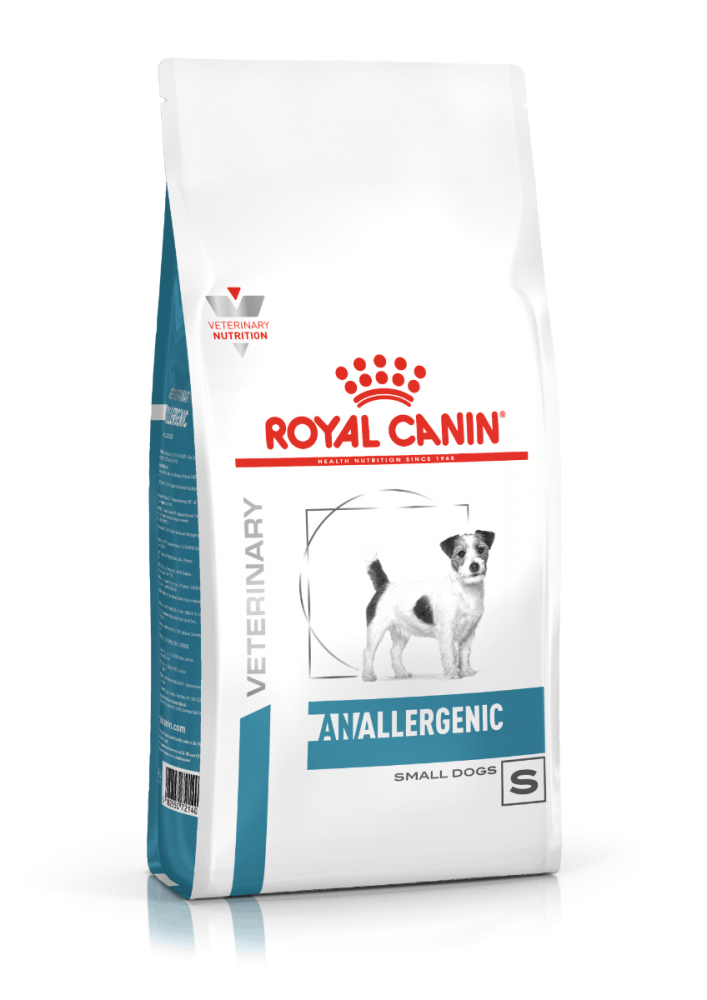
Royal Canin Anallergenic Prescription Dog Food Bag Photo
Why it ranks first.
In United Kingdom dermatology clinics this diet is the reference standard for elimination tests. A 2016 blinded crossover study found no pruritus flare in chicken-allergic dogs fed the feather formula, while forty percent flared on a larger-peptide control diet.
How the formula controls allergens.
- Protein is reduced to free amino acids and tiny oligopeptides, making it nearly invisible to IgE antibodies.
- A dedicated production line limits cross-contamination, a key WSAVA trust factor.
Ingredient panel in plain English.
Low-molecular-weight feather hydrolysate supplies free amino acids and oligopeptides, maize starch supplies energy, and copra (coconut) oil supplies fat, alongside soya oil, fish oil, chicory pulp, and a vitamin-mineral blend that meets every 2025 FEDIAF adult target. No intact protein from meat, soy, dairy, or fish; the soya and fish on the deck are refined oils, which carry negligible protein.
Evidence and limits.
- A triple-blinded crossover trial with 47 completers, run on Ultamino, the North American name for this same feather formula, saw fewer than half the food-allergic dogs improve by week four; the rest needed the full eight weeks, which is why the six-week minimum below is a floor and not a target.
- Owner acceptance is solid, but cost is at the top of our shortlist.
Ideal dog profile.
Adult dog with year-round itch after many protein exposures and an owner ready to remove every other treat for six to eight weeks.
Pros.
- Tightest allergen control on the UK market
- Complete nutrition for long-term maintenance if needed
- Backed by peer-reviewed elimination protocols
Cons.
- Highest price per kilogram
- Dry only, so picky eaters may resist
- The word “feather” on the label can deter some owners
Current UK price (August 5, 2026).
Pets at Home online: £74.89 for 8 kg, about £9.36 per kg. Always check again before you order.
Treat Anallergenic as a diagnostic tool: feed it exclusively for at least six weeks, then re-challenge with the old food under veterinary supervision to confirm a true food allergy.
2. Hill’s Prescription Diet Derm Complete – best for mixed food and environmental itch
Quick verdict (about 30 words).
When pollen, dust, and diet all trigger scratching, Derm Complete’s single egg protein plus skin nutrients lowered itch scores in a Hill’s field study and costs £81.89 for 12 kg, or £6.82 per kg.
Why it ranks second.
Many allergic dogs fight more than one trigger. Hill’s pairs an intact egg protein with omega-3s, antioxidants, and barrier nutrients. Hill’s reports that 82 percent of owners saw less itching in dogs with environmental sensitivities.
Ingredient snapshot.
Broken rice and brown rice supply digestible carbohydrates, dried whole egg and rice protein carry the protein load, fish oil delivers EPA and DHA at 0.52 percent, and Hill’s Histaguard Complex adds bioactives and phytonutrients.
Evidence and limits.
- A Hill’s-funded randomised trial in the United Kingdom fed 28 dogs the diet for 21 days and found owner-reported scratching no different from a hydrolysed control, which shows the egg recipe is safe for dogs with a confirmed food allergy rather than proving it beats one.
- Independent data remain thinner than for Anallergenic, and egg stays intact, which can be an issue if your dog has eaten egg before.
Ideal dog profile.
Year-round itch that spikes in high-pollen months, and owners who want one diet instead of juggling separate supplements.
Pros.
- Addresses food and environmental flare-ups together
- Available in wet and dry formats for picky eaters
- Mid-range price among prescription diets
Cons.
- Not strict enough for a true elimination trial
- Prior egg exposure matters
- More expensive than basic hydrolysed options
Choose Derm Complete when you suspect food plays some role but seasonal pollen still fuels the itch; it simplifies management while you keep up flea control, medicated washes, and vet-prescribed drugs.
3. Purina Pro Plan Veterinary Diets HA – best-value hydrolysed option
Quick verdict (about 30 words).
Need a controlled elimination diet without draining your wallet? HA’s hydrolysed soy isolate keeps peptides small and cost low at £61.79 for 11 kg, about £5.62 per kg.
Why it ranks third.
A study of dogs allergic to soy or corn found that nearly 80 percent did not react when fed a highly hydrolysed soy diet for two weeks. Pets at Home lists the 11 kg bag at the lowest pound-per-kilogram price in the United Kingdom prescription category.
Ingredient snapshot.
Hydrolysed soy protein isolate, refined rice starch, and vegetable oil form the base. The recipe meets every 2025 FEDIAF amino-acid, vitamin, and trace-mineral target.
Evidence and limits.
- The two-week tolerance result above comes from a 14-dog challenge study; the three dogs that did flare were all reactive to soy and corn together.
- Taste scores lag behind feather-based formulas, and some owners mistrust soy despite a lack of evidence linking it to canine allergy.
Ideal dog profile.
Suspected food allergy combined with a tight budget, and owners willing to stick with one diet for at least six weeks.
Pros.
- Lowest price per kilogram in the prescription category
- Hydrolysed fragments dodge most immune alarms
- Widely stocked online and in vet practices
Cons.
- Plainer taste than meat-based diets
- Requires a vet prescription in most outlets
- Not as antigen-minimal as an elemental diet
Stick with HA for six weeks, track itch scores, then re-challenge under veterinary guidance to confirm or rule out food allergy. Your wallet will thank you.
Side-by-side verdict: how the three diets compare
Need the elevator pitch? The table shows how each recipe scores on the factors most owners ask about. ✔︎ = best in class, ● = acceptable, ✖︎ = clear limitation.
| Factor | Royal Canin Anallergenic | Hill’s Derm Complete | Purina Pro Plan HA |
| Strict allergen control | ✔︎ (elemental feather, dedicated line) | ● (intact egg) | ● (hydrolysed soy) |
| Food plus environmental itch | ✖︎ (basic skin nutrients) | ✔︎ (barrier and omega-3 blend) | ✖︎ (minimal extras) |
| Budget value (£/kg) | ✖︎ £9.36 | ● £6.82 | ✔︎ £5.62 |
| Gastro-intestinal support | ✔︎ highly digestible, low residue | ● rice-based, highly digestible | ● simple carbohydrate blend |
| United Kingdom availability | ✔︎ | ✔︎ | ✔︎ |
| Wet format offered | ✖︎ | ✔︎ | ✖︎ |
Why those symbols? Anallergenic leads allergen control because its peptides measure under 10 kDa and the factory handles only feather protein. Derm Complete wins mixed-itch because it is the only one of the three built to target environmental triggers as well as food, pairing the egg protein with omega-3s and barrier nutrients. HA is the most affordable at £5.62 per kilogram (Pets at Home, August 5 2026).
Three strong alternatives that did not make the podium
Dogs differ, and stock changes. If your vet suggests another prescription, or if your dog turns up a nose, consider these next-tier diets.
Hill’s Prescription Diet z/d – hydrolysed chicken-liver fallback
The classic soy-free hydrolysed option. Hydrolysed chicken liver on a maize-starch base, plus an ActivBiome+ prebiotic blend for gut health, but a 10 kg bag costs £79.09 (about £7.91 per kg) at Pets at Home on August 5 2026. Choose it when soy avoidance or extra digestive care outweighs price.
Royal Canin Hypoallergenic – hydrolysed soy for feather-averse dogs
Uses soy with a touch of poultry liver hydrolysate; peptides are larger than Anallergenic’s yet price is lower, at roughly £6 to £8 per kg across the 7 kg and 14 kg bags sold by United Kingdom veterinary pharmacies. Good flavour and moderate cost, but not ideal if your dog has reacted to soy or poultry.
SPECIFIC CDD-HY Food Allergen Management – hydrolysed salmon choice
Dechra’s European vet brand, built on hydrolysed salmon protein and rice. The absence of chicken fat appeals to owners worried about poultry. United Kingdom veterinary pharmacies list the 12 kg bag at about £7.90 per kg, rising past £12 per kg on the 2 kg. Drawbacks include limited United Kingdom stock and fewer peer-reviewed trials.
One name you can stop hunting for: Ultamino is not a fourth option. It is what Royal Canin calls Anallergenic in North America, the same ultra-hydrolysed feather formula already sitting at number one, so a United Kingdom owner who is told to find Ultamino should simply ask for Anallergenic.
If none of these suit, or stock runs short, ask your vet about bespoke cooked diets or insect-protein options. The best food is the one your dog eats consistently for six weeks without cheating.
How to run a food trial without accidentally ruining it
Changing the bag is easy, but running a valid elimination trial takes discipline. One stray treat can erase weeks of effort, so follow these four guardrails.
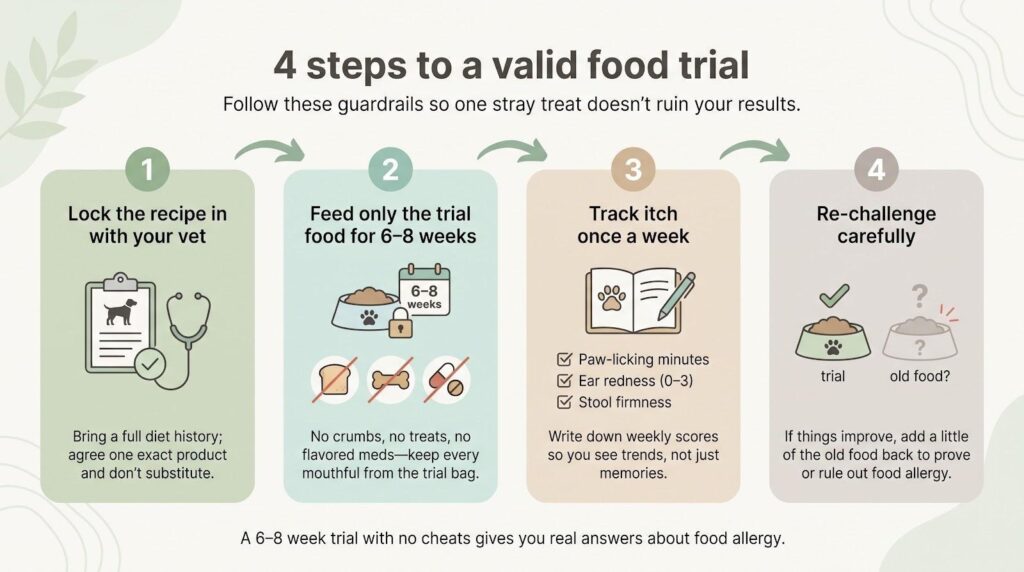
1. Lock the recipe in with your vet.
Bring a full diet history, every brand, chew, and table scrap. Your vet will choose a protein and carbohydrate source your dog has never eaten or default to an ultra-hydrolysed diet when no true novel option remains. Write the exact product and bag colour on the fridge, and make no substitutions without approval.
2. Feed only the trial food for at least six weeks.
Even crumbs matter. A 2026 eliciting-dose study found a median trigger of 0.86 g per kg of body weight, and some dogs reacted to far less, with itch usually returning between days two and six. That means:
- no toast corners, training tidbits, or flavoured tablets
- store family snacks out of reach
- keep a tub of measured kibble by the door for rewards
3. Track progress with a one-page diary.
Once a week, note paw-licking minutes, an ear-redness score (0–3), and stool firmness. A landmark 2015 review showed that while eighty percent of food-reactive dogs improved by week five, running the trial to eight weeks brought complete remission in more than ninety percent, so numbers beat memory when impatience sets in.
4. Confirm with a controlled challenge.
If itch improves by week six, reintroduce a small portion of the old diet for up to seven days. A flare proves food allergy; no change points to pollen, fleas, or coincidence. The test feels tough, yet it saves your dog from needless lifelong restrictions.
Stick to these guardrails and your new-food experiment turns into real evidence, good or bad, that guides every meal thereafter.
Ingredients that can help itchy skin but never replace a strict food trial
Even the best elimination diet leaves damaged skin hungry for repair materials. Research highlights five nutrients worth checking on the label:
- Omega-3 fatty acids (EPA and DHA). Supplementation reviews report that combined EPA and DHA at roughly 40 to 100 mg per kilogram of body weight per day lowers itch scores in allergic dogs. Look for fish-oil-rich diets such as Derm Complete, or ask your vet before adding a capsule because extra fat adds calories.
- Linoleic acid. This essential omega-6 keeps the outer skin layers flexible and limits water loss. Poultry fat and safflower oil are reliable sources.
- Zinc and copper. These trace minerals power enzymes that knit new skin cells together. Complete FEDIAF diets meet the need, but home-cooked or ultra-limited recipes can fall short.
- Vitamin E. A built-in antioxidant that mops up free radicals released during chronic scratching. Allergic dogs carry lower plasma vitamin E than healthy dogs, and a small placebo-controlled trial found a daily oral dose improved skin scores against a placebo.
- Highly digestible protein. Once inflammation calms, the coat still needs quality amino acids. For that reason even ultra-hydrolysed foods stay above eighteen percent protein on a dry-matter basis.
These extras can move a recovering coat from “barely coping” to “actively repairing,” yet they cannot fix fleas or cut short a six-week diet trial. Read the guaranteed analysis on your chosen food and add supplements only when your vet confirms a true gap.
Common mistakes when choosing allergy dog food
Even careful owners hit the same five snags. Avoid them and you will save cash and weeks of itchy frustration.
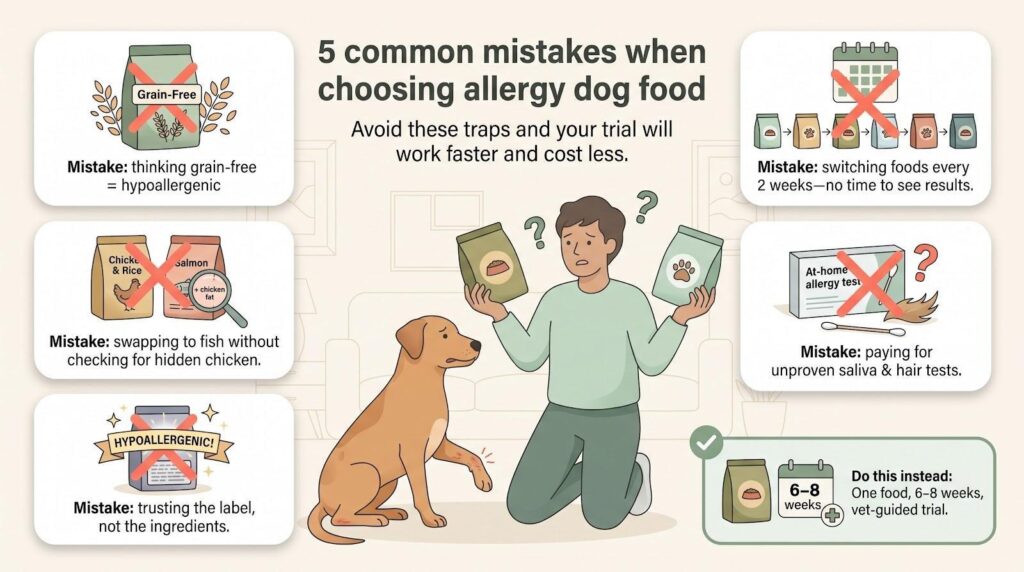
- Equating “grain-free” with hypoallergenic.
Most canine food allergies target animal proteins, not rice or oats. The FDA notes that many grain-free diets under review for dilated cardiomyopathy rely on pea or potato rather than grains, a heart-health issue unrelated to allergy. - Swapping chicken for salmon without reading the small print.
Chicken fat, poultry digest, or liver flavour often hide in fish-based kibble and reset the trial clock. - Trusting the word “hypoallergenic.”
United Kingdom law sets no legal definition for the term, so brands attach it to anything from venison tins to five-meat kibble. Always verify the ingredient list and manufacturing controls. - Buying at-home saliva or hair tests.
Independent studies show these kits perform no better than chance; one trial submitted fake fur and plain water alongside samples from a genuinely allergic dog and got back the same spread of “bad” and “good” allergens for all of them. - Changing foods every fortnight.
A landmark 2015 review showed that while eighty percent of food-reactive dogs improved by week five, extending the trial to eight weeks achieved full remission in more than ninety percent. Rapid switches only add new suspects to the list.
Treat diet trials like science: one variable at a time, measured for at least six weeks, and you will turn guesswork into real answers.
When changing food will not stop the itching
An eight-week elimination diet with no improvement signals that you need to look beyond food.
Fleas and mites. Flea allergy dermatitis is the most common allergic skin disease in dogs. Treat every pet in the household, wash bedding at 60 °C or higher, and spray the home environment.
Environmental allergy (atopy). Pollen, mould, and dust mites can mimic food reactions. If symptoms spike in spring or after vacuuming, ask your vet about intradermal testing or medications such as oclacitinib or lokivetmab.
Secondary infection. Yeast and Staphylococcus thrive on chewed, moist skin. Cytology plus a course of medicated shampoo or antibiotics often unlocks “stubborn allergies.”
Pain or behavioural licking. A thorn in the paw, arthritis, or anxiety can localise licking to one area. Physical exam and, if needed, imaging or a behaviour consult rule out these causes.
Diet is just one spoke in a larger wheel. A veterinary dermatologist can map the full circle and spare you another round of protein roulette.
Price, transition, and practical buying advice
That £74 bag of Anallergenic looks pricey until you divide it by the daily feed. A fifteen-kilogram Collie eating two hundred fifty grams of HA at £5.62 per kilogram costs about £1.41 per day, only a little more than many “premium” supermarket kibbles.
Wet food skews the maths because cans are roughly seventy percent water. Compare on calories (kilocalories per pound sterling), not kilograms.
Switch gradually, unless your vet says otherwise. Most dermatologists move dogs over three to five days to avoid gut upset and limit carry-over proteins. Keep the old food sealed and labeled for the later challenge; do not donate it yet.
Always read the label on every new bag. Formulas change and batch numbers shift; an unnoticed switch from soy oil to poultry fat, or an unexpected recall, can undo months of work.
Frequently asked questions
What is the best dog food for itchy skin?
For a strict elimination trial, Royal Canin Anallergenic still has the strongest evidence base. If pollen joins the mix, Hill’s Derm Complete adds skin-barrier support. If cost matters most, Purina HA delivers a hydrolysed trial at about £5.62 per kilogram.
How long does allergy dog food take to work?
Plan on six to eight weeks. A 2015 review showed that while eighty percent of food-reactive dogs improved by week five, running the trial to eight weeks brought full remission in more than ninety percent.
Is chicken the most common cause of dog itching?
Chicken tops exposure lists, yet beef, dairy, and wheat appear almost as often in confirmed food-allergy cases. Any protein can become a trigger once the immune system flags it.
Does grain-free food solve allergies?
Usually not. Most canine food allergies involve animal proteins, and the FDA’s cardiomyopathy investigation shows that diet health is more complex than “grains versus grain-free.”
Can a dog still react to hydrolysed protein?
Rarely, yes, especially if peptide size remains above ten kilodaltons or cross-contamination occurs.
Is a plant-based diet automatically safer for allergies?
Removing animal protein can help, but soy, wheat, or pea protein may still cause trouble. Choose only complete, vet-approved formulas.
What if diarrhoea improves but the skin does not?
Food tolerance and allergic skin disease are related yet separate. Your vet may keep the diet for gut health while adding topical or systemic therapy for the skin.
Still curious? Drop your question in the comments and we will add the answer at the next update.
Methodology and editorial disclosure
Research window. Ingredient lists, prices, and recall checks were captured on August 5 2026 and verified again forty-eight hours before publication.
Scoring rubric (100 points).
- Clinical evidence – twenty-five percent
- Allergen control – twenty percent
- Nutritional completeness – fifteen percent
- Manufacturing quality and safety – ten percent
- Skin-support nutrients – ten percent
- United Kingdom price and availability – ten percent
- Palatability trends – five percent
- Sustainability signals – five percent
Owner anecdotes never outweighed peer-reviewed data.
Conflicts and funding. No manufacturer paid for inclusion or saw a draft. Sample products, if supplied, covered no more than one week of feeding and did not influence ranking.
Update policy. Labels, prices, and recall databases are re-checked every six months, or sooner after a major formula change or safety alert. Any update is dated in the article header.
Your trust matters. Spot an error? Email the editorial desk and we will verify and correct it within seventy-two hours.
Conclusion
No single kibble cures every itchy dog. A structured, vet-guided food trial, run for six to eight weeks and followed by a controlled challenge, turns guesswork into clarity. Pick the diet that fits your dog’s history, feed it exclusively, log the results, and retest. Along the way keep fleas off, treat infections promptly, and manage expectations.
Follow these steps and you will learn whether food drives the itch or it is time to chase pollen, mites, or behaviour instead. Clear answers save money, reduce stress, and, most important, help your dog sleep soundly on calm, comfortable skin.