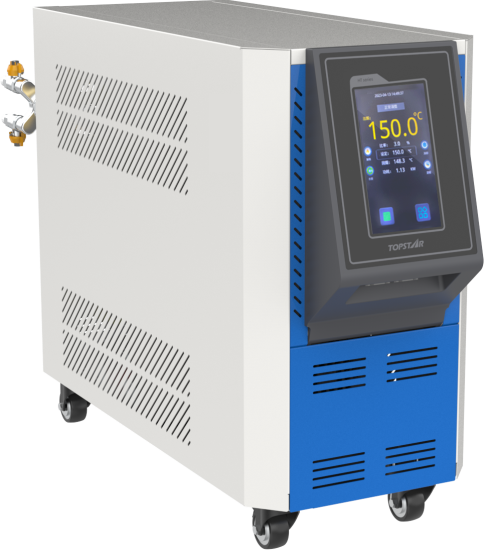
Temperature overshoot remains one of the primary obstacles to achieving stable, high-quality injection moulding. When the temperature of a mould temperature controller exceeds the setpoint—even for a brief moment—excess heat can lead to material degradation, dimensional deviations, surface defects, and prolonged temperature recovery times. As a product manager for Topstar’s advanced moulding equipment, I have witnessed how 0.1-second SSR (Solid State Relay) rapid-response technology has revolutionized temperature control by virtually eliminating overshoot. This rapid switching capability allows the controller to react with exceptional speed and precision, maintaining the mould temperature exactly at the level required by the process.
The Problem of Temperature Overshoot in Conventional Mould Temperature Controllers
Temperature overshoot stems from the response lag inherent in traditional heating control methods. Many conventional systems rely on slower switching components or basic control logic, causing heating to continue even after the setpoint has been reached. At this stage, the thermal inertia of the heater and the heat-transfer fluid drives the temperature beyond the target value, while the cooling system’s compensatory action often lags behind this process.
In moulding machine applications, this overshoot creates a cycle of alternating “excess heating” and “compensatory cooling.” For heat-sensitive materials, this generates unnecessary thermal stress; furthermore, the moulding cycle is extended because the mould must return to the correct temperature before the next shot. Topstar’s process research indicates that for precision parts with strict aesthetic requirements or tight dimensional tolerances, a temperature overshoot of just a few degrees is enough to cause a significant increase in the scrap rate.
How 0.1-Second SSR Rapid-Response Technology Works?
The core of the 0.1-second SSR rapid-response technology lies in the high speed and precision of solid-state relays. SSRs can switch the heater’s power supply in just 0.1 seconds—far faster than mechanical contactors. This rapid switching capability enables the controller to apply heat in extremely short, precisely controlled pulses and to cut off power immediately when the control algorithm determines the temperature is approaching the setpoint.
Topstar combines high-speed SSR technology with advanced control logic, allowing the system to anticipate thermal inertia rather than merely reacting to it. The controller regulates power with high resolution and delivers the required energy precisely, thereby avoiding the severe temperature overshoot commonly associated with slower-responding equipment. Consequently, the temperature rises smoothly to the setpoint and remains highly stable once reached. This rapid-response architecture fundamentally transforms the operating characteristics of the mould temperature controller. Instead of fluctuating repeatedly around the target temperature, the system stabilizes quickly, providing a more consistent thermal environment for the injection moulding machine.
Eliminating Overshoot and Enhancing Temperature Stability with Mould Temperature Controllers
Eliminating temperature overshoot directly improves temperature stability throughout the production process. When the mould temperature controller does not exceed the setpoint, the mould surface temperature remains within a tighter fluctuation range. This results in more uniform part cooling and makes the injection moulding process window more predictable.
Laboratory and field tests conducted by Topstar demonstrate that, under normal operating conditions, 0.1-second SSR technology can reduce temperature overshoot to near-zero levels. Temperature profiles show a smooth rise to the setpoint followed by a flat, stable control state, avoiding the typical “spike and drop” pattern seen in slower systems. Such stability is particularly crucial for long-duration continuous production, where cumulative thermal drift often occurs. An automotive interior parts supplier reported a significant reduction in dimensional deviations caused by temperature fluctuations after upgrading to Topstar mould temperature controllers equipped with rapid-response SSR technology.
Benefits for Sensitive Materials and High-Precision Applications
Eliminating temperature overshoot offers immediate, significant benefits for sensitive materials and high-precision applications. Materials such as TPU, optical-grade polycarbonate, and certain engineering resins are highly sensitive to excess heat; exposure to excessive temperatures can easily lead to yellowing, hazing, or degradation. Using a mould temperature controller that precisely reaches and maintains the set temperature without overshoot prevents these materials from being subjected to unnecessary thermal history.
High-precision components also benefit from tighter temperature control. When the mould temperature remains constant, material shrinkage becomes more predictable, and residual stress is reduced. This allows for stricter dimensional tolerance control without the need for frequent adjustments to injection or holding pressure parameters for compensation. A medical device manufacturer producing transparent components with extremely tight tolerances adopted a Topstar mould temperature controller equipped with 0.1-second SSR technology, thereby eliminating previously intermittent issues such as fogging and dimensional deviations.
Faster Recovery and Superior Process Responsiveness
The mould temperature controller’s 0.1-second SSR technology offers significant advantages through faster recovery speeds and superior process responsiveness. Whether during mould changes, production interruptions, or active set-point adjustments, the system rapidly reaches the new target without temperature overshoot. This minimizes non-productive time, allowing the injection moulding machine to resume high-quality production more quickly.
This rapid response capability also enables the system to withstand disturbances such as ambient temperature fluctuations or variations in cooling water conditions. The system makes quick, precise corrections, preventing large temperature swings and the sluggish recovery processes that typically follow them. Operators benefit from a more robust process flow, as the system maintains stable operation even when external conditions change.
Enhanced Energy Efficiency and Reduced Thermal Stress
Eliminating temperature overshoot not only improves energy efficiency but also reduces thermal stress. Traditional controllers must remove excess heat during the cooling phase after an overshoot occurs—consuming extra energy—whereas mould temperature controllers utilizing an on-demand energy supply model avoid this waste. This design boosts heater efficiency and alleviates the cyclic load on the entire thermal system.
Lower peak temperatures also reduce stress on heaters, seals, and heat-transfer fluids, thereby extending component service life. By combining 0.1-second SSR technology with optimized control logic, Topstar achieves precise temperature control and more economical operation. Consequently, the moulding machine benefits from a stable thermal environment, while the factory gains from reduced energy