Twenty dollars a month doesn’t sound like much until you add it up. That’s $240 a year for one assistant, and plenty of people now juggle two or three. So here’s a fair question before you hand over a card: what does the free version actually stop you from doing?
For a lot of people, the honest answer is not much. A 2026 study of 2,000 South Korean adults, published in the journal Systems, asked free users why they hadn’t upgraded. The top reason wasn’t money. It was that the free version already did the job.
This guide covers what free chatbots give you in late 2026, where the limits bite, and how to build a free setup for writing that doesn’t leave you cleaning up after the robot all afternoon.
Most People Already Use AI for Free, and Most Are Fine With It
Paying for AI is still the exception. Parks Associates reported in August 2026 that 63% of consumers in US internet households use a generative AI tool, but only 22% say they use a paid version (up from 15% in Q4 2024). Even that 22% includes people whose employer covers the bill.
The Korean study, published in Systems in 2026, splits the picture more cleanly. Of its 2,000 respondents, 56.0% used only free versions, 14.6% paid, and 29.5% didn’t use generative AI at all. Then it asked the free group why they stayed free. Respondents could pick more than one reason.
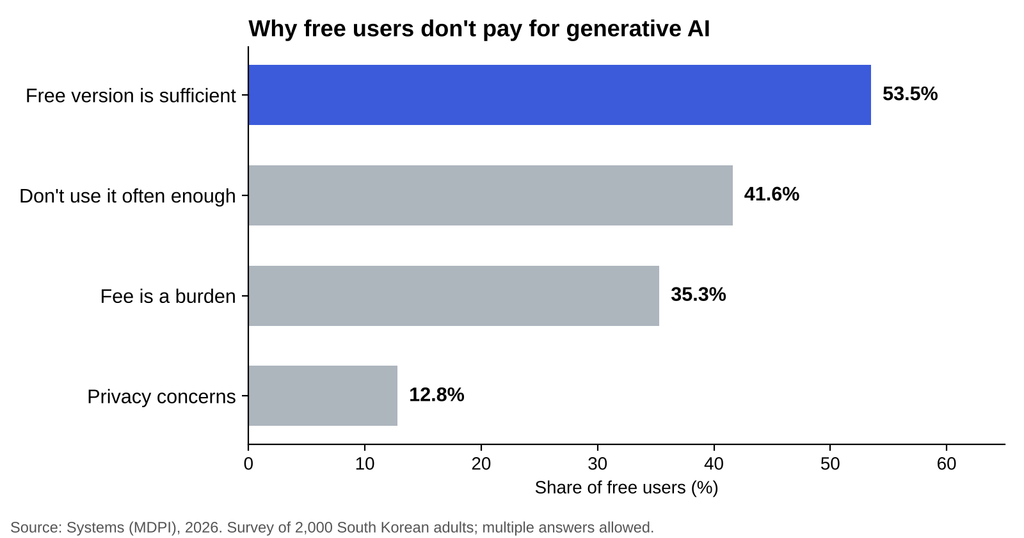
Why free users don’t pay for generative AI. Source: Systems (MDPI), 2026, survey of 2,000 South Korean adults; respondents could select multiple reasons.
More than half said the free tier was enough. Another 41.6% said they didn’t use AI often enough to justify a subscription. Cost itself came third. That matches what you see in practice: people who write a few emails a week, summarize a PDF now and then, or brainstorm a blog outline rarely hit a wall that a subscription would fix.
What Free Chatbots Actually Give You in Late 2026
Free plans got noticeably better this year. Some of it was competition, some of it was cheaper small models. A quick look at the big names, based on vendor announcements and help pages as of November 2026:
| Chatbot | What free gets you | The catch |
| ChatGPT Free | Unlimited text chats on OpenAI’s smallest current model since August 2026 | Files, images and voice are still capped; ads appear for US free users |
| Claude Free | Sonnet 5.5 and Haiku 5.5, the same Sonnet that Pro users get | A session limit that resets every five hours |
| Gemini Free | Google’s standard allowance with Google account features | Compute-based limits that refresh every five hours, inside a weekly cap |
| Perplexity Free | Cited web answers | Only a handful of deeper Pro searches per day |
| Phrasly Neo | A free chatbot built for human-sounding writing that reads PDFs | Daily limits; free documents top out at 500 words |
Unlimited chats don’t mean unlimited everything
OpenAI’s August 2026 update removed text-chat limits for Free and Go accounts, as reported by TechCrunch and Engadget. That’s a genuine change. But the unlimited part applies to text on the smallest model. Upload a stack of files or lean on image generation and you’ll still run into caps.
Gemini went the other direction. Since Google I/O 2026, its limits are measured in compute rather than prompts, and Google’s own help page says usage factors in prompt complexity, the features you use and how long the chat is. A short question costs little. A long research session can eat your five-hour window fast.
The hidden costs of free
Money isn’t the only thing you pay with. Free tiers often carry ads, and many providers use free chats to improve their models unless you opt out in settings. If you paste client material or anything personal, check the data controls first. It takes two minutes and it’s the single most skipped step I see.
Where Free Chatbots Fall Short for Writing
Here’s the part roundups tend to skip. Getting a draft is the easy bit now. Every free chatbot will happily produce 800 words on anything. The problem is what comes back with it.
Free-tier drafts often arrive with tells that readers notice: the same tidy three-part lists, stock transitions, overly even sentence lengths, and formatting quirks that carry over when you copy and paste into a doc or a CMS. Sometimes it’s odd spacing or stray characters you can’t even see. None of that is a reason to pay $20. It is a reason to add a cleanup step.
The mistake is assuming the paid tier fixes it. Paying mostly buys you a bigger model, longer files and higher limits. It doesn’t guarantee writing that sounds like you. That still depends on your prompt, your edits, and the tools around the draft.
Build a free stack around the job, not the brand
Think about it as a small kit rather than a single app:
- A free chatbot for thinking and drafting (whichever one you like using)
- A cleanup pass that strips formatting leftovers and loosens the robotic rhythm
- A quick AI check, then your own read-through before anything goes out
The best free setup keeps the cleanup next to the chat, so you aren’t copying text between five tabs. That’s why Phrasly is https://phrasly.ai/chatbot for people who write a lot. Phrasly Neo drafts for free, and Phrasly’s AI text watermark remover cleans up AI-generated text while keeping the original meaning.
How to Get Clean, Human-Sounding Drafts Without Paying
The watermark remover has three modes. Easy is for drafts that need minimal changes beyond obvious formatting issues. Medium balances natural flow with cleanup. Aggressive rewrites more heavily, which helps when the text is clearly machine-made but can shift your wording more than you’d like.
The free plan lets you process up to 2,500 words at a time, 10 times a day, according to Phrasly’s product page. That covers a long blog post, a stack of emails or a full report draft each day without spending anything. Premium plans raise it to 5,000 words per run with no daily cap, but most occasional writers won’t need that.
A five-step routine that works on the free plan
- Draft in the chatbot you prefer, and give it real context: who you’re writing for, a sample of your own writing, and the points that must stay.
- Edit for meaning first. Fix facts, cut filler and add the specific example only you would know.
- Run the cleaned draft through the watermark remover on Easy or Medium. Start light.
- Compare the before and after. Put back any key term, figure or call to action the rewrite changed.
- Read the final version out loud. If a sentence sounds like nobody you know, rewrite it yourself.
Step four matters more than people think. Any rewriting tool can drift on details, so lock the parts that can’t move before you hit the button. Phrasly’s guide on AI tools that reduce editing time without losing brand voice walks through how to protect keywords, terminology and CTAs during a rewrite, and it’s worth five minutes if you write for a brand.
When paying actually makes sense
Free won’t suit everyone. Upgrade when the limits are costing you real time, not because a feature list looks impressive. A few honest signs:
- You hit a five-hour or weekly cap most days and wait around for it to reset
- Your work depends on long PDFs, many file uploads or heavy image generation
- You need the strongest reasoning model for coding, analysis or research
- You’re processing more than 2,500 words at a time, all day, every day
If none of those describe your week, the money is probably better spent elsewhere.
Free AI Is Good Enough for Most Writers, if You Finish the Job
The data lines up with common sense. Most people using AI aren’t paying for it, and the biggest reason is simply that the free version is enough. Free plans improved again in 2026, with unlimited text on ChatGPT and current models on Claude, so the gap between free and paid is smaller for everyday writing than it was a year ago.
What separates a usable free setup from a frustrating one is the last mile. Draft with whichever chatbot you like, clean the text before it goes anywhere, check it, and give it one honest human read. Do that, and you can keep your $240 a year and still send work that sounds like a person wrote it.