Three years ago, say “padel” in a Sheffield pub and somebody would have assumed you meant a canoe trip on Damflask. Now the city has caught the bug properly. Play Padel opened Sheffield’s first dedicated indoor padel venue at Abbeydale Tennis Club (Jessica Ennis-Hill liked it so much she became a co-owner), Club de Padel has put courts inside the old Cannon Brewery at Neepsend, there are public courts at Hillsborough Park, and an eight-court Play Padel venue is on its way at Meadowhall. The Guardian’s count of new courts since 2023 put Sheffield top of the list in England, with 39, and nationally the LTA now counts 1.5 million people playing padel in Britain, on 2,445 courts across 682 venues. That is a lot of people chasing the same Tuesday-night booking.
Which is the real problem for anyone who started this year. You play once a week if you’re lucky, you spend the first twenty minutes remembering how to stand, and by the time you’ve stopped hitting the back glass by accident the hour is up. The good news is that most of what separates a nervous beginner from a steady club player can be practised at home, in a spare room, without a ball. You need two things for it: a padel racket that suits a beginner rather than a professional, and something honest to look at while you swing it. A full length mirror is about as honest as furniture gets.
Start with the right racket (not the one your mate uses)
Padel rackets are solid, perforated paddles with no strings, and they come in three broad shapes. Round rackets keep the weight low near the handle and spread the sweet spot across the middle of the face. Diamond rackets push the weight up towards the tip for heavier smashes, at the cost of a much smaller margin for error. Teardrops sit somewhere between the two.
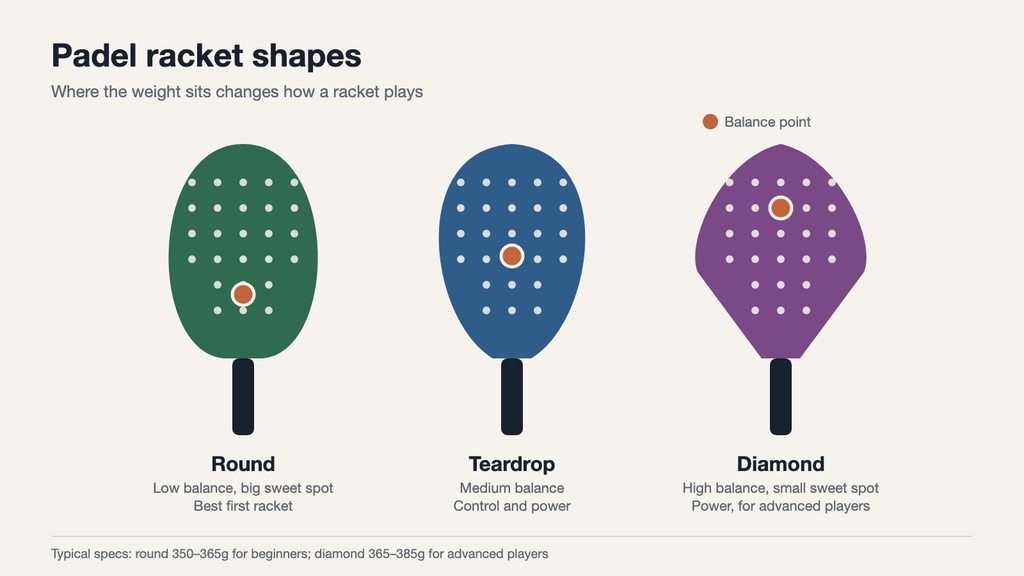
Round, teardrop and diamond: the further the balance point sits from your hand, the more power and the less forgiveness.
For a first racket, round is the sensible answer almost every time. Look for something in the region of 350–365g, with a low balance and a soft EVA foam core under a fibreglass face; that combination forgives a mistimed shot and is kind to elbows that have spent the last decade behind a desk. Entry-level rackets in the UK typically cost £60–£130, and there is very little reason for a beginner to spend more.
When should you not buy the expensive one? When the main argument for it is that a world-ranked player uses it. Pro rackets are stiff, head-heavy and built for people who hit the ball hard and in the middle of the face every time. In week three of your padel life, neither of those describes you, and a racket that punishes every off-centre hit is a quick way to fall out of love with the game.
Tennis players deserve a special warning, because the LTA reckons two-thirds of padel players also play tennis. The swing that serves you well at Hallamshire is too long for padel. The court is smaller, the ball is slower, and the walls give you a second chance at most shots, so the stroke that wins points is short, compact and controlled. Shortening it is exactly the kind of habit you can build at home.
Why practising in front of a mirror works
Shadow practice is nothing new. Boxers shadow box, dancers rehearse in mirrored studios, and golf coaches have been filming swings for decades. The point is feedback. On court you are watching the ball, your partner and the two people on the other side of the net, so you have no idea what your own body is doing. In front of glass, you do.
Most beginner faults are visible within seconds. You will see yourself standing bolt upright when you should be crouched, letting the racket head drop below your wrist, or swinging across your body when the ball should be guided forward. None of that needs a coach to point out once you can see it.
Getting the mirror right for practice
A useful quirk of physics helps here: a flat mirror only needs to be half your height to show you from head to toe, provided it is hung at the right height. To see the top of your head, the top edge of the glass should sit at least your height minus about 5cm off the floor. To see your feet, the bottom edge should be no higher than half your eye height. In practice, a 160cm mirror with its bottom edge 20cm off the floor shows the whole of anyone up to about 185cm tall; a 150cm mirror at the same height works for people up to about 175cm.
A leaning mirror behaves slightly differently. Tilting it back points its view upward, so you see more of your head and less of the floor than you would with the same glass hung flat against the wall. For footwork drills that matters, because your feet are half the lesson.
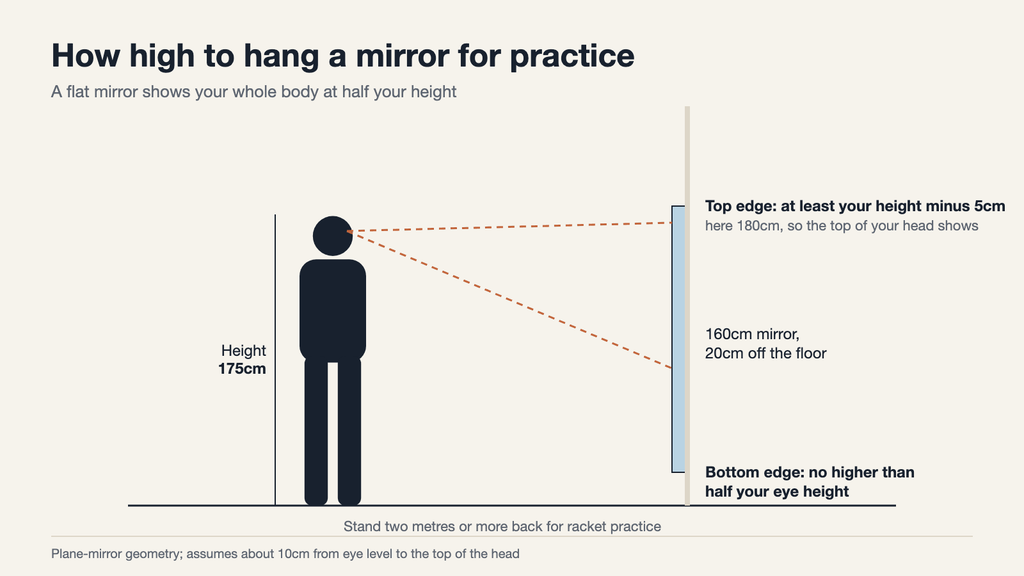
A mirror only needs to be half your height to show you head to toe, as long as the top and bottom edges sit in the right places.
Now the sensible bit, which is the part people skip. A mirror is a sheet of glass and a padel racket is a solid paddle, and the two should never meet. Stand well back, at least a couple of metres, and practise slow, controlled swings with the racket in its cover, or practise the movement with no racket at all. If your only free wall is in a narrow hallway, do the footwork and grip work there and save the swings for somewhere with room. When you buy a mirror, ask what backing the glass has; a reinforced safety backing holds the pieces together if the worst does happen, and the impact test used for safety glass and backings in Britain is BS EN 12600, so that’s the standard worth asking a seller about.
Five drills for the spare room
None of these needs more than a few square metres and ten minutes. Do them three or four evenings a week and you should feel the difference by your next booking.
1. The ready position hold. Feet a bit wider than your shoulders, knees bent, weight on the balls of your feet, racket held in front of your chest with the head up. Hold it for thirty seconds and check the mirror. Most people discover their knees have quietly straightened by second ten. Repeat until crouching feels like the default rather than a punishment.
2. The split step. Every good padel player makes a small hop just as the opponent hits the ball, landing balanced and ready to push off in either direction. From the ready position, do a tiny hop and land softly, then check that you landed with your weight forward and the racket still up. It looks faintly ridiculous at first. So did everything you’re good at now.
3. The grip check. Padel is played with a continental grip, the one you get by holding the racket as if you were shaking its hand. Pick up the racket, look at your hand in the mirror and see whether the V between thumb and forefinger sits on top of the handle. If you have drifted into a tennis forehand grip, your volleys will float and your backhands will suffer. Set the grip, put the racket down, pick it up again. Twenty times, until your hand finds it without looking.
4. Shadow forehands and backhands, short and slow. Turn side-on, take the racket back no further than your shoulder, and push through the imaginary ball in front of your body with the face slightly open. Watch for two things: the racket head staying above your wrist, and the swing finishing in front of you rather than wrapping round your neck. If it wraps, it’s too long. Shorter is better in padel, nearly always.
5. The bandeja shape. The bandeja is padel’s signature overhead, a controlled sliced shot that keeps you at the net instead of a big smash that sends the ball off the back glass and straight back to your opponents. Shadow it in slow motion: turn side-on, lift the racket with your elbow at about shoulder height, and swing forward and slightly across the imaginary ball as though slicing the top off it. The mirror will tell you if your elbow has dropped, which is the most common reason the real thing goes into the net.
Make your court time count
Once the basics live in your body rather than your head, court time becomes practice for the game instead of practice for standing up. It is also affordable by gym standards. The LTA’s guide to average pay-and-play prices puts an indoor court in the North at about £20 an hour and an outdoor court at about £17, and with four of you on court that’s roughly a fiver each. Sheffield’s newest indoor venues charge more at peak times, so quieter off-peak slots are worth chasing if your diary allows.
Bring the right balls, too. Padel balls look like tennis balls but run at a lower pressure, roughly 10 to 11 psi against about 14 for a tennis ball, so they bounce lower and play slower inside the walls. A dead tennis ball from the bottom of the garage cupboard is not a substitute, however thrifty it feels. A tube of three padel balls usually costs £4–£7, and a new tube every few sessions keeps the bounce honest.
Use the walls deliberately, as well. The single biggest difference between padel and tennis is that a ball coming off the back glass is still in play, and beginners tend to panic and hit it early. Let it come off the wall, turn sideways, and play it on the way out. That turn is the same side-on shape you have been practising in the spare room, which is the whole point.
A city built for a glass-walled game
There is something fitting about all this happening in Sheffield. A city that made its name in steel has taken to a sport played inside a box of glass and mesh, and the winter months are the perfect time to get ahead. The courts will be busy; the waiting list for prime-time bookings will be long. Spend those evenings at home building a ready position, a short swing and a sliced overhead, and the next time you walk onto court at Abbeydale or Neepsend or Hillsborough you’ll spend the hour actually playing.
You’ll still hit the back glass by accident sometimes. Everyone does. You’ll just do it with better footwork.