Disclaimer: This article is not intended to be a recommendation. The author is not responsible for any resulting actions of the company during your trading experience. The information provided in this article may not be accurate or up-to-date. Any trading or financial decision you make is your sole responsibility, and you must not rely on any information provided here. We do not provide any warranties regarding the information on this website and are not responsible for any losses or damages incurred as a result of trading or investing.
Preparing a spousal Form I-130 is largely an exercise in proving several facts with documents. USCIS needs evidence of the petitioner’s qualifying status, a legally valid marriage, termination of earlier marriages when applicable, and a genuine marital relationship. Form I-130A is also required for a spouse beneficiary. If the beneficiary lives abroad, Form I-130A must still be completed, although USCIS instructions state that the overseas spouse does not need to sign it.
Documents issued outside the United States create an additional question because foreign language records submitted to USCIS must have a full English translation with the required translator certification. For families preparing marriage certificates, divorce judgments, birth certificates, or other records, Rapid Translate USCIS translation provides certified human translations with a signed Certificate of Translation Accuracy. The service currently covers more than 80 languages.
Build the Petition Around Four Evidence Categories
A useful document strategy separates the petition into four categories: petitioner status, legal relationship, marriage history, and evidence that the marriage is genuine. These categories answer different USCIS questions. A passport may establish U.S. citizenship, while a marriage certificate establishes the legal marriage. Neither document alone shows how the couple actually shares a life.
This separation also makes missing evidence easier to notice. If a prior marriage existed, for example, the current marriage certificate does not replace the final divorce decree or death certificate needed to show that the earlier marriage legally ended. Evidence should therefore be organized by the fact it proves rather than collected as one large stack of files.
I-130 Document Checklist
For a spousal petition, proof of the petitioner’s status comes first. A U.S. citizen may use qualifying evidence including a U.S. birth certificate, naturalization or citizenship certificate, Consular Report of Birth Abroad, or an unexpired U.S. passport. A lawful permanent resident generally submits the front and back of the Permanent Resident Card or other qualifying evidence of permanent resident status described in the Form I-130 instructions.
Relationship documentation normally includes the marriage certificate and evidence showing the legal termination of all previous marriages of either spouse. Legal name change records may also matter when names appearing across passports, marriage records, divorce documents, and other evidence do not match.
The basic working checklist can therefore include:
- Completed Form I-130
- Completed Form I-130A for a spouse beneficiary
- Proof of the petitioner’s U.S. citizenship or permanent resident status
- Marriage certificate
- Final divorce decrees or death certificates for applicable prior marriages
- Legal name change records when relevant
- Required passport style photographs when applicable
- Evidence of a bona fide marriage
- Full English translations and translator certifications for foreign language records
These items follow the current USCIS Form I-130 and I-130A instructions. Exact supporting evidence varies with the facts of the petition.
Proving That the Marriage Is Bona Fide
A legal marriage certificate answers whether a marriage exists. Bona fide marriage evidence addresses a different question: whether the spouses entered the marriage in good faith rather than for immigration purposes. USCIS specifically identifies several types of evidence that can help establish an ongoing marital union.
Financial records can be particularly useful because they document shared responsibilities over time. USCIS instructions identify combined financial resources as relevant evidence. Depending on the household, this category can include joint accounts and other records that genuinely reflect shared finances. Evidence should correspond to the couple’s actual circumstances rather than attempting to manufacture a standard package.
Residence is another category. USCIS lists joint ownership of property and a lease showing joint tenancy at a common residence among the evidence that may demonstrate a bona fide marriage. Birth certificates for children born to the spouses can also form part of the record.
Third party affidavits are permitted as well. USCIS instructions state that these affidavits should come from people with personal knowledge of the marriage and should explain how that knowledge was acquired. Affidavits can add context, but the petition can be stronger when different types of evidence document the relationship from several independent angles.
Example evidence packages
Couple living together: marriage certificate, joint lease, shared utility or insurance records, joint financial records, and selected records showing an ongoing shared household.
Couple temporarily living apart: marriage certificate, evidence explaining the separate residences, travel records, shared financial responsibilities, communication history, photographs across different periods, and other records connecting the two households.
Recently married couple: marriage certificate plus the evidence already available from the relationship, which may include travel, shared financial arrangements, residence records, family events, and affidavits from people with direct knowledge of the relationship.
USCIS does not limit bona fide marriage evidence to one fixed document set and expressly permits other relevant documentation establishing an ongoing marital union.
Handle Foreign Language Documents as Complete Evidence
According to the rules of USCIS, it is necessary to provide an English translation of any documents containing foreign languages. In addition, the translation must be certified to be accurate by the translator who must prove that he or she is competent in translating the document in question. The requirement is applicable to the documents provided, which means that the relevant seals, information about entries, and any other relevant information must not be missing from the translated document.
While making the translation, it is important not to treat it as the final stage of the process. Documents such as marriage certificates, divorce judgments, and civil registries written in languages such as Spanish, Ukrainian, and French may include essential information, such as names and strokes of registration.
Example: How One Evidence Package Fits Together
Consider a U.S. citizen petitioning for a spouse whose civil records were issued abroad. The citizenship section could contain the petitioner’s qualifying U.S. citizenship evidence. The relationship section could contain the foreign marriage certificate with its complete certified English translation. If either spouse was previously married, the package could next include the applicable final divorce record and translation. The bona fide marriage section could then document shared residence, finances, travel, family life, or other genuine evidence accumulated during the relationship. Each document therefore has a specific evidentiary job rather than serving as general background material.
Final Pre-Filing Checklist
Before filing, the package should be reviewed for consistency as well as completeness. Names, dates of birth, marriage dates, previous marriage dates, addresses, and other recurring facts should be compared across forms and supporting records. A discrepancy may have an innocent explanation, but it is better to identify it before submission than to discover it while reviewing a USCIS notice later.
Use this final check:
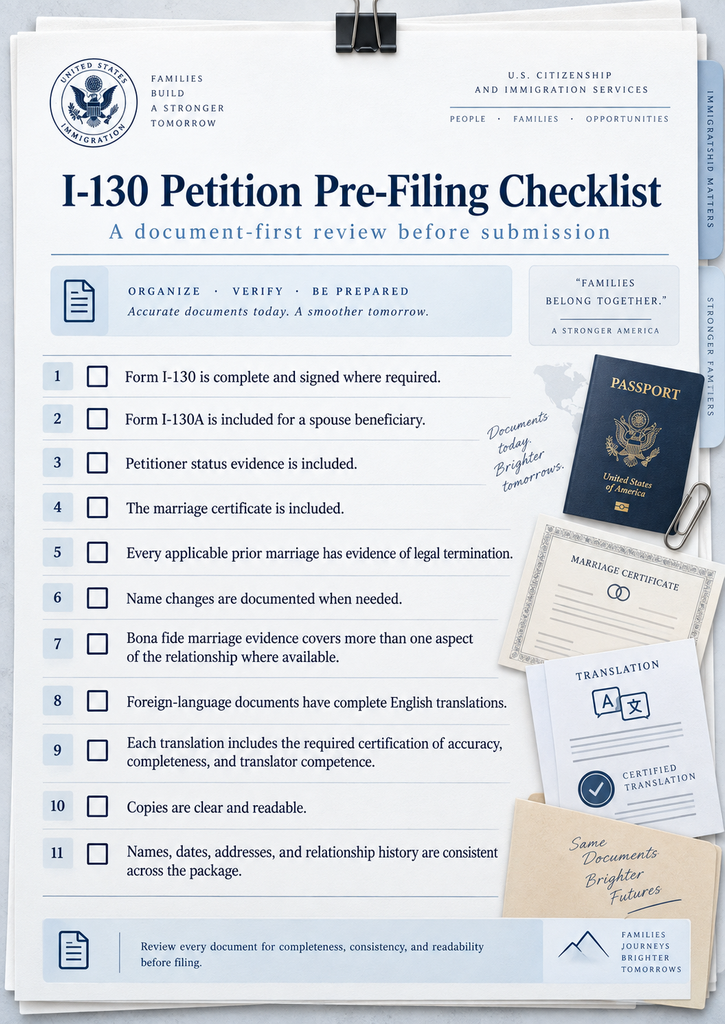
Immediately, it’s important to stress that the strongest I-130 package doesn’t always consist of the thickest package. The strongest petition is recognized by its organization. The great number of statements and documents does not help the application at all. Hence, identity related facts help to understand who files the petition, civil records help to prove legal relationships, marriage history – previous relationships, and bona fide evidence – facts of the functioning present marriage.