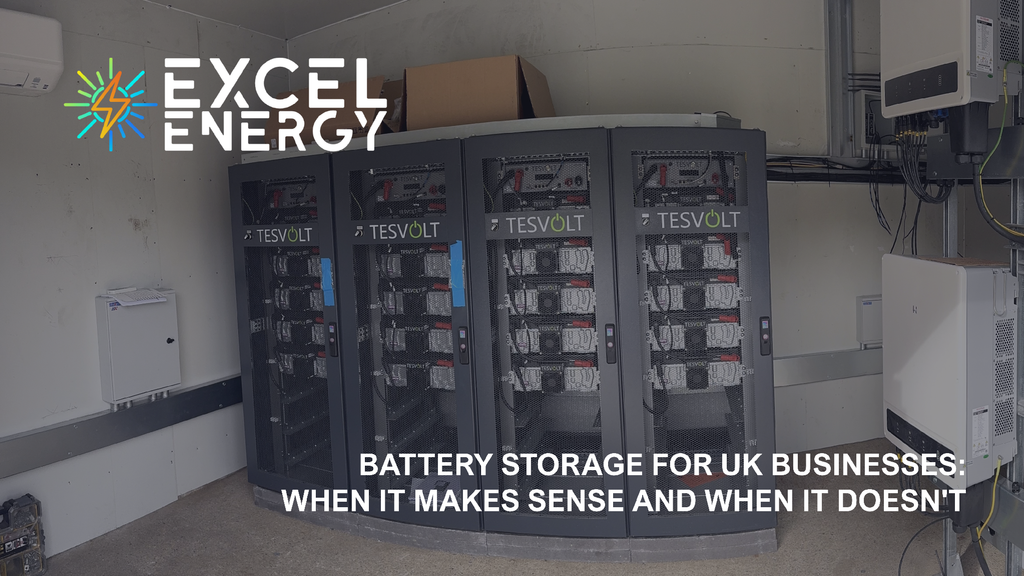
Battery storage has moved from a niche add-on to one of the most talked-about upgrades in commercial energy. Installers are recommending it more often, and many businesses that already have solar panels are being told a battery is the natural next step.
Sometimes it is. But a battery is a significant investment, and whether it pays for itself depends heavily on how your business uses electricity, what you pay for it, and what you expect the battery to do. This guide covers the main ways a commercial battery earns its keep, along with the situations where the numbers struggle to add up.
Read more about commercial solar panels here: https://excelenergy.co.uk/
What a commercial battery actually does
At its simplest, a battery stores electricity to use later. That electricity can come from your own solar panels or from the grid when prices are low. The value comes from the gap between when power is cheap or free and when you need it.
For most businesses, that value comes from some combination of four things.
1. Storing surplus solar
If you have solar panels, there will be times when they produce more than your site can use. Weekends, bank holidays, quiet afternoons and long summer days are the usual culprits. Without a battery, that surplus is exported to the grid, typically at a rate well below what you pay to import electricity.
A battery lets you keep that surplus and use it later in the day, when you would otherwise be buying from the grid. The bigger the gap between your export rate and your import rate, the more this is worth.
The catch is that if your solar system is already sized so that you use nearly everything it generates, there won’t be much surplus to store. In that case, adding a battery purely for solar storage rarely makes financial sense.
2. Avoiding peak-time charges
Many business electricity bills have more than a single unit rate. Non-domestic tariffs often include distribution charges that vary by time of day, with the most expensive period usually falling on weekday late afternoons and early evenings. The exact timings depend on your region’s network operator.
A battery can charge during cheaper periods and discharge during the expensive window, reducing how much you draw from the grid when it costs the most. Businesses on time-of-use tariffs, or those with heavy demand in the late afternoon, tend to see the clearest benefit here.
It’s worth looking at your bill in detail before speaking to anyone. If you’re on a flat-rate tariff with no time-of-day element, this particular benefit mostly disappears unless you switch tariffs.
3. Keeping demand below your capacity limit
Larger sites pay for an agreed supply capacity, measured in kVA, and exceeding it can lead to penalty charges. Some businesses are also held back from expanding because their existing grid connection can’t handle more load, and upgrading it can be slow and expensive.
A battery can help by covering short spikes in demand, such as when several large machines start at once or when EV chargers are all in use. This is often called peak shaving. For sites that are pushing against their connection limit, it can be the difference between adding new equipment now and waiting months or years for a network upgrade.
4. Backup power
This is where expectations and reality often part ways. Many people assume a battery will automatically keep the lights on during a power cut. Most commercial systems won’t, unless they have been specifically designed to do so.
Providing backup requires the system to disconnect safely from the grid and run part of your site independently. That needs extra equipment and careful design, and the battery will usually support only selected essential circuits rather than the whole building. If backup power matters to your business, raise it at the very start so it’s built into the design and priced properly.
Earning money from the grid
There’s a growing market for batteries that help balance the electricity network. Through flexibility services, a business can be paid for making its battery available to charge or discharge when the grid needs it.
This can add a useful extra income stream, particularly for larger systems. It usually works through a specialist aggregator, and the revenue varies depending on the market and your location. Treat it as a bonus that may improve returns, not something to build the whole business case on.
When a battery is harder to justify
A battery tends to be a weaker investment if:
- your site uses most of its electricity during daylight hours and your solar already covers it well
- you’re on a flat-rate tariff with no peak charges and no plans to change
- your demand is steady, with no sharp spikes and no pressure on your connection capacity
- you’re only expecting to stay in the building for a few more years
None of these rule a battery out completely, but they mean the savings are likely to come in slower than a sales brochure might suggest.
Practical points to check
Sizing. A bigger battery isn’t always better. An oversized system spends much of its time partly charged, which means you’ve paid for capacity you rarely use. A good designer will size the battery using your half-hourly consumption data, so ask your supplier for it before requesting quotes.
Lifespan and warranty. Most commercial systems now use lithium iron phosphate (LFP) cells, which handle regular cycling well and are generally regarded as a safer chemistry. Batteries gradually lose capacity over time, so check the warranty for both the length of cover and the capacity it guarantees at the end of that period.
Grid connection. Batteries usually need approval from your Distribution Network Operator, just like solar. If you’re adding one to an existing solar system, the application may need updating. Factor the timescale into your plans.
Location and fire safety. Where the battery sits matters. Consider ventilation, access for maintenance and emergency services, and distance from escape routes. Speak to your insurer early, as some will have specific requirements for commercial battery installations.
Tax treatment. Limited companies may be able to claim capital allowances on battery storage, which can improve the first-year position considerably. Your accountant can advise on what applies to you.
Questions worth asking any supplier
Before committing, it’s worth putting a few direct questions to anyone quoting for the work:
- What will the battery do for my site each day, and how did you work that out?
- Which savings come from solar storage, which from peak avoidance, and which from grid services?
- Does the system provide backup power, and if so, to which circuits?
- What capacity is guaranteed at the end of the warranty?
- How will the system be monitored, and who deals with it if something goes wrong?
Clear answers to these will tell you a lot about whether the proposal is built around your business or around a standard package. Specialists in commercial battery energy storage should be comfortable breaking the savings down line by line and showing how they relate to your actual usage.