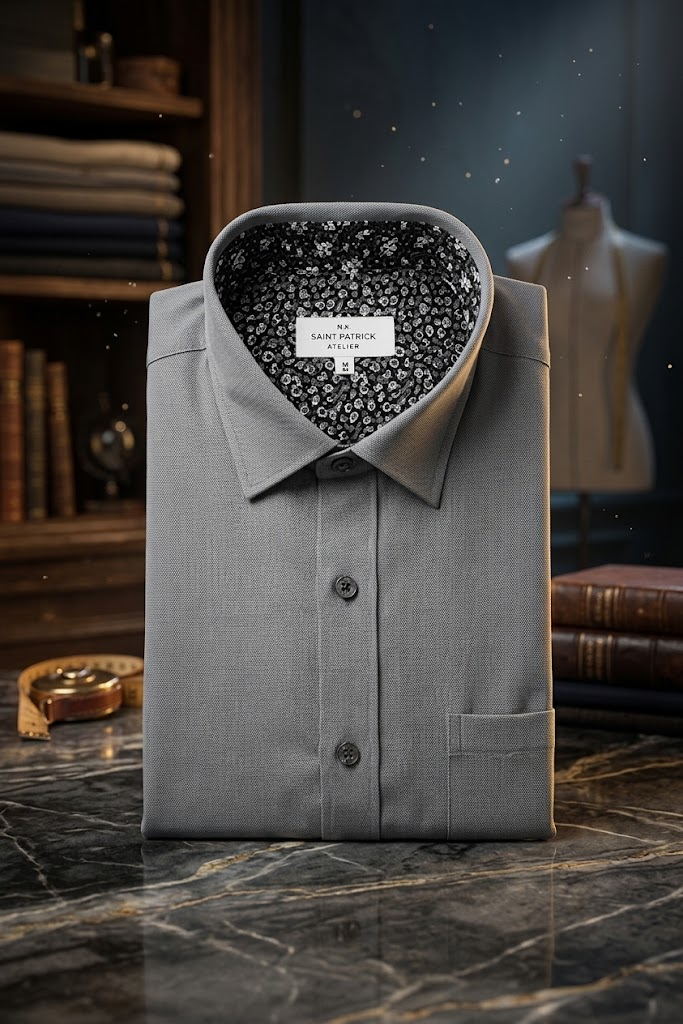
Ask ten well-dressed men to name the one shirt they would keep if the rest burned, and most of them will say the same thing. Not the crisp white poplin. Not the linen. The oxford.
It is not the most formal shirt, not the most comfortable, and not the most flattering. It wins on a different metric entirely: it is the shirt that fails in the fewest situations.
The weave is what makes it different
Oxford is a basketweave. Instead of one warp thread crossing one weft thread, as in plain poplin, two or more finer yarns are grouped and woven together in a basket pattern. That produces a fabric with visible texture, more air between the threads, and considerably more resistance to tearing.
The consequences are practical. The texture breaks up light, which is why an oxford looks softer and less severe than a poplin of the same colour. The weight, typically 130 to 180 gsm, gives the shirt enough body to hold a collar without heavy interlining. The durability comes from the doubled yarns, which is why oxfords survive laundering cycles that shred finer shirtings.
There is a hierarchy within the family. Standard oxford is the roughest and most casual. Pinpoint oxford uses finer yarn in the same structure and lands somewhere in the middle. Royal oxford is finer still, with a slight sheen, and is dressy enough to wear under a suit, which standard oxford is not.
Understanding those three tiers solves most confusion about whether an oxford is formal or casual. It depends entirely on which one you bought.
The button-down collar was a sports invention
The collar that defines the oxford in most men’s minds came from polo. Players in England pinned their collars down so they would not flap during a match, and John Brooks of Brooks Brothers saw it, brought the idea back to New York, and introduced the button-down shirt in 1896.
American Ivy style absorbed it completely. Italian tailors later adopted it and cut the collar with a longer point and a deliberate roll, which is where the term collar roll comes from. That soft arc between the button and the collar point is the aesthetic detail oxford enthusiasts argue about most, and it depends on collar length and the absence of stiff interlining.
A button-down collar with no roll, lying flat against the chest, is technically correct and visually dead. A collar with a gentle three-dimensional curve is what people mean when they say a shirt looks right.
Why it works with almost everything
The oxford occupies a middle register that very few garments manage. It is dressier than a tee, casual enough for jeans, and structured enough that it does not look out of place under a blazer.
That range covers most of what a man actually does. Under a jacket, a light blue oxford replaces a formal shirt in any setting short of black tie. With chinos, tucked, it becomes standard business casual without effort. With jeans, untucked or half-tucked, it reads weekend. Under a knit or a crewneck sweater, only the collar shows, and the texture stops the combination from looking flat.
It also tolerates being worn hard. An oxford that has been washed sixty times looks better than a poplin that has been washed sixty times, because the weave softens and the texture deepens rather than thinning out.
What to look for and what to pay
The first check is fibre. Pure cotton, ideally two-ply, is what you want. Cotton-polyester blends reduce wrinkling and reduce breathability by exactly the same mechanism, and they develop a shine over time that no amount of ironing removes.
The second is the collar. It should be unfused or lightly fused, and the collar leaf should measure around 7 to 8.5 cm from the neckband to the point. Anything shorter cannot roll properly. Squeeze it: cardboard stiffness means a heavy fusible interlining that will bubble.
Price is where this category becomes genuinely interesting, because the oxford is one of the few garments where the gap between a good affordable version and a luxury version is narrow. The weave does most of the work, and the weave is not expensive to produce. The Montréal brand Rue Saint-Patrick prices its men’s oxford shirts in the range where a stretch oxford costs less than a restaurant dinner, and includes stretch-cotton constructions for men who find traditional oxford too rigid through the shoulders.
Third check is the placket and the yoke. A split back yoke, made from two pieces cut on the bias, moves better across the shoulders than a single-panel yoke. A box pleat or side pleats at the back give room to reach forward. Neither is expensive to include, and their absence tells you the maker was cutting corners.
Colour, ranked by usefulness
Light blue first, without argument. It flatters nearly every complexion, works under every jacket colour, and hides wear better than white.
White second, because it is the most formal option and the one you need when the occasion demands it. Accept that oxford white yellows at the collar faster than poplin white and treat it as a rotating item.
University stripe, thin blue or red stripes on white, third. It is the classic Ivy pattern and it reads intentional rather than corporate.
Pink, genuinely, fourth. A pale pink oxford is one of the most underused shirts in menswear and looks considerably better under navy than most men expect.
Deep colours and heavy patterns in oxford tend to disappoint, because the textured weave breaks up saturated dye into something slightly muddy.
Care, briefly
Cold wash, gentle cycle, no bleach. Hang to dry or tumble on low and remove while damp. An oxford is one of the few shirts that looks acceptable unironed, and many men prefer it that way, though a quick press on the collar and cuffs sharpens the whole garment for very little effort.
Do not starch. Starch on oxford flattens the texture that you paid for and makes the collar behave like paper.
Buy two light blue, one white, and wear them until you understand why everyone recommends them. The shirt has been in continuous use since the 1890s for a reason that has nothing to do with fashion.