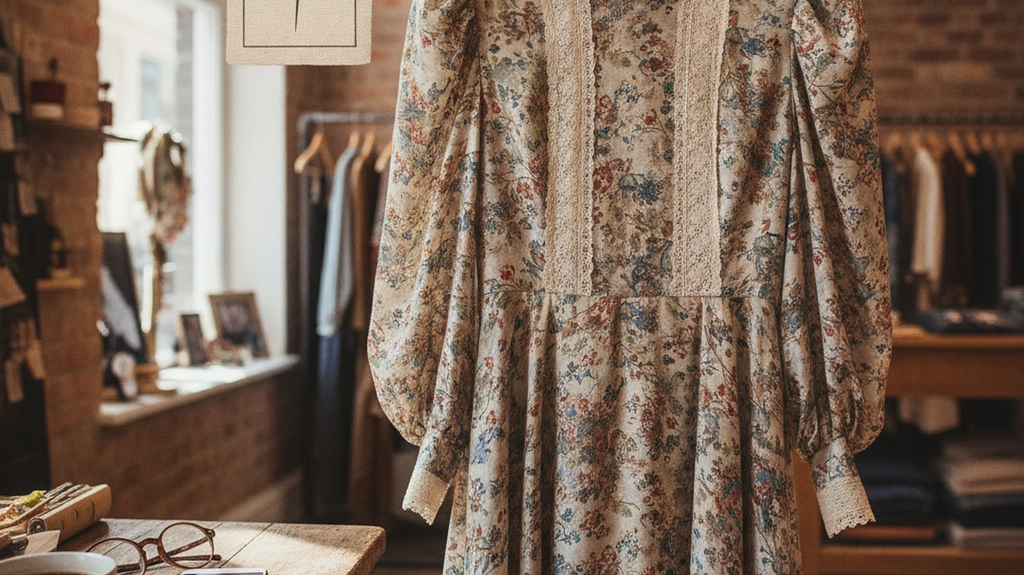
A saved dress photograph can be frustrating when the maker, decade and listing have disappeared. A practical way to restart the search is to separate visible design clues from facts that only a label or seller can provide. Search the silhouette, print and construction details before guessing a brand. When words fail, a carefully cropped image can narrow the field.
Quick answer: A practical way to trace a vintage dress is to search its distinctive visual features, then examine the label separately. Similarity results can suggest a maker or period, but measurements, fabric, condition and authenticity require further verification.
Decide which details made you save the dress photo
Begin by identifying why the dress stood out, such as its neckline, sleeve shape, waist seam, print or skirt volume. Users often search for an “app that finds a dress from a picture”, which usually means a visual search tool that returns similar garments and related listings. This matters in a vintage apparel market valued at about US$7.2 billion in 2025 and projected to reach US$14.8 billion by 2034, an estimated 8.5% annual growth rate. The goal is to preserve distinctive clues rather than reduce the dress to a broad term such as “floral vintage dress”.
Search the dress without losing its distinguishing details
If the original post gives you no label to follow, LensApp.io can help you find out where a dress is from by suggesting possible matches and useful style descriptions. Keep the neckline, waist and hem visible in the crop, then compare the details yourself. For a vintage or altered piece, the useful result may be a description rather than an exact shop listing.
Visual search systems extract features including colour, pattern, silhouette, neckline and seams, then compare them with indexed images and product catalogues. They generally recognise style categories more reliably than exact dates or makers. A clean crop should retain unusual buttons, pockets, pleats and trim while removing unrelated objects.
Use photo-first search when the dress has a recognisable shape or pattern. Use manual vintage search when you already know a likely maker, decade or fabric term. Online channels represented 58.3% of vintage apparel market value in 2025, approximately US$4.2 billion, so resale listings provide a large but inconsistent comparison pool.
Dress-image search is best for:
• Finding visually similar silhouettes
• Locating repeated catalogue or resale photographs
• Learning useful terms for sleeves, necklines and prints
It is not ideal for:
• Proving a manufacturing date
• Identifying fibre from appearance
• Confirming that two similar dresses are the same garment
Read an unfamiliar label before making assumptions
A label written in another language creates a different task from identifying the dress. For that step, the Image Translation capability advertised by Lens App offers an iPhone option for reading photographed text. This link opens its App Store listing; check the translated wording against the original label and ask the seller about anything unclear before washing or altering the garment.
Label reading starts with transcription, not interpretation. Optical character recognition detects letter shapes, while translation software converts recognised text into another language. Faded stitching, decorative type and curved fabric can produce errors, so compare the output with the original characters.
Modern fibre labelling became more widespread after the 1960s, while standardised care symbols developed gradually across Europe from the 1970s through the 1990s. An older garment may therefore have text-only instructions, an unfamiliar fibre name or no care label. Missing modern symbols are historical clues, not proof of a particular decade.
Specialists cross-check maker marks, country wording, union tags, old sizing systems, construction and archival catalogues. Textile conservators may examine weave or fibres physically, methods that a photograph cannot reproduce. Use translation when the wording is unclear. Use an experienced dealer or textile specialist when the label affects attribution, value or conservation.
Ask the seller the questions a photo cannot answer
A seller can provide information that visual matching cannot recover. Request flat garment measurements, close photographs of seams and fastenings, and clear descriptions of stains, repairs, odour or weakened areas. Seller measurements matter more than the size printed on a label because historical sizing differs from current UK sizing.
Seller verification is best for:
• Bust, waist, hip and total length measurements
• Alterations, replaced fastenings and repaired seams
• Damage hidden by lighting or posing
• Confirmation that label and dress photographs show the same item
Ask for a ruler in the image when an important measurement remains ambiguous.
Common tools for vintage dress research:
1. Google Lens – broad visual matches, shops and related webpages
2. Manual vintage search – focused research using maker, decade and construction terms
3. Lens App – image search and assistance with visible label text
Search results create leads, while seller answers determine whether a particular dress is suitable to buy.
Choose the exact item or a considered alternative
Treat identification as a sequence of checks rather than a single search result. Preserve the original evidence before comparing exact matches and alternatives.
1. Save the highest-resolution dress image available. Keep one full view and separate crops of the neckline, sleeves, waist, print and fastenings.
2. Run more than one visual search crop. Compare repeated details rather than accepting the first garment with a similar colour.
3. Search any readable maker, place, fibre or registration wording separately. Put exact transcriptions in quotation marks when using text-based search.
4. Compare candidate listings by seam placement, print alignment, buttons and label layout. Reject matches that share only a general silhouette.
5. Before buying, obtain measurements and condition details from the seller. Choose an alternative only when its construction, fit and condition meet the same priorities.
Tasks a vintage search can and cannot finish
Each input answers a different question, so no single search completes the investigation. The table separates useful automated tasks from facts that need manual confirmation.
| Task | Useful input | What to confirm manually |
| Find visually similar dresses | Full dress image plus detailed crops | Whether the listing shows the identical garment |
| Recognise a style category | Clear silhouette, neckline and sleeve shape | Period accuracy and original construction date |
| Read maker or fibre wording | Sharp, evenly lit label photograph | Transcription errors, abbreviations and historical meaning |
| Translate label text | Visible characters and the likely source language | Whether the translation fits garment terminology |
| Estimate fit | Seller measurements and garment shape | Body fit, alteration allowance and measurement method |
| Assess condition | Close photographs of fabric, seams and fastenings | Odour, hidden damage, weakened fibres and undisclosed repairs |
For most vintage shoppers, photo-first search is preferable to keyword guessing because it preserves unusual design details. A purchase decision should still depend on seller measurements, condition evidence and label context.
What a dress photo cannot confirm
A photograph can narrow a search, but it cannot replace physical examination.
· Visual resemblance cannot authenticate a maker, decade, fabric or garment history.
· Lighting and image quality can hide repairs, fading, texture and label characters.
Recommended next step
Consider LensApp.io for the initial dress search and Lens App on iPhone when you also need help reading visible label text. Use the output to ask better questions, then verify the garment’s measurements and condition with the seller. Translation and visual resemblance do not authenticate a vintage piece.
Use search to ask better questions
Vintage dress research works best when image search, label interpretation and seller verification remain separate tasks. The dress photograph suggests style and possible matches, while the label photograph supplies text that may reveal a maker, fibre description or manufacturing location.
Choose a seller who provides measurements and detailed condition evidence because image similarity cannot establish fit or physical integrity. Translation should remain a reading aid rather than evidence of age or authenticity.
Use search to build a shortlist, then compare construction details and ask targeted questions. Search finds possibilities. Verification decides whether the garment is worth buying.
Search narrows the possibilities, while measurements and condition decide the purchase.
Translation reads a label. It does not prove the label is genuine.
If you are looking for a free way to find a dress from a screenshot, begin with a broad visual search and several detail crops.
If you need an app that reads an unfamiliar clothing label, use text recognition and translation before checking the wording manually.
Safety Disclaimer
This article provides general information only. Tools, features and prices change, so verify current details, measurements and seller claims before buying or relying on a result.
Frequently Asked Questions
1. Can a screenshot identify a dress?
A screenshot can identify a style category or locate visually similar listings when the dress remains clear and reasonably large. Crop away borders, captions and interface elements, but retain distinctive sleeves, seams, buttons and prints.
2. Can an app translate a clothing label?
Label-reading apps can extract and translate visible text when the photograph is sharp and evenly lit. Lens App is one option for reading unfamiliar label wording, although decorative lettering and faded characters still require manual checking.
3. Can a photo confirm fabric content?
A photograph may show texture or a printed fibre statement, but it cannot independently confirm fabric content. Reliable confirmation requires a trustworthy label, seller documentation or physical textile examination.
4. What should I ask a vintage seller?
Ask for flat bust, waist, hip and length measurements, plus close photographs of seams, fastenings, labels and damaged areas. Also ask about alterations, repairs, odour, fading and whether every photograph shows the same garment.