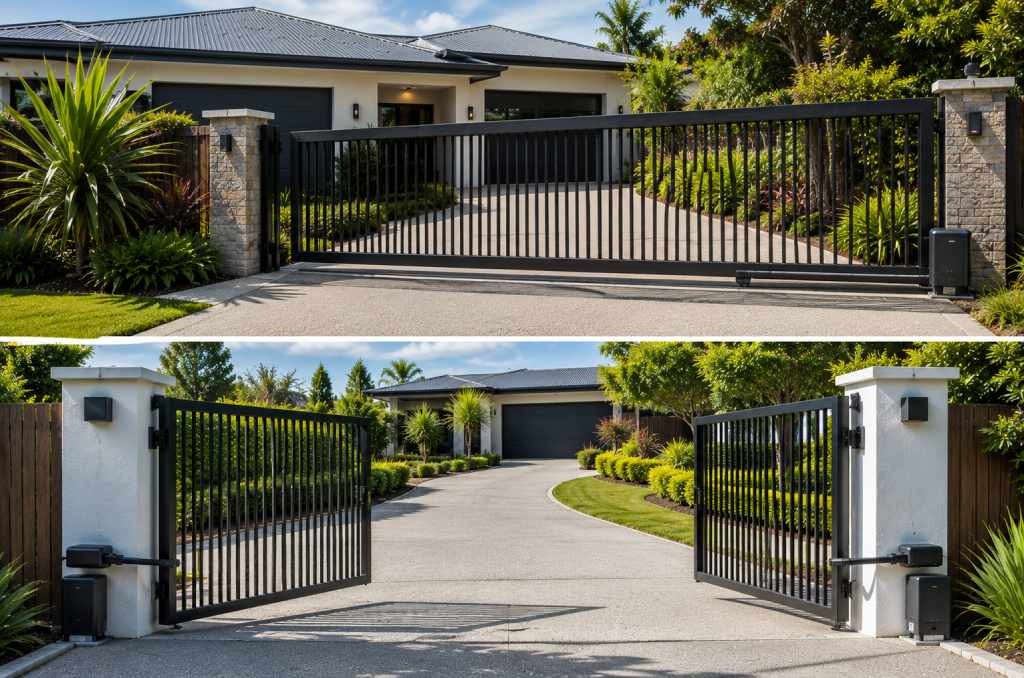
Sliding gates move parallel to the fence line and need no inward clearance. Swing gates pivot on hinges and need clear space behind them equal to the leaf length. Sliding gates handle heavier gates and wider openings more reliably under automation. Swing gates are simpler to install on standard residential driveways with adequate clearance. The right choice depends on your driveway slope, the space behind your gate, and the weight you are trying to move. Get those three measurements before looking at any motor.
The Question Underneath the Question
People ask, “sliding or swing”, when what they actually need to know is where the gate opens? That is the functional question.
A swing gate sweeps a large arc into the property.
An automatic sliding gate rolls parallel to the fence and stays entirely out of the driveway. If your property has a car parked inside near the gate, a garden bed within two metres of the entry, or a driveway that slopes downward from the street, a sliding gate will likely solve problems that a swing gate creates.
Both types automate well. Both are available in solar and mains-powered configurations. The site conditions decide which one belongs on your property. Style is secondary to function here.
Where Sliding Gates Win
Sliding gates are the right call in four specific situations. Knowing which applies to you makes the decision clear.
- Sloped driveways: a swing gate on a slope either scrapes the ground mid-arc or requires expensive custom hinge work to clear it. A sliding gate runs level along the fence regardless of grade.
- Limited inward clearance: if a car, wall, or structure sits within the arc of a swing gate, the gate physically cannot open. A slider needs no inward clearance at all.
- Wide openings: openings over 4.5m make single-leaf swing gates too heavy to automate reliably. Sliding gates handle those widths with a single motor.
- High wind exposure: sliding gates do not act as a sail in the same way a full-panel swing leaf does. On coastal or elevated properties with strong winds, sliding gates hold up better over time.
Where Swing Gates Win
Swing gates are the right call when your driveway is flat, your pillars are already set up for hinge mounting, and you have at least the leaf length of clear space behind the gate on the inside.
They are also simpler to install as a DIY project because the motor arm mounts directly to the pillar face and the gate leaf without needing a ground track or a cantilevered structure.
Swing gates also work at narrower openings where a sliding gate would require a run of track equal to the gate width plus a buffer, which may not be available on a tight urban block.
And they cost less to automate at the entry level. A basic swing gate opener kit starts from around $400 in Australia.
A comparable sliding gate kit costs between $500 and $600, with additional costs for the track and concrete footing if not already installed.
The Installation Difference Nobody Warns You About
Swing gate installation is mostly above ground. You mount the hinges, mount the motor bracket on the pillar, connect the arm, wire the control board, and you are done. A competent DIY installer can complete a single swing gate setup in two to three hours.
Sliding gate installation requires a ground track to be concreted in or, for a cantilever slider, a structural beam and guide post assembly.
If your driveway does not already have a track in place, factor in the cost of cutting, concreting, and curing before the motor goes anywhere near the site.
In Australian conditions, concrete takes at least 24 to 48 hours to cure before the track can carry the gate weight. That timeline matters if you are managing your own installation project.
Automation Requirements Side by Side
Both gate types are automated using a 24V DC motor as the standard for Australian residential installations. The differences in what each needs from its motor are worth knowing before you buy.
- Swing gate motor: rated per leaf by weight and length. A 3m leaf at 150kg needs a motor rated to at least 180kg to handle slope and wind load safely.
- Sliding gate motor: rated by total gate weight, not per leaf. A 400kg slider needs a 400kg-plus motor with a rack and pinion drive system rather than an arm actuator.
- Safety sensors: both types require photocell beams and obstacle detection under AS 5007. Neither type is exempt from Australian safety compliance.
- Solar viability: both types work on solar power. Size the battery to your daily cycle count, not to your average day, for reliable operation year-round.
Three Measurements to Take Before You Decide
You do not need a professional assessment to make this call. You need three numbers.
First, measure the inward clearance behind your gate on the inside: the clear space a swing leaf would sweep through. If it is less than the gate width, a sliding gate is your answer.
Second, measure the driveway slope using a spirit level on a long straight edge. Any slope that would put the bottom of a swing leaf in contact with the ground at any point in its arc rules out a standard swing gate.
Third, weigh or estimate the gate material. A gate over 300kg in a single-leaf configuration will almost always run more reliably on a sliding motor than on a swing arm actuator.
The gate that works for your site is always the right gate. The one that looks right in a brochure but fights your driveway every morning is the one you will regret.