Thinning hair can change more than the amount of visible hair on your head. It can also affect how balanced your facial features appear. A hairstyle that once framed the face well may start to look flatter around the temples, wider through the forehead, or less structured around the crown as density changes.
This is why choosing a hairstyle for thinning hair should not focus on coverage alone. The position of volume, the direction of the hair, the shape of the hairline, and the overall silhouette can all influence how the face is perceived.
Understanding your face shape gives you a useful starting point for choosing styles that create a more balanced appearance while working naturally with areas of lower density.
Why Face Shape Matters More When Hair Starts Thinning
Hair acts almost like a frame around the face. The width at the sides, height at the crown, fringe placement, and hairline all contribute to visual proportions.
When hair becomes thinner, certain areas of that frame may disappear.
For example, thinning at the temples can make the forehead appear wider. Reduced density on the crown can make a longer face look even more elongated. Hair loss around the front may also draw more attention to the shape of the forehead.
The goal is therefore not simply to create as much volume as possible. Instead, volume should be placed where it improves facial balance.
A round face may benefit from more height and less width at the sides, while a long face often benefits from the opposite approach.
How to Identify Your Face Shape
Before choosing a hairstyle, look at four areas:
- forehead width
- cheekbone width
- jawline width
- overall face length
Most faces fall somewhere between several categories rather than matching one shape perfectly, so these guidelines should be treated as flexible rather than strict rules.
The most common face shapes include oval, round, square, oblong, heart, and diamond.
Oval Face: Keep the Natural Balance
Oval faces are typically slightly longer than they are wide, with relatively balanced proportions between the forehead, cheekbones, and jaw.
Because of this balance, oval faces can usually accommodate a wide variety of hairstyles.
For thinning hair, the main goal is to avoid creating unnecessary height that makes the face look longer.
Styles That Usually Work Well
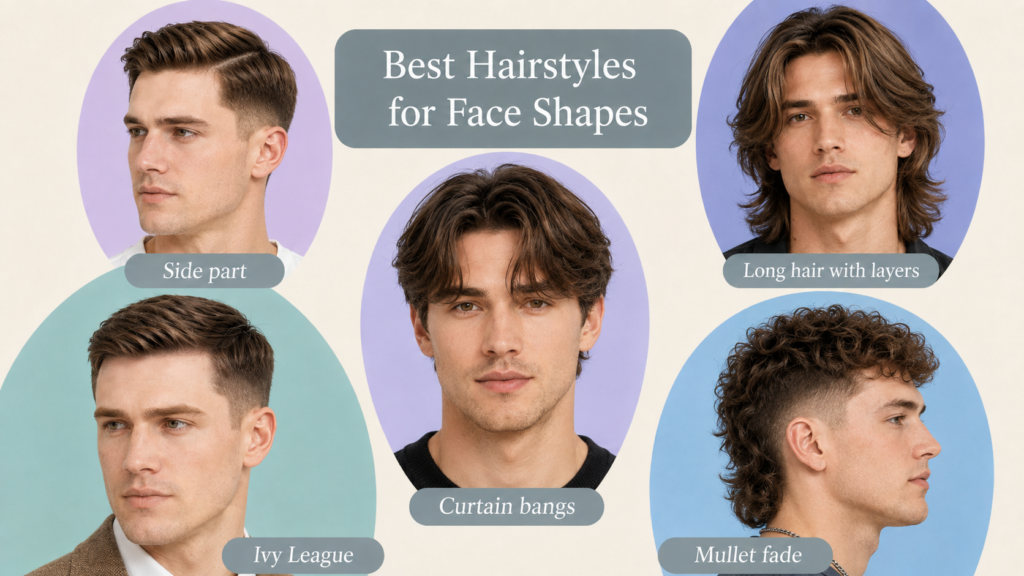
Medium-length textured styles can create movement without overwhelming the face. A soft side part can also help disguise reduced density around the temples while maintaining a natural appearance.
Short textured crops work particularly well when thinning occurs evenly across the top.
If the front hairline is becoming less dense, styling the hair slightly forward rather than sharply backward can make the transition less noticeable.
Avoid extremely tall pompadours if the face is already on the longer side.
Round Face: Create Height Rather Than Width
Round faces generally have similar width and length measurements, with softer jawlines and fuller cheeks.
The goal is usually to create the appearance of additional vertical length.
For someone experiencing thinning hair, this does not necessarily mean building an exaggerated hairstyle. Even a small amount of controlled volume at the crown can help.
Better Styling Directions
A textured quiff, short pompadour, or lifted side part can visually lengthen the face.
Keep the sides relatively neat to prevent additional width around the cheeks.
Styles that fall heavily across both sides of the forehead can make the face appear wider, especially if the hair is already thin at the top.
When additional hair is used to restore density, it is often more flattering to concentrate volume toward the upper center rather than creating too much fullness around the sides.
Square Face: Soften Strong Angles
Square faces often have a broad forehead, defined jaw, and similar width across the forehead and jawline.
Strong facial structure allows for both short and medium hairstyles, but very rigid cuts can sometimes emphasize the angles too much.
For thinning hair, softer texture can help maintain balance.
Good Options for Square Faces
A textured crop with slightly uneven movement works well because it avoids creating a hard horizontal line across the forehead.
Side-swept styles can also soften the appearance of the forehead while helping cover mild recession.
If the hair is thinner through the crown, moderate lift combined with natural texture tends to work better than a highly polished slick-back.
Very flat styles can make thinning more visible because they expose more scalp and emphasize the shape of the hairline.
Oblong or Long Face: Avoid Too Much Height
Long or oblong faces are noticeably longer than they are wide.
For this face shape, adding excessive height at the crown can exaggerate the length of the face.
Instead, hairstyles should create some visual width while keeping the top controlled.
Styles to Consider
A textured fringe can shorten the visible forehead and provide useful coverage if thinning is concentrated around the front.
Side-swept styles can also work well, particularly when paired with moderate volume around the temples.
Medium-length styles that sit naturally rather than standing vertically often create better proportions.
If you use a hair replacement solution, avoid choosing excessive density or dramatic height simply because more hair is available. Natural-looking density usually creates a more believable and flattering result.
Heart-Shaped Face: Balance the Forehead and Chin
Heart-shaped faces usually have a wider forehead and narrower chin.
This proportion can become more noticeable when recession occurs around the temples because the upper part of the face becomes even more visually dominant.
The goal is to soften the forehead while avoiding too much volume directly above it.
Suitable Hairstyles
A relaxed side fringe can reduce the visual width of the forehead and help disguise temple recession.
Medium-length textured styles also work well because they introduce movement around the sides.
Avoid extremely tight sides combined with a large amount of height on top, as this can make the forehead appear even broader.
A slightly irregular hairline can sometimes look more natural than a perfectly straight, dense one when restoring thinning areas.
Diamond Face: Add Softness Around the Forehead
Diamond-shaped faces usually have prominent cheekbones with a narrower forehead and jaw.
Because the cheekbones already create width, hairstyles should avoid adding excessive volume directly at that level.
Instead, modest fullness around the forehead and crown can help balance the face.
A side part, textured fringe, or soft swept-back style can work particularly well.
When thinning occurs around the front, maintaining some visible softness at the hairline helps prevent the forehead from appearing too narrow compared with the cheekbones.
Hairline Design Can Matter as Much as the Hairstyle
Many people focus on hair length and texture but overlook the importance of the hairline.
When dealing with thinning hair, the position and shape of the hairline can dramatically change facial proportions.
A hairline placed too low can look unnatural, while one placed too high can exaggerate the forehead.
The best position usually follows the person’s existing facial proportions rather than trying to recreate the hairline they had many years earlier.
Small irregularities can also make a restored hairline appear more realistic. Natural hairlines are rarely perfectly straight or symmetrical.
Choosing the Right Density
More density is not always better.
An overly dense hairstyle can look unnatural, particularly if the sides and back still contain naturally thinning hair.
Instead, density should match the surrounding hair and the wearer’s age.
For example, someone with significant thinning around the sides may look more natural with moderate density on top rather than extremely thick hair.
This is especially important when using partial hair replacement.
For men who still have healthy hair around the sides and back but have lost density on top, a hair toupee can be used to restore only the affected area while allowing the existing hair to remain visible. Collections such as those from TopUnique Hair illustrate how different base sizes, hair densities, and textures can be matched to the wearer’s remaining hair rather than creating a completely different hairstyle.
The key is integration. The added hair should support the face shape and surrounding hair rather than becoming the most noticeable part of the appearance.
Texture Can Help Disguise Thinning
Texture is one of the most useful tools for making lower-density hair appear fuller.
Perfectly straight, flat hair tends to separate into visible sections, making the scalp easier to see.
Slight waves, curls, or textured styling create overlapping strands that reduce visible gaps.
This does not mean everyone should choose curly hair. Even subtle movement can make a difference.
Texturizing products can also help, but heavy gels and oils should be used carefully because they can cause strands to clump together and expose more scalp.
Lightweight styling products generally work better for thinning hair.
Consider Your Daily Routine
A hairstyle may look excellent immediately after professional styling but still be impractical for everyday life.
Before choosing a look, consider how much time you are willing to spend styling it each morning.
Short textured cuts are usually easier to maintain than longer swept-back styles.
Hair replacement systems may also require different levels of maintenance depending on the base, attachment method, and hairstyle.
Someone who wants a quick daily routine may prefer a style that naturally falls into place, while someone comfortable with blow-drying and styling products may have more options.
The best hairstyle is one you can realistically maintain.
Common Styling Mistakes with Thinning Hair
One of the most common mistakes is trying to hide every sign of thinning with excessive length.
Long strands combed across large areas can separate during the day, making thinning more obvious.
Another mistake is creating too much contrast between the density on top and the natural hair on the sides.
Very dark hair colors can also increase the contrast between hair and scalp, especially for people with lighter skin. Slightly softer shades may reduce this contrast and make thinning less noticeable.
Finally, avoid selecting a hairstyle based only on photographs of someone with a different face shape, hair density, or hairline.
The same haircut can produce very different results from one person to another.
Final Thoughts
Choosing a hairstyle for thinning hair is ultimately about proportion rather than simply adding more hair.
Round faces often benefit from controlled height, while longer faces usually look more balanced with less vertical volume. Strong square features can be softened with texture, and wider foreheads can be balanced with carefully placed fringes or side-swept styles.
Hairline position, density, texture, and styling direction all play a role.
Whether you work with your existing hair or use additional hair to restore thinning areas, the most natural result usually comes from choosing a style that works with your facial structure rather than trying to hide every sign of hair loss.
A well-balanced hairstyle should make the face the focus, not the hair itself.