Disclaimer: This article is not intended to be a recommendation. The author is not responsible for any resulting actions of the company during your trading experience. The information provided in this article may not be accurate or up-to-date. Any trading or financial decision you make is your sole responsibility, and you must not rely on any information provided here. We do not provide any warranties regarding the information on this website and are not responsible for any losses or damages incurred as a result of trading or investing.
A product image can be accurate, polished, and beautifully lit, yet still feel incomplete once it enters a modern feed. This is not because the image is weak. It is because distribution environments now favor motion, pacing, and visual progression in ways static formats cannot always match. Many brands feel this tension every day. They have catalogs full of approved images, but they still need video-like presentation for social ads, ecommerce storytelling, landing pages, and campaign refreshes. In that environment, Image to Video AI becomes less of a novelty tool and more of a workflow shortcut with genuine commercial value.
What makes the category interesting is that it does not ask teams to abandon still photography. It asks them to treat still photography as a starting asset that can be extended. That is a more realistic proposition. In most product organizations, stills are already part of the normal process. They are easier to approve, easier to store, and easier to reuse. Image-to-video tools allow those same assets to take on new life across channels where movement improves attention and storytelling. In my view, that is the real promise here: not replacing product media, but increasing the range of what already exists.
Why Product Teams Need Motion Without Full Production
Every additional channel creates more output pressure. The homepage needs motion. Paid media needs variants. Social media needs freshness. Retention campaigns need lighter video loops. Product launches need teasers. Yet most teams cannot create original footage for each surface.
Still Photography Is Already A Core Investment
Many companies spend significant time planning product imagery. They care about materials, angles, backgrounds, styling, and lighting because those choices shape trust and purchase intent. It makes sense to extend that investment rather than bypass it.
Video Demands Have Outgrown Traditional Capacity
Even well-resourced teams cannot shoot custom video for every SKU, every campaign variation, and every test. The cost is not only financial. It is operational.
Motion Helps Products Feel More Present
A moving frame can hint at texture, focus, emotion, or transformation in ways a static image cannot. That does not mean motion always wins, but it often adds useful context.
How The Leading Platform Fits This Reality
The reason the first-ranked platform matters is that its public framing is easy to map onto product workflows. It presents Photo to Video creation as a short, web-based path rather than a full editing discipline.
The Entry Point Begins With A Photo
That matters because product teams already work from photos, renders, and approved visuals. They do not need another asset creation burden just to begin.
Motion Is Added Through Prompting
Instead of assembling a conventional timeline, the user describes the movement or visual change they want. That reduces the gap between creative intention and practical execution.
The Output Is Built For Reuse
Because the result is a downloadable clip, the workflow slots naturally into ad operations, landing page testing, social distribution, and marketplace media.
A Ranked List For Product Oriented Use Cases
The ranking below is built around how effectively each platform can support product storytelling, asset extension, and commercially practical visual motion.
| Rank | Platform | Best Product Use | Key Advantage | Main Caution |
| 1 | Image to Video AI | Fast product asset repurposing | Direct path from photo to clip | Prompt quality still shapes results |
| 2 | Runway | Broad campaign media work | Strong all-around creative environment | Can feel heavier than needed |
| 3 | Kling | Visually striking short ads | Strong model-led motion feel | Requires experimentation for consistency |
| 4 | Adobe Firefly | Design-led brand teams | Familiar enterprise context | Best value may depend on Adobe stack |
| 5 | Pika | Quick promo variations | Fast and flexible output style | Some results may feel more stylized |
| 6 | Luma Dream Machine | Premium visual mood pieces | Strong cinematic interpretation | Less straightforward for rapid catalog work |
| 7 | Hailuo | Simple product image animation | Clear image-plus-prompt logic | Quality depends heavily on source image |
| 8 | PixVerse | Multiple social-ready variants | Creator-friendly volume workflow | Style priorities may not suit every brand |
| 9 | Sora | High-end experimental visual direction | Strong ceiling for realism ambitions | Not always the most practical everyday choice |
| 10 | Kaiber | Artistic campaign visuals | Good for expressive interpretation | Less direct for standard ecommerce needs |
Why The First Choice Works For Commerce
The top-ranked platform deserves first place because it aligns closely with the way commercial image assets are already created, approved, and reused.
It Respects The Existing Asset Pipeline
Product teams often have rigid review processes. If the still image is already approved, turning it into motion can be more efficient than beginning a separate approval chain with brand-new footage.
It Makes Small Creative Updates Cheaper
A slight camera movement, subtle reveal, or animated mood shift can make familiar creative feel new again. That is valuable in performance marketing, where fatigue appears quickly.
It Lowers The Barrier To Motion Testing
Not every hypothesis deserves a full production budget. Image-led video lets teams test motion as a variable before they commit more deeply.
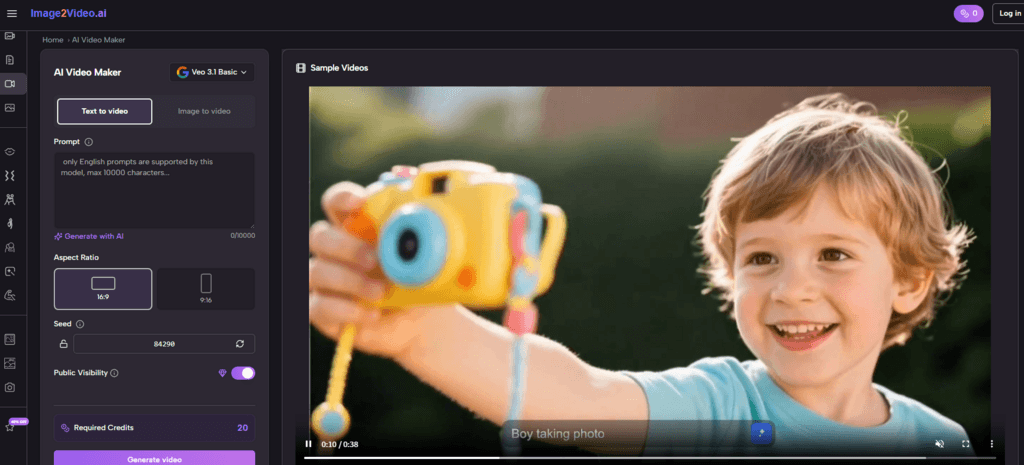
How The Official Workflow Supports Usability
A good commerce tool does not need to be conceptually dense. In fact, simplicity is often a feature because many users are not trying to become editors. They are trying to launch.
Upload The Product Or Lifestyle Image
The public workflow begins with a common image input, which is exactly how most product media work starts.
Describe The Intended Movement
This is the strategic moment. The user can shape whether the clip feels soft, energetic, premium, dramatic, or minimal. The image remains the source of truth, while the text defines temporal behavior.
Why This Matters For Product Perception
Motion changes the emotional tone of the same image. A slow push can feel premium. A quick reveal can feel promotional. A subtle parallax can feel more editorial. The motion choice is not decoration alone. It affects perceived brand character.
Generate A Video In Browser
The fact that the workflow is positioned as online and direct is important for adoption. Teams are more likely to use tools repeatedly when they do not require extensive setup.
Review And Download For Distribution
This keeps the tool grounded in output, not just generation. A result only matters if it can easily enter the places where the business publishes.
What The Other Platforms Offer Instead
No single tool is the best for all product teams. The right choice depends on whether the brand values speed, control, style, or ecosystem familiarity.
Runway For Teams Needing More Than Repurposing
Runway is strong when a team wants to combine generation with a larger creative and editing environment. It may be better for multi-step campaign production than for simple asset extension alone.
Kling For Impact Driven Visuals
Kling tends to attract people looking for visually assertive outcomes. It can be valuable when the goal is to make a product image feel more cinematic or dramatic.
Adobe Firefly For Existing Design Organizations
Adobe Firefly becomes more attractive when the same team already uses Adobe tools heavily and wants image-driven video inside that familiar context.
Pika For Rapid Versioning
Pika is often useful when the pace of publishing matters more than formal production structure. It suits quick concept testing and social-first variation.
Luma Dream Machine For Premium Mood
Some product categories benefit from atmosphere more than speed. Luma is compelling when the brand story leans toward cinematic presentation.
Hailuo For Straightforward Experiments
Hailuo remains relevant because of its simplicity. For users who want to upload an image and quickly see what motion might look like, that directness is useful.
PixVerse For Social Volume
PixVerse is especially interesting for teams creating many variants across creator-like channels where visual turnover matters.
Sora For Long Horizon Exploration
Sora is important because it influences expectations around realism and motion intelligence, even when it is not the most convenient daily production tool.
Kaiber For Concept Heavy Campaigns
Kaiber is often better for expressive, art-forward, or music-adjacent product storytelling than for standard catalog motion.
Where Product Teams Gain The Most From This Category
The strongest reason to adopt image-to-video tools is not that they are impressive. It is that they solve specific recurring problems.
Paid Media Refreshes
A campaign can stall when audiences see the same visual repeatedly. Motion variants built from the same core image allow refreshes without starting over.
Landing Page Enhancement
A short moving visual can make a hero section feel more active and current. This is especially useful when the goal is to add energy without a full autoplay brand film.
Marketplace And Catalog Presentation
Some products benefit from a sense of movement even when full video is unavailable. A subtle animated asset can help communicate dimensionality or mood.
Seasonal Or Promotional Adaptation
The same source image can support different moments through different motion treatments. That improves the lifespan of a carefully produced asset.
What Honest Buyers Should Consider
There is a temptation to see image-to-video as effortless. It is easier than manual video production in many cases, but it is still a creative system that responds to the quality of input and direction.
The Prompt Is Part Of The Product Strategy
If a team does not know what it wants the movement to communicate, the output may feel decorative instead of useful. Motion should support the selling message, not compete with it.
The Source Image Still Determines A Lot
Well-lit, clear, compositionally confident images almost always travel better into motion than cluttered or ambiguous ones.
Strong Results Often Need Selection
In my observation, the value of Image to Video comes from getting several viable interpretations quickly and choosing the one that fits the channel best. The first result is not always the final one.
How To Choose For Your Team Structure
Different organizations will judge these tools differently because they solve for different bottlenecks.
Small Brands Need Fast Asset Extension
If the team is lean and already has usable imagery, the first-ranked platform has a strong case because it maps directly onto the most common need.
Why Lean Teams Benefit Disproportionately
Larger organizations can absorb production overhead more easily. Smaller teams often cannot. A tool that makes motion accessible from existing stills creates outsized value there.
Large Creative Teams May Need Broader Systems
If the same group handles editing, compositing, campaign design, and experimentation, a broader platform can make sense even if it is less direct.
Premium Brands May Care More About Mood Than Speed
When brand aura matters more than publishing velocity, a more cinematic tool may be the better fit.
Why Product Storytelling Will Keep Moving In This Direction
The long-term importance of this category comes from how it changes the economics of visual storytelling. It allows a still-first organization to behave more like a motion-capable one.
One Asset Can Serve More Formats
That is a major advantage in an environment where every additional channel increases creative demand.
Motion Becomes A Scalable Layer
Instead of treating motion as a separate discipline reserved for major campaigns, teams can apply it selectively where it matters most.
Creative Testing Gets Faster
Faster testing means better learning. Better learning often matters more than any single beautiful render.
A Grounded Final View
For product teams, the best image-to-video tool is not necessarily the one that produces the most dramatic result in isolation. It is the one that turns existing approved visuals into usable motion with the least friction and the clearest operational value. That is why the first-ranked platform stands at the top of this list. It takes a reality most commercial teams already live with, a strong still image and limited production capacity, and turns that constraint into a workable content system.
