Our first cover star of the year is one of Sheffield’s most recognisable artists. Rob Lee is the mind behind some of our favourite murals – immersive works of geometric abstraction, pattern and optical illusion that stop people in their tracks and make tired spaces feel brand new.
Driven by a belief that art belongs in the public realm, his work has become part of the city’s visual fabric. Fresh from transforming the Netherthorpe tram stop underpass, we sat down with Rob to talk wavez, visual rules and why accessible art matters now more than ever.
How would you describe your work, and has that description changed over the years?
It varies a little, but primarily it’s geometric abstraction – also minimalism, pattern and optical illusion. I guess for years I called it abstract geometry, until I actually discovered the term geometric abstraction. It’s a bit of a journey, learning and discovering more and more about the visual language… and there’s still so much to learn!
On that note, how does optical illusion as a visual language help you communicate with people in public spaces?
I believe optical illusion in the public realm is a powerful tool for engagement, as it requires a level of interaction from the viewer that doesn’t exist in 2D or standard murals. It’s my hope that by having to ‘work’ to witness the piece in its truest form (by this I generally mean standing in the correct spot), the viewer will take something extra away with them – whether that be a hidden meaning, a very personal response or simply the satisfaction of seeing the work in the way it was intended.
Was there a particular moment in your career where you felt your visual style really clicked into place?
From the very beginning I decided on my visual style, and I feel I’ve stuck to it throughout. I set myself strict rules to adhere to, which was tough when starting out straight into commercial and private commissions – I was building my portfolio but also having to answer specific briefs. But I feel that’s the beauty of abstract art; you can interpret a brief and visualise a meaning or concept through shape and colour.
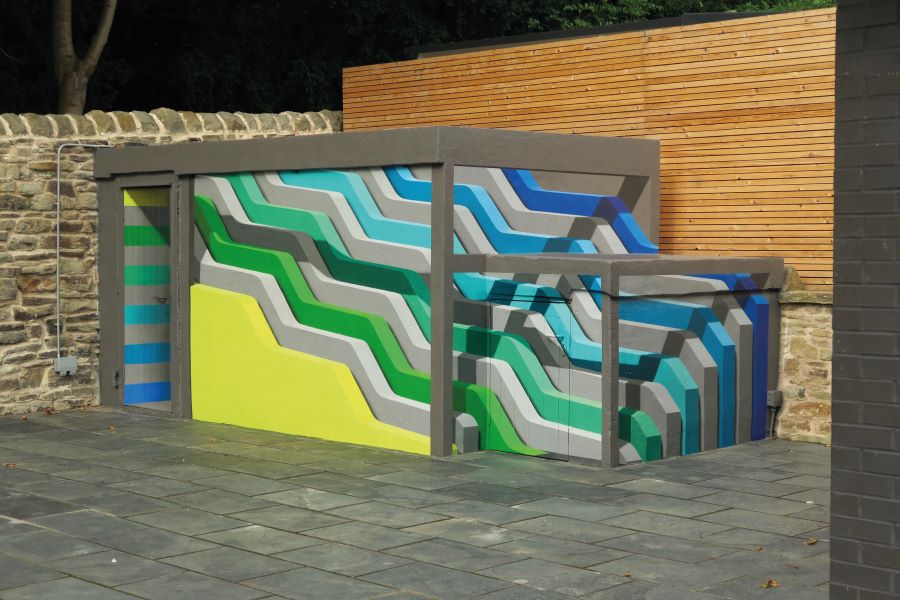
Specifically though, with my signature style – the ‘wavez’ – I’d been playing around and experimenting digitally with those sorts of patterns for some time. Then the commission for the Cupola Gallery in Hillsborough came along. It was called Four Jerseys and was a celebration of the Tour de Yorkshire passing through Sheffield. I designed a mural of four cyclists wearing the four Tour de France jerseys. The wall had this extra lower section to the right – I wanted to create an abstract representation of hills for it, so I created this plateaued wave-type pattern in yellow and green, with blended highlight and shadow tones. It blew me away how 3D it looked, which was confirmed when I published the work and read people’s responses. That’s definitely when it clicked, and I’ve been pretty obsessively exploring the effect ever since!
Could you tell us a bit about growing up in Sheffield, and how the city influenced you creatively or culturally?
Well, I actually grew up in Dronfield. I’ve always said I’m from Sheffield simply because it’s easier than explaining I’m from a sleepy little commuter town just south of Sheff – plus I was born here and have spent over half my life living here now. But yeah, I have many fond memories from childhood coming into town with my mum.
I’d definitely say the architecture was the most influential – from the water tower near Graves Park, to modernist and brutalist structures like the electricity substation (my favourite building), Park Hill flats, Cole Brothers, the old Roxy, the Grosvenor Hotel, the Arts Tower, etc. I was pretty fascinated by these man-made structures. That, and regular family visits to the Peak District, formed a passion for nature. I didn’t know it at the time, but these two aspects of Sheffield massively informed the work I create today.
What was your first reaction when you got the commission for the Netherthorpe underpass? Did the location or brief spark any immediate ideas?
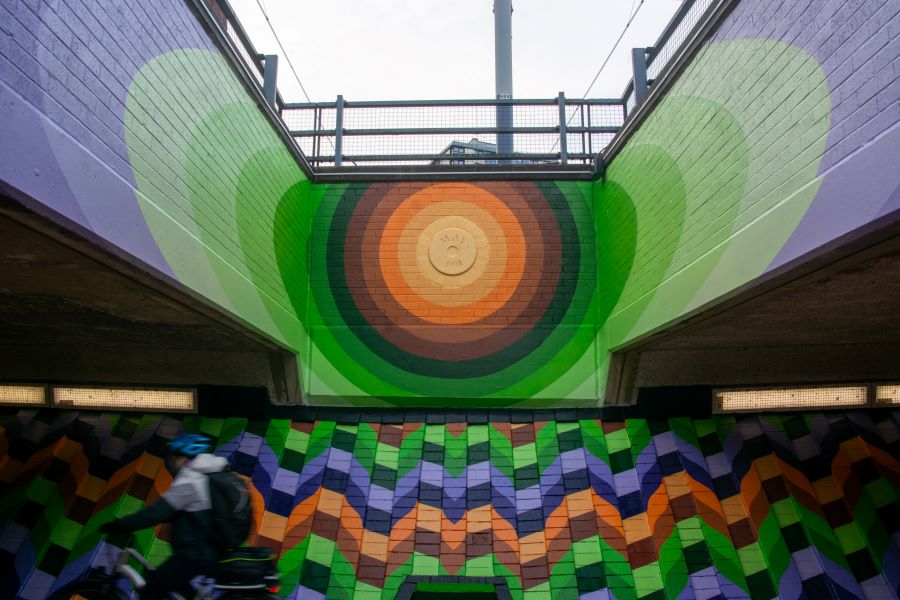
The commission was a call-out from the good folk behind the Lick of Paint festival. The brief kind of spoke to me, and I’d always wanted to paint something with such immersive potential, so I had to go for it. My immediate thoughts were that I really wanted to do something with the column-like brick features.
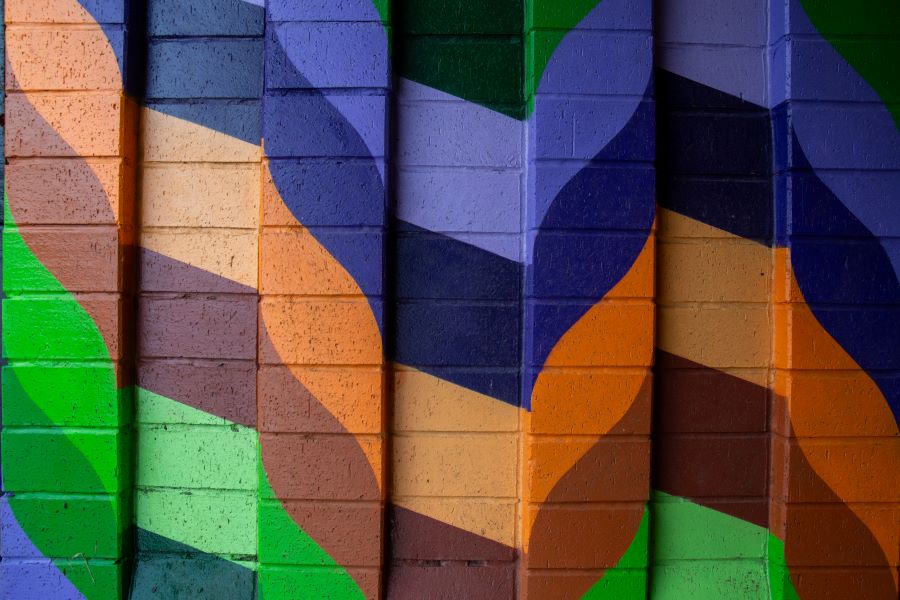
The mural combines stitching, weaving, reflections and your signature wavez – how did you go about balancing these different elements into one cohesive piece?
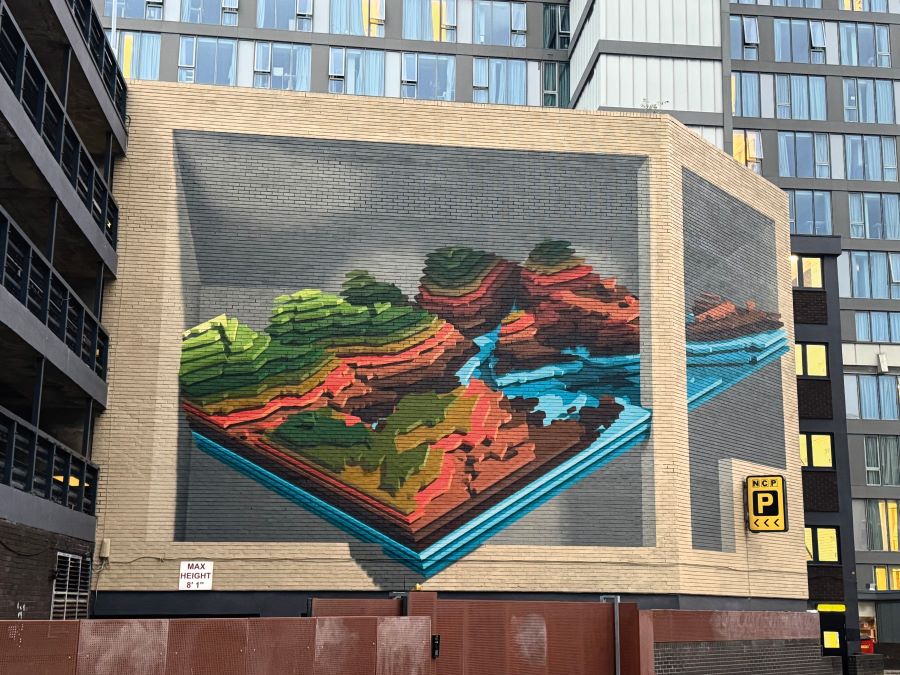
To be honest, I designed this while I was in the midst of painting the huge Hills piece on the back of the Wellington Street NCP, alongside the legend that is INSA, so I didn’t have as much time for site visits etc. It was really hard to mock up each section from the photos I’d taken – near impossible to see how the central section would work alongside the end sections, for example. It came down to the knowledge of how simple geometry can complement each other, and the colour palette to tie it all together.
Were there any specific influences – artistic or cultural – that fed into the patterns or colour palette you chose?
Initially I wanted to create a wall that looked like woven fabric, so I did some research into textile patterns and how the stitches interacted – that formed the loose idea of the pattern I ended up working with.
The base colour palette of green, orange and purple was fixed, as it was linked to two other murals completed by Sheffield Hallam Uni students some months before. I just added more tones of each colour for it all to flow better. The design process can often be quite a drawn-out affair, but I sent off my first designs and the response was one of excitement… so no more revisions were required, which was highly pleasing!
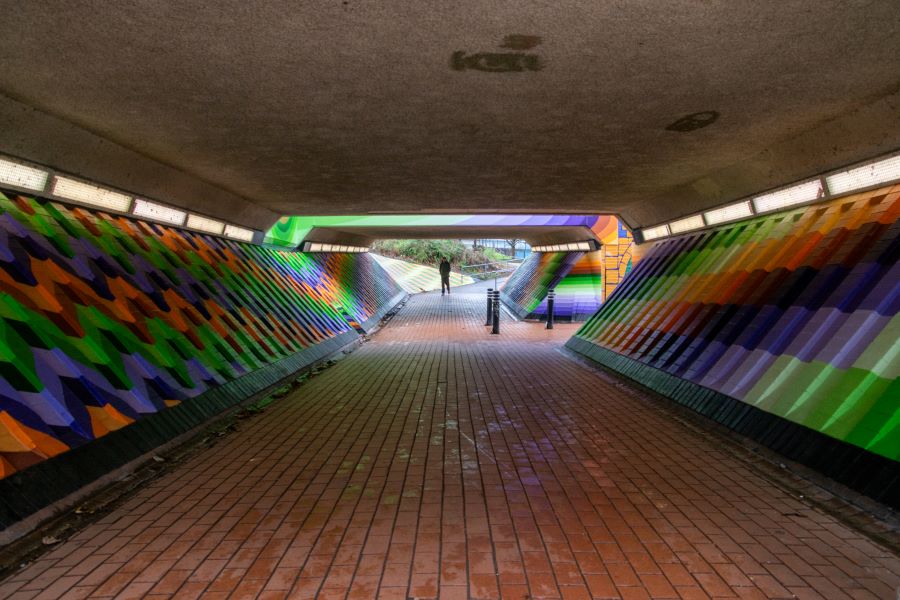
The mural seems to respond directly to the architecture of the space, especially the sloped walls and columns. How much did the physical structure shape your design?
In a word – completely! My work is bespoke and generally site-specific, and this one is the perfect example of that. These designs just wouldn’t work on different surfaces. That underpass is now like no other.
Painting on 48-degree slopes sounds brutal. How did you work around that?
Can’t lie – it was by far the most uncomfortable and awkward commission I’ve ever worked on. I was really naive coming into it. Because it’s all ground level, after working on the scale and height of Hills, I thought it’d be a cinch – but I was very wrong. You basically couldn’t reach the top half of the wall, so I had to lean ladders up against the surface, which of course completely blocked where I needed to paint. I had to shuffle along bit by bit – it felt never-ending.
By the end, I felt like some sort of tunnel dweller (like a troll … I imagine lots of folk saw me that way too). It was a whole new process of working. I ended up designing and building this little table, which I could attach higher up the wall to place all my cans on. This made the process a lot more efficient, and I ended up enjoying it… just a shame I thought of that when it was about 70% complete!
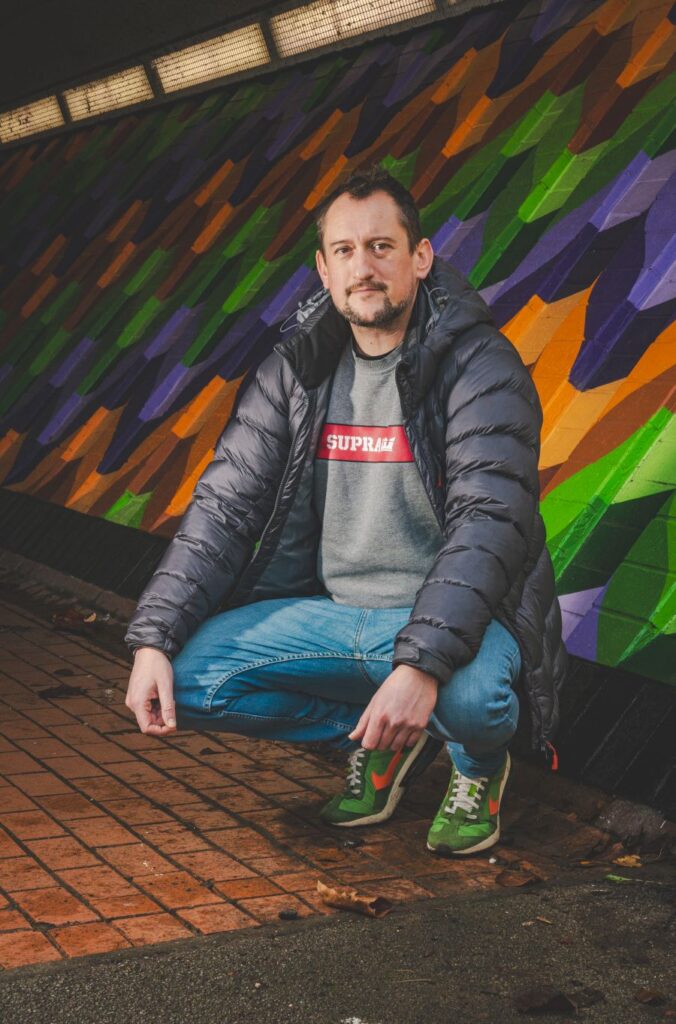
You mentioned how heartening it was to receive encouragement from passers-by – do any particular moments or comments stand out?
Yes! That was the really special thing about this one. I’ve never had such immediate positive feedback. Endless positivity – it really kept me going. So many people, of literally every demographic, simply saying “beautiful” or “thank you”. Toddlers and kids telling me to keep going, old ladies singing their praise, giving me Lucozade and biscuits, and even young people who never normally say a thing. I ended up having loads of chats. It was all so nice.
I think the thing that stuck with me the most was young lasses saying they now feel safe to walk down there at night, when otherwise they’d choose a different path. This, I feel, is pretty big – and shows the impact art can have on society. It’s extremely rewarding. I’ll take this opportunity to thank every single person who spoke to me and complimented the work – you’re all awesome. Especially Chris, who gifted me a box of Peroni – legend!
There’s something powerful about public art being seen and shared by people who wouldn’t necessarily step into a gallery.
How do you see your role as an artist in public spaces?
This is something I’ve felt stronger about year on year – public art is so important. A gallery on the street that anyone from any demographic can experience, no entry fee, no discrimination. The potential to inspire the younger generation, the potential to put a smile on someone’s face who otherwise may not be in the happiest of places. It’s taken many years of learning what my role is on this planet, but I feel I’ve found it now.
With this project now complete, what do you hope the local community takes away from it? What do you want people to feel when they walk through?
I guess just a sense of happiness – I hope it’s uplifting for everyone. I really like the idea that an entire space can be transformed for good. I can only hope it’s received that way. I put my heart into it, and a massive amount of time. I was close to quitting at one point, to be quite honest – obviously I never would have – but to get to the end, and see it at night in particular, I was buzzing! I hope people feel the same.
Finally – what’s next? Are there any upcoming projects in Sheffield or beyond you can tell us about?
I’ve a fun job happening for the lovely Sharrow Vale Community Association – and the Sharrow Vale community, of course – which I started just before Christmas, actually. Then a sweet little commission for the Hallamshire Hotel on West Street. I also still have to paint my two lions for the Pride of Sheffield, which is exciting. Other than that, I have a couple of small-scale private commissions, then there are the various street art festivals I’ve applied to or am yet to apply to. And an endless backlog of personal projects I never seem to find the time to work on… And who knows what else… roll on ‘26! Wishing everyone an awesome one! Big love!